History & GeographyVisual listPart 7 of 9, Plate TectonicsUpdated 1 October 2026
Staying Safe in an Earthquake: Drop, Cover and Hold On
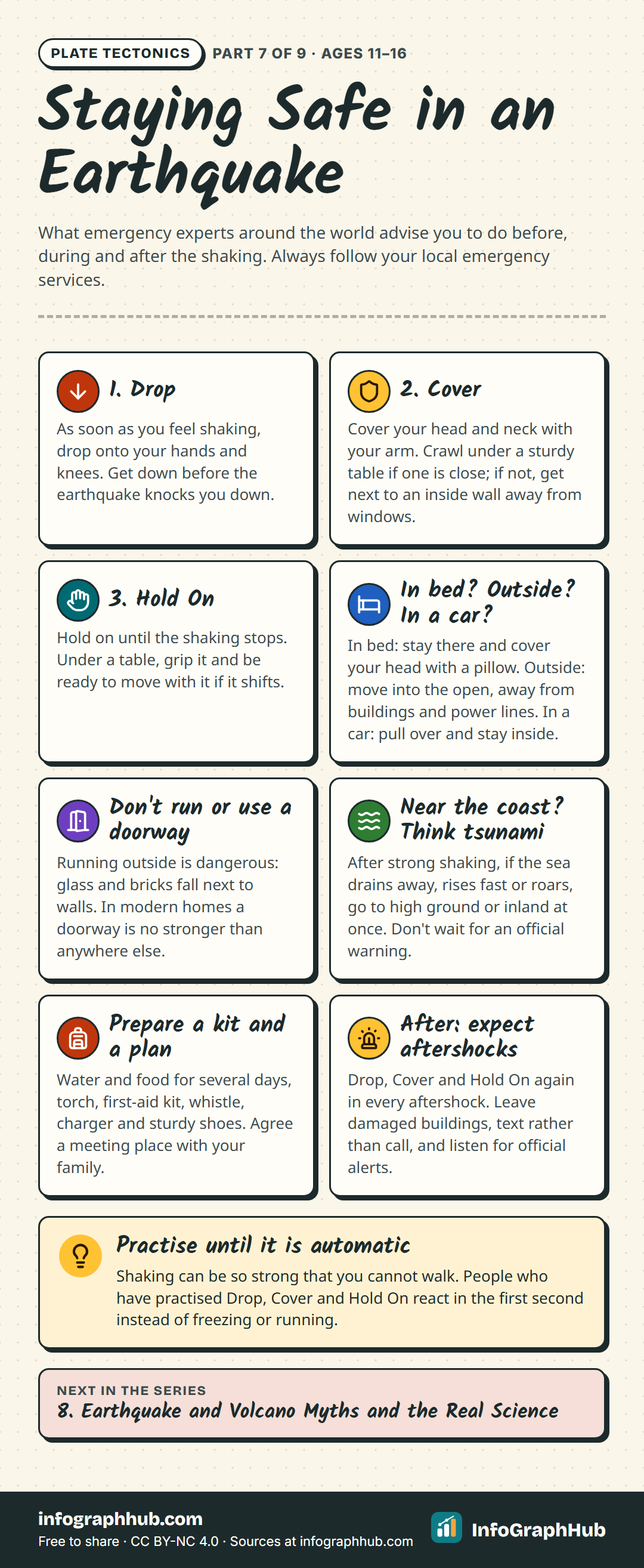
Official earthquake safety advice in eight cards: Drop, Cover and Hold On, what to do in bed, outdoors or in a car, why not to run outside or stand in a doorway, the natural warning signs of a tsunami and how to prepare a kit.
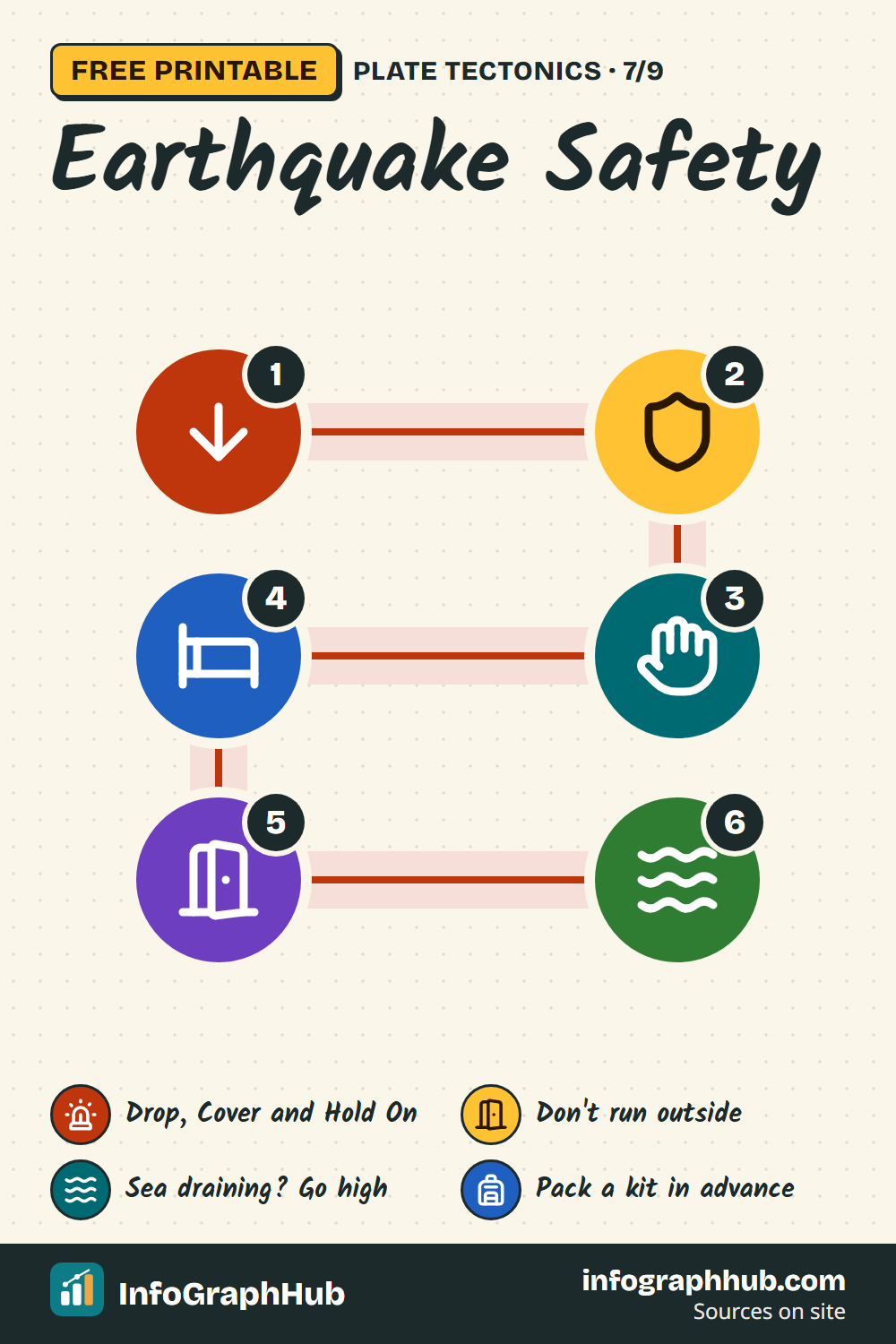
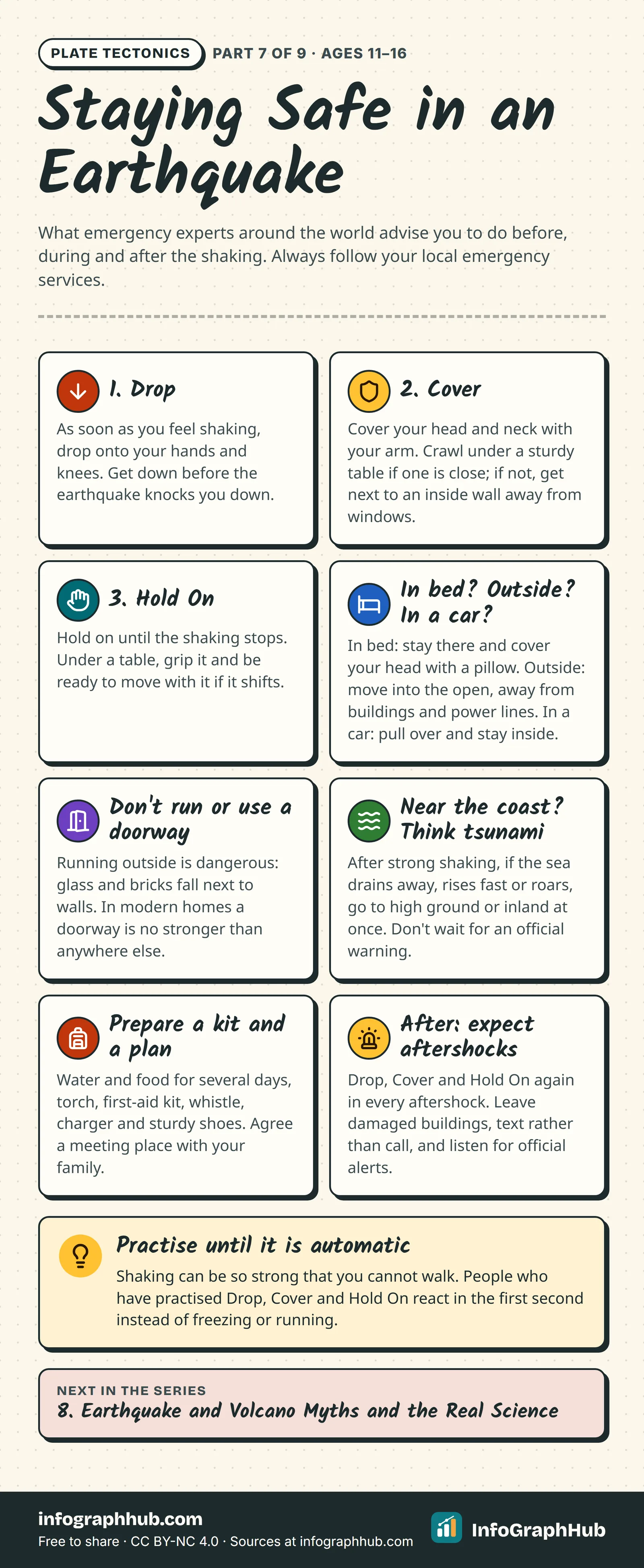
Use this infographic
Free under CC BY-NC 4.0, with credit to InfoGraphHub.
Why the advice is the same almost everywhere
Earthquakes strike without warning, and nobody can predict exactly when one will happen. What you do in the first few seconds matters most. Rescue teams, emergency managers and researchers who have studied earthquakes around the world agree on one simple action: Drop, Cover and Hold On.
The reason is that most injuries in earthquakes are not caused by buildings collapsing. They are caused by people falling over as they try to move, and by falling and flying objects such as televisions, lamps, glass and bookcases. Dropping to the floor and protecting your head and neck guards against exactly those dangers. This infographic summarises official guidance; always follow the advice of your own country's emergency services.
During the shaking
- Drop onto your hands and knees where you are, before the shaking knocks you down. This position also lets you crawl to shelter.
- Cover your head and neck with one arm and hand. If a sturdy table or desk is close by, crawl under it. If not, get down next to an inside wall, away from windows.
- Hold On until the shaking stops. If you are under a table, hold on to it and be ready to move with it.
If you are in bed, stay there, turn face down and cover your head and neck with a pillow. If you are outdoors, stay outdoors and move to an open space away from buildings, trees, street lights and power lines, then drop and cover. If you are in a vehicle, pull over, stop and stay inside, away from bridges, buildings and power lines. People who use a wheelchair or walker should lock their wheels, get as low as they safely can and protect their head and neck.
What not to do
- Don't run outside during shaking. The area just outside a building's walls is one of the most dangerous places, because glass, bricks and decorations fall there first.
- Don't stand in a doorway. In modern buildings a doorway is no stronger than any other part, and it does not protect you from falling objects.
- Don't rely on the 'triangle of life', an idea spread by email that tells people to lie next to furniture instead of under it. Experts say it is dangerous.
The Earthquake Country Alliance notes one exception: on the ground floor of an unreinforced mud-brick building with a heavy roof, moving quickly outside to open space may be safer.
Near the coast: tsunami warning signs
A large earthquake under or near the sea can cause a tsunami, a series of huge waves. If you are near the coast, protect yourself from the shaking first. As soon as it stops, look for natural warning signs:
- strong shaking that makes it hard to stand,
- the sea suddenly draining away, exposing the sea floor, or rising fast,
- a loud roar from the ocean.
If you notice any of these, go to high ground or as far inland as possible straight away. Do not wait for an official warning, and do not go to look at the water. Stay away until officials say it is safe, because tsunamis come as a series of waves.
Getting ready before an earthquake
- Practise Drop, Cover and Hold On with your family or class, so it becomes automatic.
- Secure heavy things such as bookcases, televisions and mirrors, and keep heavy or breakable objects on low shelves.
- Make a plan: agree where to meet if you are separated and who to contact.
- Prepare a kit: water and food for several days, a torch, spare batteries, a first-aid kit, medicines, a whistle, a phone charger and sturdy shoes to protect your feet from broken glass, one of the most common earthquake injuries.
After the shaking stops
Expect aftershocks, and Drop, Cover and Hold On again each time. Leave a damaged building and do not go back in. If you are trapped, tap on a pipe or wall or use a whistle rather than shouting, and send a text if you can. Text messages often get through when phone lines are busy. Listen to local radio or official alerts for instructions.
Frequently asked questions
What should you do during an earthquake?
Drop onto your hands and knees, Cover your head and neck (under a sturdy table if one is close), and Hold On until the shaking stops. Do not try to run outside.
Is a doorway the safest place in an earthquake?
No. In modern buildings doorways are no stronger than other parts of the building and do not protect you from falling objects. You are safer under a sturdy table.
What are the warning signs of a tsunami?
A strong earthquake, the sea suddenly draining away or rising fast, or a loud roar from the ocean. If you notice any of them near the coast, go to high ground or inland at once without waiting for an official warning.
What should be in an earthquake emergency kit?
Water and food for several days, a torch and batteries, a first-aid kit and medicines, a whistle, a phone charger and sturdy shoes. Store it where you can reach it quickly.
Sources & methodology
Every fact is checked against the sources below. We write original explanations and draw original graphics; no figures are copied from textbooks. Spotted an error? See our corrections policy.
- Earthquakes (Ready.gov (US Federal Emergency Management Agency), accessed 1 Oct 2026)
- Tsunamis (Ready.gov (US Federal Emergency Management Agency), accessed 1 Oct 2026)
- How to protect yourself during an earthquake (Earthquake Country Alliance, accessed 1 Oct 2026)
- Earthquake Safety (American Red Cross, accessed 1 Oct 2026)
- Can you predict earthquakes? (U.S. Geological Survey (USGS), accessed 1 Oct 2026)
Editorial review pending · Updated
Made by the InfoGraphHub editorial team (how we research and check: editorial and AI policy). First published 1 October 2026, last reviewed 1 October 2026. Found a mistake? Tell the editors.
For teachers: ages and curriculum fit
Ages 11–16 · Grades 6–10 (US) · Years 7–11 (UK) · Classes 6–10 (India)
NGSS is a registered trademark of WestEd. Names and codes are used only to describe curriculum fit; InfoGraphHub is not endorsed by these organisations.
Embed this on your site
Paste this HTML into your page. Keep the credit line: it is required by the CC BY-NC 4.0 license.
Related infographics


For teachers and parents: new InfoGraphHub resources by email
One short email when new free resources go live. For adults (18+) only. No spam, no tracking in emails, unsubscribe anytime.