Science, plants and cellsComparisonPart 4 of 9, PhotosynthesisUpdated 2 October 2026
Photosynthesis vs Respiration: Key Differences
Photosynthesis stores energy in glucose; respiration releases it. Compare where and when each happens, what goes in and comes out, and why plants do both, plus the compensation point and the day and night gas exchange of a leaf.
Interactive
Explore it step by step
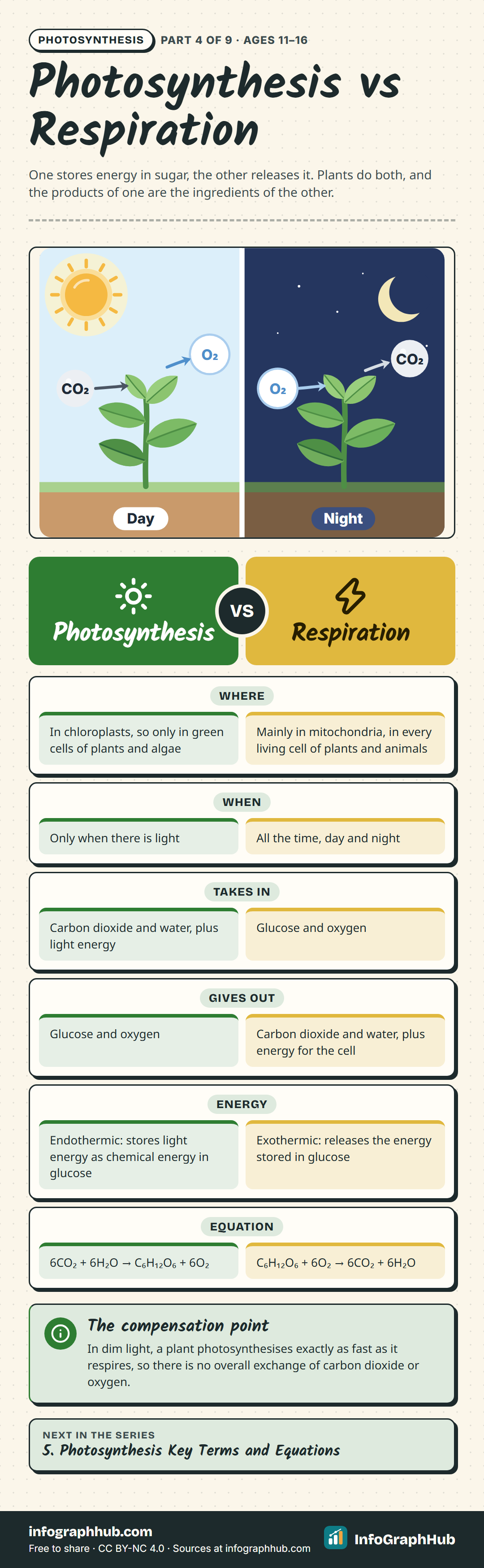
- Where
Photosynthesis: In chloroplasts, so only in green cells of plants and algae
Respiration: Mainly in mitochondria, in every living cell of plants and animals
- When
Photosynthesis: Only when there is light
Respiration: All the time, day and night
- Takes in
Photosynthesis: Carbon dioxide and water, plus light energy
Respiration: Glucose and oxygen
- Gives out
Photosynthesis: Glucose and oxygen
Respiration: Carbon dioxide and water, plus energy for the cell
- Energy
Photosynthesis: Endothermic: stores light energy as chemical energy in glucose
Respiration: Exothermic: releases the energy stored in glucose
- Equation
Photosynthesis: 6CO₂ + 6H₂O → C₆H₁₂O₆ + 6O₂
Respiration: C₆H₁₂O₆ + 6O₂ → 6CO₂ + 6H₂O
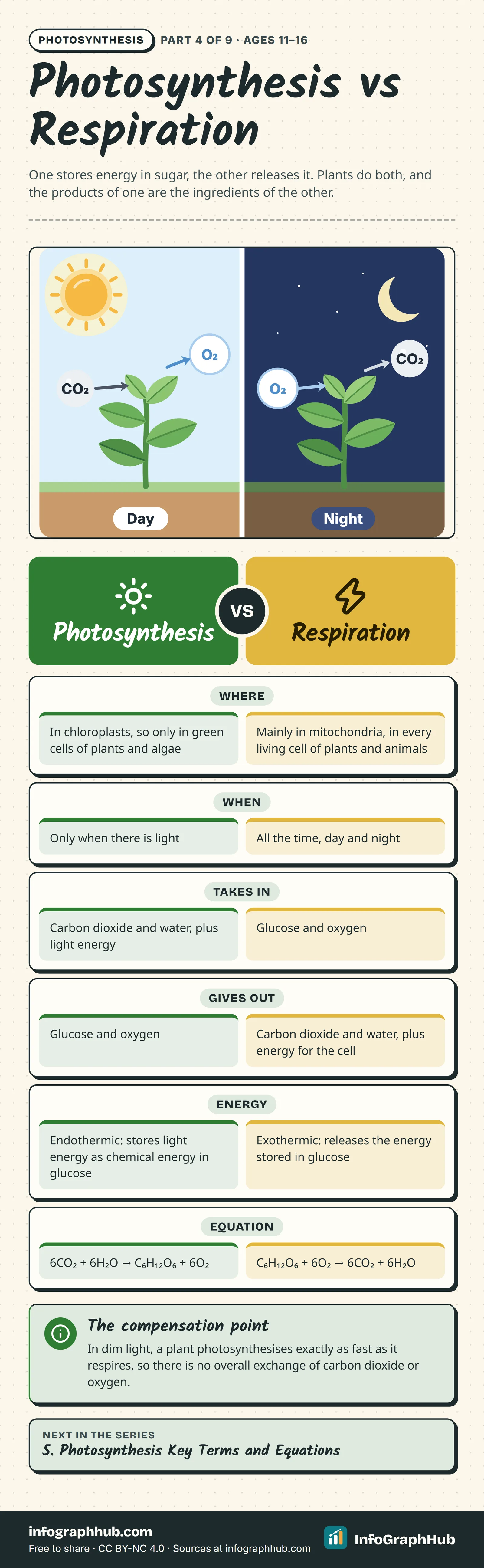
Use this infographic
Free under CC BY-NC 4.0, with credit to InfoGraphHub.
Two reactions that mirror each other
Photosynthesis and aerobic respiration are almost exact opposites. Put their equations side by side:
- Photosynthesis:
6CO₂ + 6H₂O → C₆H₁₂O₆ + 6O₂(light energy is taken in) - Aerobic respiration:
C₆H₁₂O₆ + 6O₂ → 6CO₂ + 6H₂O(energy is released)
The products of one are the reactants of the other. Photosynthesis is endothermic: it takes in energy from light and stores it as chemical energy in glucose. Respiration is exothermic: it releases that stored energy so cells can use it for building molecules, moving and, in animals such as mammals, keeping warm. If you learn one equation, you can write the other by reading it backwards.
Plants respire too
A very common mistake is to think that plants photosynthesise while animals respire. In fact respiration goes on all the time in every living cell, in plants as well as animals, by day and by night. Most of it happens in the mitochondria.
Photosynthesis only happens in cells with chloroplasts, and only when there is light. So during the day a green leaf is doing both at once. It is easy to miss the respiration because, in bright light, photosynthesis runs much faster and hides it.
Watching the balance change
You can see the balance shift with hydrogencarbonate indicator, which is red at normal carbon dioxide levels, turns yellow when carbon dioxide rises and purple when it falls. Put a leaf in a sealed tube with the indicator:
| Conditions | What the leaf is doing | Indicator |
|---|---|---|
| Dark | Respiration only, so CO₂ builds up | Turns yellow |
| Dim light | Photosynthesis equals respiration | Stays red |
| Bright light | Photosynthesis faster than respiration, so CO₂ is used up | Turns purple |
The point in dim light where the two rates are exactly equal is called the compensation point. At this light level there is no overall gain or loss of gases.
Why the balance matters
A plant can only grow if, over a whole day, it makes more glucose by photosynthesis than it uses up in respiration. A seedling kept in deep shade, below its compensation point for most of the day, slowly uses up its stores.
The same balance works on a global scale. In the Northern Hemisphere, where most of the land is, carbon dioxide in the air falls in spring and summer when plants are growing fast and rises again in winter when growth stops and dead leaves decay.
Respiration is not breathing
In everyday speech, 'respiration' and 'breathing' mean the same thing, but in biology they do not. Breathing (ventilation) is moving air in and out of the lungs. Respiration is a chemical reaction inside cells. Plants do not breathe at all: gases simply diffuse in and out of their leaves through the stomata.
When oxygen is short, for example in waterlogged soil around roots, plant cells can also respire anaerobically, turning glucose into ethanol and carbon dioxide. This releases much less energy than aerobic respiration.
Frequently asked questions
Do plants respire?
Yes. Plants respire all the time, day and night, in every living cell. In the light they also photosynthesise, usually faster than they respire, so overall they take in carbon dioxide and give out oxygen.
What is the compensation point?
It is the light intensity at which a plant's rate of photosynthesis exactly equals its rate of respiration. At that point there is no net uptake or release of carbon dioxide or oxygen.
What is the main difference between photosynthesis and respiration?
Photosynthesis uses light energy to make glucose and oxygen from carbon dioxide and water, so it stores energy. Respiration breaks glucose down with oxygen into carbon dioxide and water, releasing energy for the cell.
Where does respiration happen in a cell?
Aerobic respiration happens mainly in the mitochondria, which are found in almost all plant and animal cells. Photosynthesis happens in chloroplasts, which only green plant cells and algae have.
Sources & methodology
Every fact is checked against the sources below. We write original explanations and draw original graphics; no figures are copied from textbooks. Spotted an error? See our corrections policy.
- GCSE Biology (8461) specification: 4.4 Bioenergetics (AQA, accessed 1 Oct 2026)
- What is respiration and photosynthesis in plants? (BBC Bitesize, accessed 1 Oct 2026)
- What is photosynthesis and how does it affect plants? (CCEA) (BBC Bitesize, accessed 1 Oct 2026)
- Respiration and photosynthesis: animation (Science & Plants for Schools (SAPS), accessed 1 Oct 2026)
- The Carbon Cycle (NASA Earth Observatory, accessed 1 Oct 2026)
Approved for publication by InfoGraphHub editorial team on 17 Oct 2026 · Updated
Made by the InfoGraphHub editorial team (how we research and check: editorial and AI policy). First published 1 October 2026, last reviewed 17 October 2026. Found a mistake? Tell the editors.
For teachers: ages and curriculum fit
Ages 11–16 · Grades 6–10 (US) · Years 7–11 (UK) · Classes 6–10 (India)
NGSS is a registered trademark of WestEd. Names and codes are used only to describe curriculum fit; InfoGraphHub is not endorsed by these organisations.
Embed this on your site
Paste this HTML into your page. Keep the credit line: it is required by the CC BY-NC 4.0 license.
Related infographics


For teachers and parents: new InfoGraphHub resources by email
One short email when new free resources go live. For adults (18+) only. No spam, no tracking in emails, unsubscribe anytime.