FinanceNumbersUpdated 1 October 2026
How Credit Scores Work: What Moves Your Score
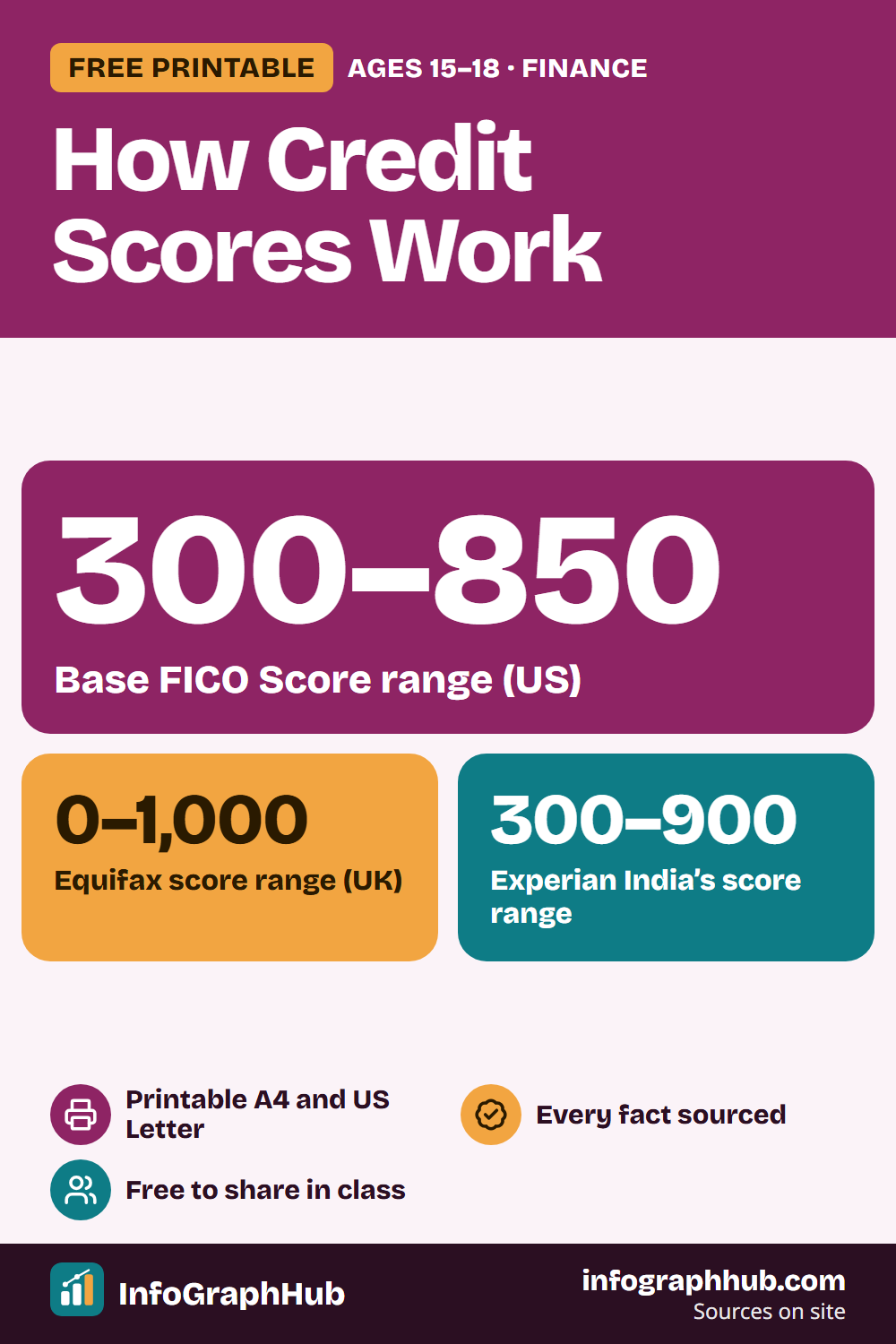
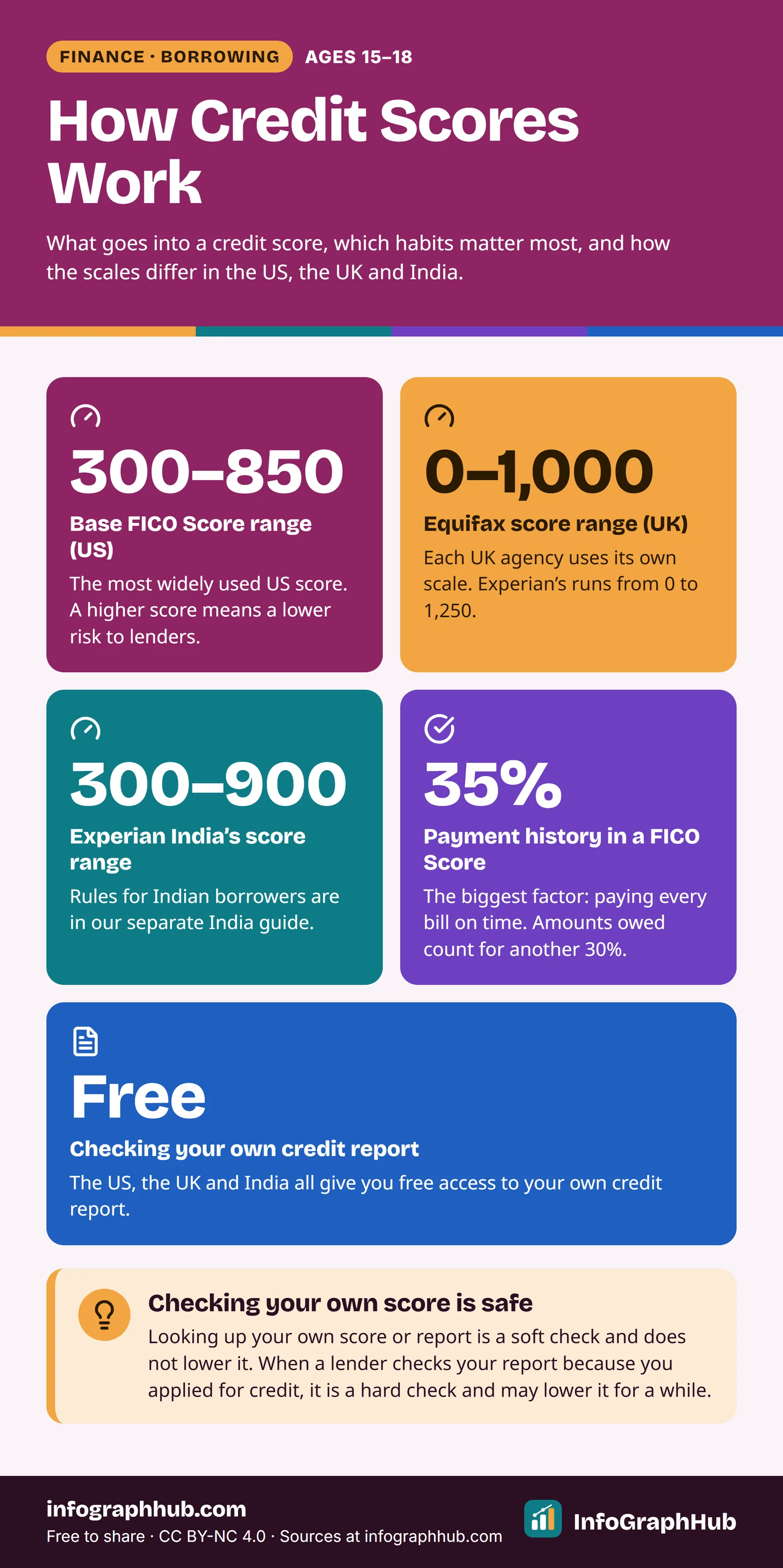
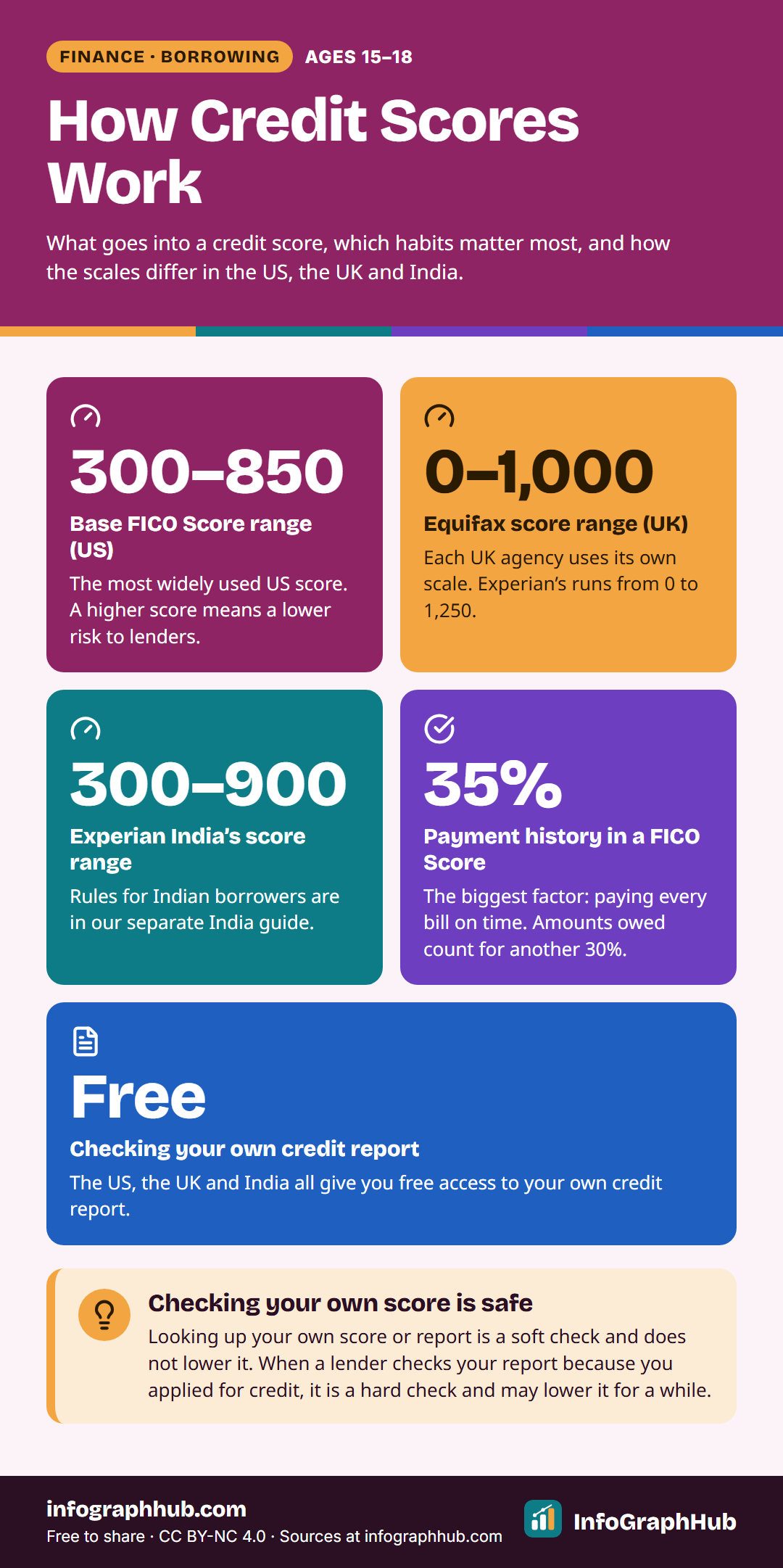
A credit score is a number that predicts how likely you are to repay borrowing on time, built from your credit report. Paying on time and using little of your credit limit matter most. Each country, and each agency, uses its own scale.
Use this infographic
Free under CC BY-NC 4.0, with credit to InfoGraphHub.
What a credit score is
When you borrow, through a loan, a credit card or a phone contract, the lender usually reports how you repay to credit bureaus, also called credit reference agencies. Each bureau keeps a credit report listing your accounts and repayments.
A credit score turns that report into a single number. The US Consumer Financial Protection Bureau describes it as a prediction of how likely you are to pay a loan back on time. Lenders use it, along with other details such as your income, to decide whether to lend to you and at what interest rate.
You do not have just one score. Different bureaus and scoring models can give different numbers, and your score changes as your report changes.
What moves your score
Each scoring model uses its own formula, but the same habits matter almost everywhere. The US FICO Score publishes how much each part counts:
- Payment history (35%): paying every bill on time. Missed or late payments pull the score down.
- Amounts owed (30%): how much of your available credit you are using, often called credit utilisation.
- Length of credit history (15%): a longer record of handling credit well helps.
- New credit (10%): opening several new accounts in a short time can count against you.
- Credit mix (10%): having different types, such as a card and a loan.
Bureaus in other countries, such as Experian India, describe their factors as high, medium or low impact rather than as exact percentages, but payment history and utilisation still come first.
Scores around the world
There is no world-wide credit score, and the scales are not interchangeable:
- United States: base FICO Scores run from 300 to 850.
- United Kingdom: each agency has its own scale. Equifax runs from 0 to 1,000 and Experian from 0 to 1,250. TransUnion is moving from 0–710 to a new 0–999 score, rolled out between late September 2026 and June 2027.
- India: scores usually run from 300 to 900, for example Experian India’s. Our separate India guide covers the RBI rules for Indian borrowers.
So a score of 800 means something different on each scale. Compare a score only with others on the same scale.
Soft and hard checks
When you check your own score or report, that is a soft check (called a soft search in the UK and a soft inquiry in the US), and it does not affect your score. When you apply for a loan or card and the lender pulls your report to decide, that is a hard check, which can lower your score for a while. Applying to many lenders in a short time means several hard checks close together, so it is worth comparing offers before you apply.
Worked example: two first credit cards
Sam and Alex each get their first credit card with the same credit limit.
- Sam uses about 30% of the limit each month and pays the full bill before the due date.
- Alex regularly uses about 90% of the limit, pays only the minimum and is sometimes late.
After a year, Sam has a clean payment record and low utilisation, the two biggest factors. Alex has high utilisation and late payments on the report, so Alex’s score is likely to suffer, and lenders may offer less credit or charge more interest.
Checking your own report
Mistakes on a credit report can lower your score, so it is worth checking yours. In the US, AnnualCreditReport.com is the official site for free reports from the three nationwide bureaus, now available every week. In the UK, every credit reference agency must give you your statutory credit report free of charge. In India, each bureau must give you one free full report a year.
This page is general information for learning, not financial advice. For help with your own borrowing, speak to your lender, a free debt-advice service or a regulated financial adviser in your country.
Frequently asked questions
What counts as a good credit score?
It depends on the scale. For base FICO Scores in the US, myFICO describes 670–739 as good and 800 or more as exceptional. UK agencies and Indian bureaus use different scales and bands, and each lender sets its own rules.
Does checking my own credit score lower it?
No. Checking your own report or score is not an application for new credit, so it has no effect. Only hard checks, made when a lender assesses an application, can lower it, and usually only for a while.
Why do I have different credit scores?
Each bureau holds slightly different information, and lenders and bureaus use different scoring models and scales. Your score also changes over time as your report is updated.
How can I get my credit report for free?
In the US, use AnnualCreditReport.com. In the UK, ask each credit reference agency for your free statutory report. In India, each credit bureau must give you one free full report every calendar year.
Sources & methodology
Every fact is checked against the sources below. We write original explanations and draw original graphics; no figures are copied from textbooks. Spotted an error? See our corrections policy.
- What is a credit score? (Consumer Financial Protection Bureau (US), accessed 1 Oct 2026)
- Does checking my credit report hurt my credit score? (Consumer Financial Protection Bureau (US), accessed 1 Oct 2026)
- What’s in my FICO Scores? (myFICO (Fair Isaac Corporation), accessed 1 Oct 2026)
- What is a credit score? (myFICO (Fair Isaac Corporation), accessed 1 Oct 2026)
- Free credit reports (Federal Trade Commission (US), accessed 1 Oct 2026)
- Credit (Information Commissioner’s Office (UK), accessed 1 Oct 2026)
- Check your free credit score (Equifax UK, accessed 1 Oct 2026)
- Experian credit score (Experian UK, accessed 1 Oct 2026)
- TransUnion launches next-generation expanded 0–999 consumer credit score in the UK (TransUnion UK, accessed 1 Oct 2026)
- Frequently Asked Questions (Experian Credit Information Company of India, accessed 30 Sept 2026)
Editorial review pending · Updated
Made by the InfoGraphHub editorial team (how we research and check: editorial and AI policy). First published 30 September 2026, last reviewed 1 October 2026. Found a mistake? Tell the editors.
For teachers: ages and curriculum fit
Ages 15–18 · Grades 10–12 (US) · Years 11–13 (UK) · Classes 10–12 (India)
Embed this on your site
Paste this HTML into your page. Keep the credit line: it is required by the CC BY-NC 4.0 license.
Related infographics


For teachers and parents: new InfoGraphHub resources by email
One short email when new free resources go live. For adults (18+) only. No spam, no tracking in emails, unsubscribe anytime.