FinanceNumbersPart 1 of 8, Compound Interest and SavingUpdated 1 October 2026
Compound Interest Explained: How Money Grows Over Time
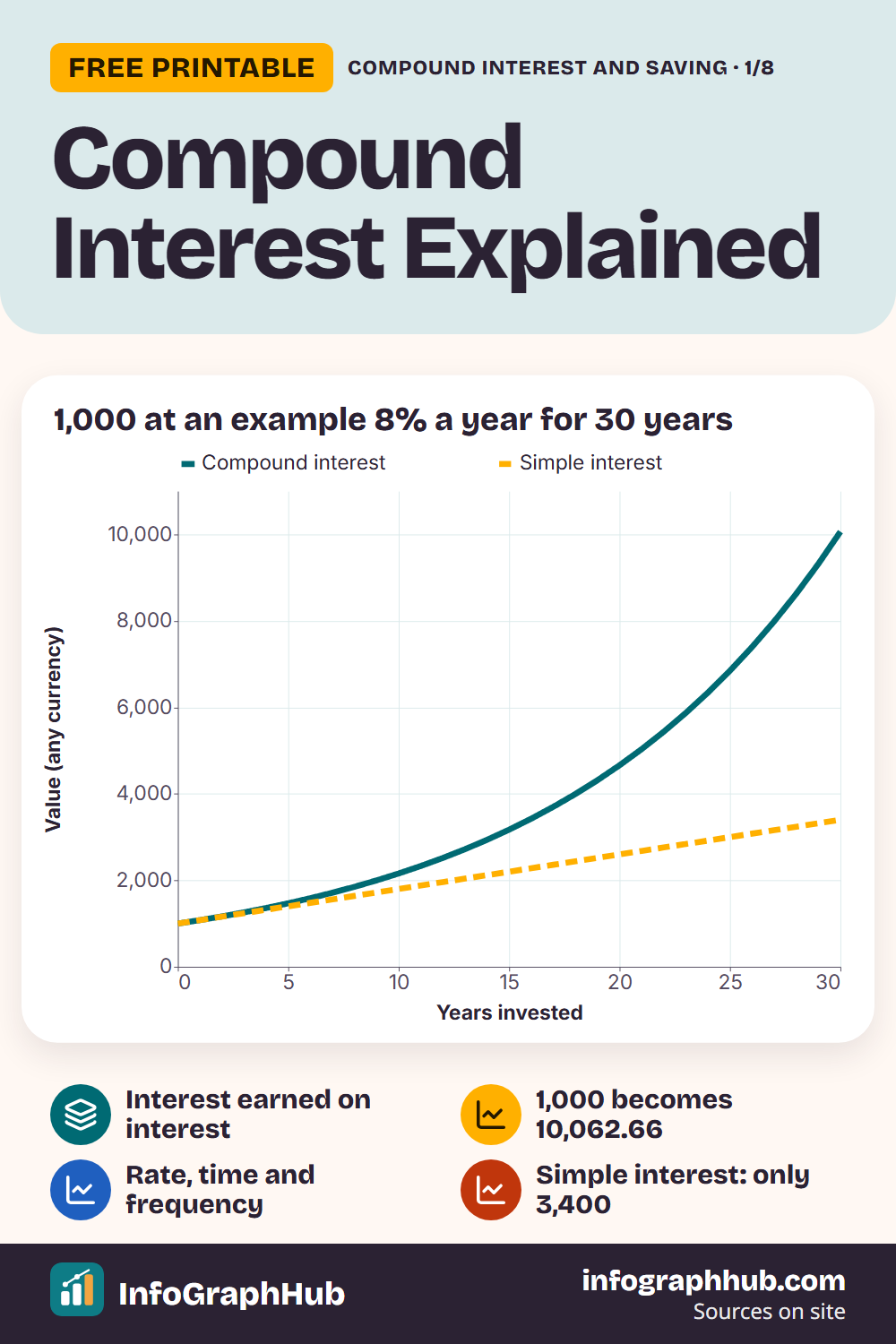
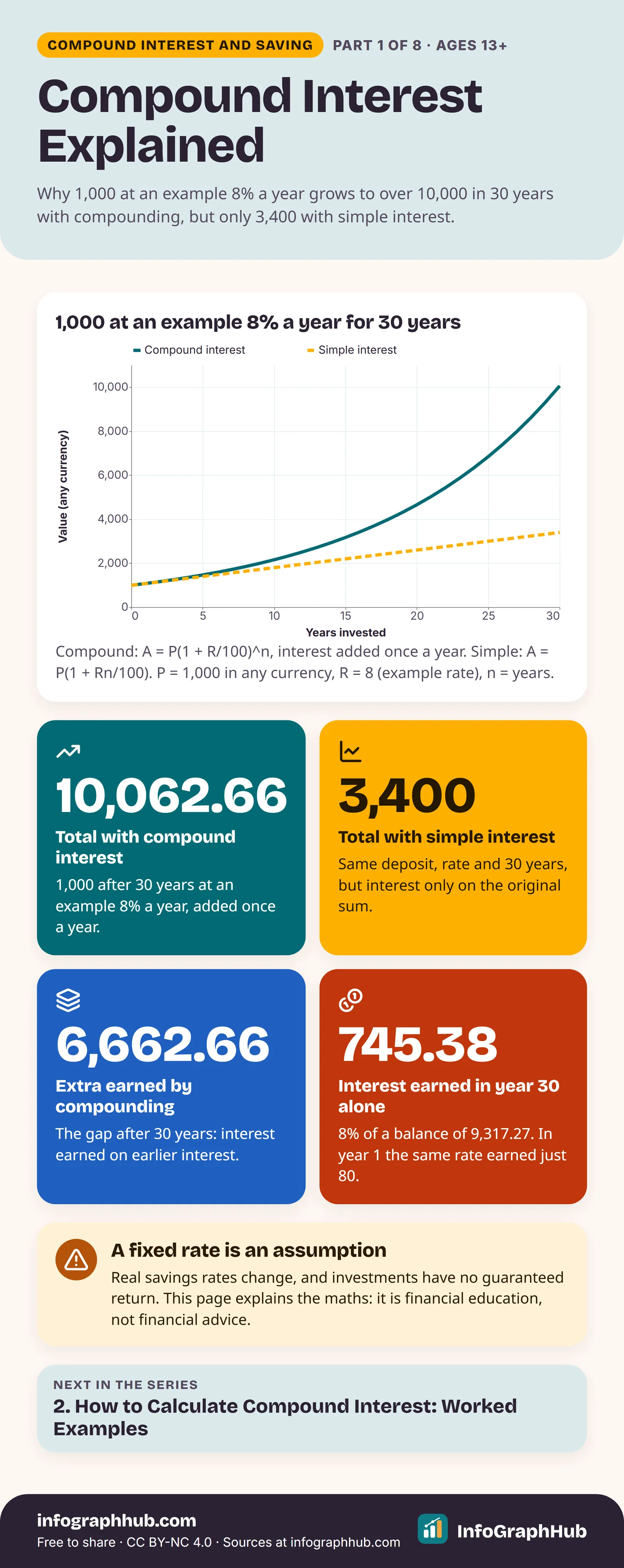
Compound interest is interest earned on interest. Each year's interest joins the balance, so the next year's interest is worked out on a bigger sum. Over 30 years at an example 8% rate, 1,000 grows to 10,062.66, against 3,400 with simple interest.
Use this infographic
Free under CC BY-NC 4.0, with credit to InfoGraphHub.
What compound interest means
When you save money in an account, the bank or other provider pays you interest: a reward for letting it use your money. When you borrow, you pay interest instead. Interest is usually given as a percentage of the money for each year, and there are two ways it can be worked out.
- Simple interest is calculated only on the original sum, called the principal. You earn the same amount every year.
- Compound interest is calculated on the principal plus all the interest already added. Each year's interest joins the balance, so the next year's interest is worked out on a bigger number.
In short, with compounding your interest starts earning interest of its own. The US Securities and Exchange Commission's glossary puts it in one line: interest paid on the principal and on interest that has built up.
Why the curve bends upwards
Simple interest adds the same amount every year, so its graph is a straight line. Compound interest multiplies the balance by the same factor every year: at 8%, the balance is multiplied by 1.08 each time. Because each new 8% is taken from a bigger balance, the amount added keeps growing, and the graph curves upwards. Mathematicians call this exponential growth.
The same pattern appears well outside money, from bacteria multiplying to a rumour spreading. A quantity that grows by a constant percentage always overtakes one that grows by a constant amount in the end.
The later parts of this series take the ideas further: Part 2 shows how to calculate compound interest step by step, and Part 3 puts simple and compound interest side by side.
The 30-year picture
The chart follows 1,000 (in any currency) left in an account that pays an example fixed rate of 8% a year, with interest added once a year and nothing taken out.
| After | Simple interest | Compound interest |
|---|---|---|
| 1 year | 1,080 | 1,080 |
| 10 years | 1,800 | 2,158.92 |
| 20 years | 2,600 | 4,660.96 |
| 30 years | 3,400 | 10,062.66 |
For the first year the two lines sit on top of each other: both pay 80. The gap is small for a long time, then opens quickly. In year 30, the compound balance earns 745.38 in a single year, because 8% is now being worked out on a balance of 9,317.27. After 30 years, compounding has produced 6,662.66 more than simple interest from exactly the same deposit and the same rate.
Notice too that more than half of the compound growth arrives in the last ten years: the balance goes from 4,660.96 to 10,062.66 between years 20 and 30. That is why time matters so much with compounding.
Three things that drive the growth
How fast a balance compounds depends on three things:
- The rate. A higher percentage means a bigger multiplier each period.
- The time. Every extra year multiplies the balance again, so the effect of time grows the longer the money is left.
- How often interest is added. Interest can be added yearly, monthly or even daily. The more often it is added, the sooner each piece of interest starts earning interest itself, although the difference is usually small.
A handy shortcut, the Rule of 72, estimates how long a balance takes to double; Part 4 tests how accurate it is. The words banks use for rates, such as APR and AER, are explained in Part 5.
Real life is less tidy
The chart assumes a fixed 8% every year to keep the maths clear. That rate is only an example. In reality, savings rates go up and down, and inflation means the same amount of money buys less over time. Investments such as shares and funds do not pay a fixed rate at all: their value can fall as well as rise, and returns are not guaranteed.
Compounding also works against borrowers. When unpaid interest on a loan or credit card is added to the debt, interest is then charged on that interest too. Part 6 looks at where compound interest shows up in everyday life, for savers and for borrowers.
This page is financial education about how the maths works; it is not financial advice. For decisions about your own money, speak to a regulated, independent adviser in your country.
Frequently asked questions
What is compound interest in simple terms?
It is interest earned on interest. Each time interest is added to a savings balance, the next round of interest is worked out on the new, bigger balance, so the amount of interest grows every period.
Why is compound interest called exponential growth?
Because the balance is multiplied by the same factor each period, such as 1.08 for 8% a year. Repeated multiplication gives a curve that gets steeper over time, while simple interest adds a fixed amount and gives a straight line.
What makes compound interest grow faster?
Three things: a higher interest rate, a longer time, and interest being added more often (for example monthly instead of yearly). Time usually has the biggest effect, because each extra year multiplies the balance again.
Can compound interest work against me?
Yes. When unpaid interest on a loan or credit card is added to what you owe, you end up paying interest on interest, and the debt can grow quickly.
Will savings really grow like the chart?
Only if they earned exactly 8% every year, which is just an example rate. Real savings rates change, inflation reduces what money can buy, and investment returns are not guaranteed and can be negative. This page is education, not financial advice.
Sources & methodology
Every fact is checked against the sources below. We write original explanations and draw original graphics; no figures are copied from textbooks. Spotted an error? See our corrections policy.
- 6.4 Compound Interest (Contemporary Mathematics) (OpenStax, Rice University, accessed 1 Oct 2026)
- What is compound interest? (Investor.gov, US Securities and Exchange Commission, accessed 1 Oct 2026)
- Glossary: Compound Interest (Investor.gov, US Securities and Exchange Commission, accessed 1 Oct 2026)
- Repeated percentage change, interest and exponential change (BBC Bitesize, accessed 1 Oct 2026)
Editorial review pending · Updated
Made by the InfoGraphHub editorial team (how we research and check: editorial and AI policy). First published 30 September 2026, last reviewed 1 October 2026. Found a mistake? Tell the editors.
For teachers: ages and curriculum fit
Ages 13+ · Grades 8–12 (US) · Years 9–13 (UK) · Classes 8–12 (India)
Cambridge and IGCSE are trademarks of Cambridge University Press & Assessment. Common Core State Standards © Copyright 2010 National Governors Association Center for Best Practices and Council of Chief State School Officers. All rights reserved. Names and codes are used only to describe curriculum fit; InfoGraphHub is not endorsed by these organisations.
Embed this on your site
Paste this HTML into your page. Keep the credit line: it is required by the CC BY-NC 4.0 license.
Related infographics


For teachers and parents: new InfoGraphHub resources by email
One short email when new free resources go live. For adults (18+) only. No spam, no tracking in emails, unsubscribe anytime.