FinanceComparisonPart 3 of 8, Compound Interest and SavingUpdated 1 October 2026
Simple vs Compound Interest: What Is the Difference?
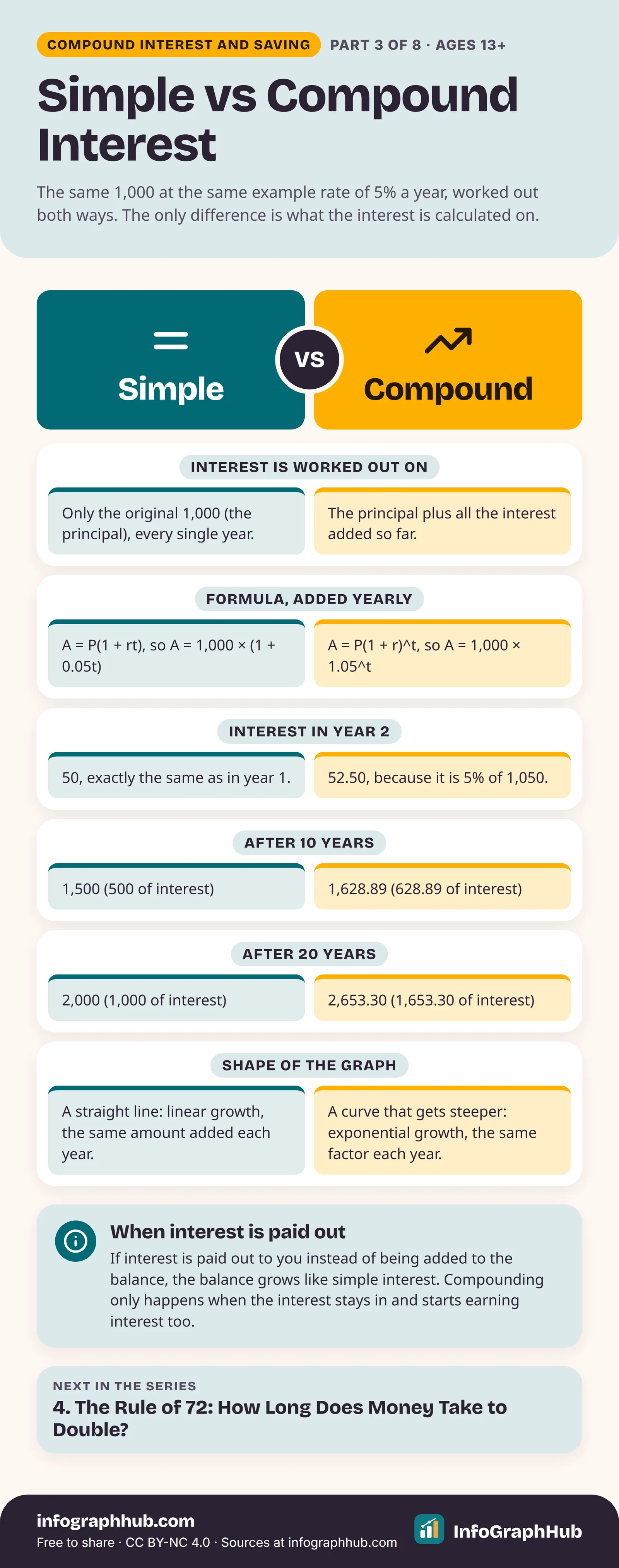
Simple interest is worked out only on the starting amount; compound interest is worked out on the starting amount plus interest already added. Side by side with the same 1,000 at an example 5%: 2,000 against 2,653.30 after 20 years.
Interactive
Explore it step by step
- Interest is worked out on
Simple: Only the original 1,000 (the principal), every single year.
Compound: The principal plus all the interest added so far.
- Formula, added yearly
Simple: A = P(1 + rt), so A = 1,000 × (1 + 0.05t)
Compound: A = P(1 + r)^t, so A = 1,000 × 1.05^t
- Interest in year 2
Simple: 50, exactly the same as in year 1.
Compound: 52.50, because it is 5% of 1,050.
- After 10 years
Simple: 1,500 (500 of interest)
Compound: 1,628.89 (628.89 of interest)
- After 20 years
Simple: 2,000 (1,000 of interest)
Compound: 2,653.30 (1,653.30 of interest)
- Shape of the graph
Simple: A straight line: linear growth, the same amount added each year.
Compound: A curve that gets steeper: exponential growth, the same factor each year.
Use this infographic
Free under CC BY-NC 4.0, with credit to InfoGraphHub.
Same money, same rate, different rule
Simple and compound interest start from the same three facts: how much money there is (the principal), the interest rate and the time. They differ in one rule only: what the interest is worked out on.
- With simple interest, it is always the original principal.
- With compound interest, it is the current balance, which already includes earlier interest.
To see the effect, this infographic follows the same 1,000 (in any currency) at the same example rate of 5% a year, with interest added once a year.
Simple interest in one line
Simple interest is the same every year, so you can find the total in a single step:
interest = principal × rate × time
For 1,000 at 5% for 20 years: 1,000 × 0.05 × 20 = 1,000 of interest, making 2,000 in total. Each year adds exactly 50, whether it is the first year or the twentieth.
Compound interest pulls ahead
With compounding, the interest itself grows. It is 50 in year 1, 52.50 in year 2 and 126.35 in year 20, because by then 5% is being taken from a balance of more than 2,500.
| After | Simple | Compound | Gap |
|---|---|---|---|
| 1 year | 1,050 | 1,050 | 0 |
| 2 years | 1,100 | 1,102.50 | 2.50 |
| 10 years | 1,500 | 1,628.89 | 128.89 |
| 20 years | 2,000 | 2,653.30 | 653.30 |
When interest is added once a year, the two methods agree exactly for the first year. After that the gap starts tiny, just 2.50 after two years, and then widens faster and faster. Over short times the difference is small; over long times it is large.
Linear vs exponential growth
Look at how each balance changes from one year to the next.
- Simple interest grows by equal differences: +50, +50, +50 … Its graph is a straight line, which is linear growth.
- Compound interest grows by equal factors: × 1.05, × 1.05, × 1.05 … Its graph curves upwards, which is exponential growth.
This is one of the most useful ideas in school maths. Any quantity that grows by a fixed percentage will eventually overtake any quantity that grows by a fixed amount, however small the percentage.
Where you meet each one
Compound interest is the usual rule for savings accounts that add interest to the balance, and for debts such as loans and credit cards when interest is added to what is owed. Simple interest appears in some short-term loans, in many maths exam questions, and whenever interest is paid out instead of being kept in the balance.
Whichever rule applies, ask two questions: what is the interest worked out on, and is it added back to the balance? The answers tell you which formula to use. This comparison is financial education about how the maths works, not financial advice.
Frequently asked questions
What is the main difference between simple and compound interest?
Simple interest is calculated only on the original amount, so it is the same every year. Compound interest is calculated on the original amount plus the interest already added, so it grows every year.
Is compound interest always more than simple interest?
At the same rate, it is never less. With interest added once a year, the two give the same amount after one year, and compound interest is ahead from then on. The gap starts small and grows over time.
What is the formula for simple interest?
Interest = principal × rate × time, with the rate as a decimal. The total amount is A = P(1 + rt). For 1,000 at 5% for 20 years: 1,000 × 0.05 × 20 = 1,000 of interest, so 2,000 in total.
Why is simple interest linear and compound interest exponential?
Simple interest adds the same amount each year, which gives a straight-line graph. Compound interest multiplies the balance by the same factor each year, such as 1.05, which gives a curve that keeps getting steeper.
Sources & methodology
Every fact is checked against the sources below. We write original explanations and draw original graphics; no figures are copied from textbooks. Spotted an error? See our corrections policy.
- Interest – Simple and Compound (KS3 Maths) (BBC Bitesize, accessed 1 Oct 2026)
- Repeated percentage change, interest and exponential change (BBC Bitesize, accessed 1 Oct 2026)
- What is compound interest? (Investor.gov, US Securities and Exchange Commission, accessed 1 Oct 2026)
- High School: Functions » Linear, Quadratic, & Exponential Models (Common Core State Standards Initiative, accessed 1 Oct 2026)
Editorial review pending · Updated
Made by the InfoGraphHub editorial team (how we research and check: editorial and AI policy). First published 2 October 2026, last reviewed 1 October 2026. Found a mistake? Tell the editors.
For teachers: ages and curriculum fit
Ages 13+ · Grades 8–12 (US) · Years 9–13 (UK) · Classes 8–12 (India)
Common Core State Standards © Copyright 2010 National Governors Association Center for Best Practices and Council of Chief State School Officers. All rights reserved. Names and codes are used only to describe curriculum fit; InfoGraphHub is not endorsed by these organisations.
Embed this on your site
Paste this HTML into your page. Keep the credit line: it is required by the CC BY-NC 4.0 license.
Related infographics


For teachers and parents: new InfoGraphHub resources by email
One short email when new free resources go live. For adults (18+) only. No spam, no tracking in emails, unsubscribe anytime.