8-part series · Ages 13–99
Compound Interest and Saving
Eight infographics on how interest earns interest: the maths of saving, borrowing and the slow work of time.
Complete pack: all 8 parts in one PDF
Printable, with the quiz answers. Free under CC BY-NC 4.0.
The 8 parts
 Overview
Compound Interest Explained: How Money Grows Over Time
 Worked example
How to Calculate Compound Interest: Worked Examples
 Compare
Simple vs Compound Interest: What Is the Difference?
 Key numbers
The Rule of 72: How Long Does Money Take to Double?
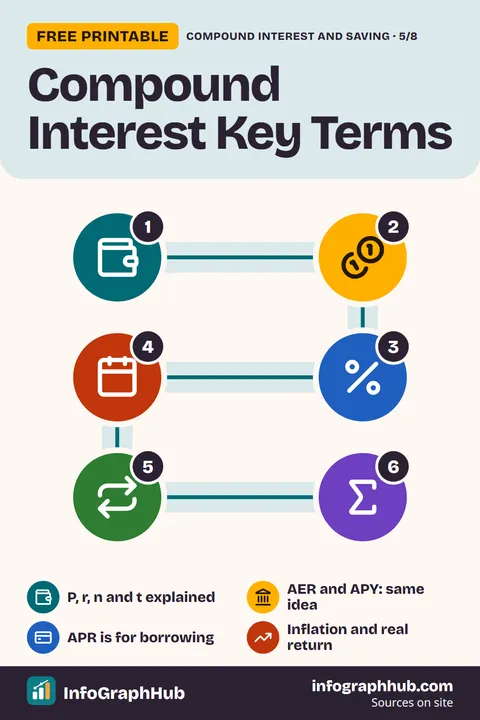 Key terms
Compound Interest Key Terms: APR, AER, APY and More
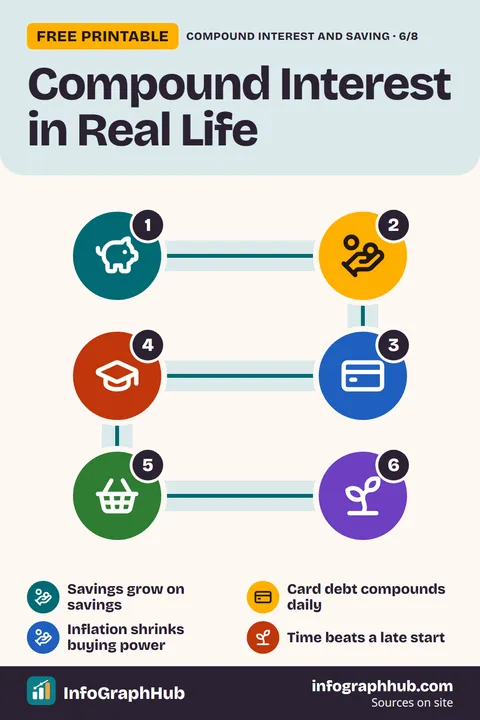 In everyday life
Compound Interest in Everyday Life
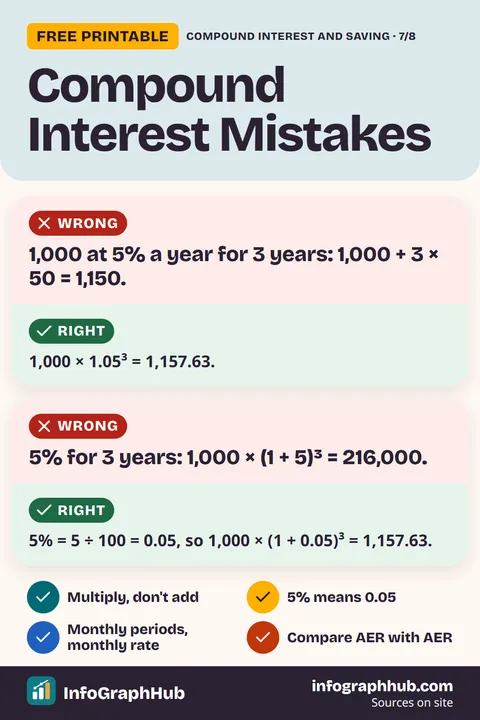 Common mistakes
Common Compound Interest Mistakes and How to Avoid Them
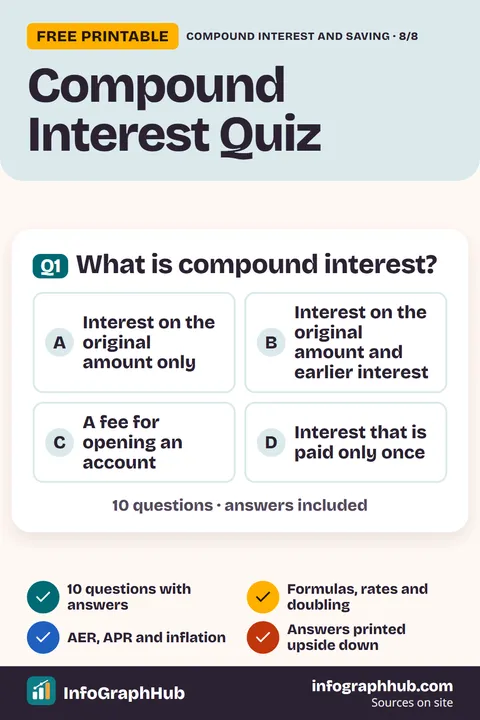 Quiz
Compound Interest Quiz: Test Yourself


Watch the whole series

The complete guide
Compound Interest and Saving explained
Compound interest is interest earned on interest, and it quietly shapes savings, loans, credit cards and what money is worth over time. This series takes it one question at a time: what compounding means, how to calculate it by hand and with the formula, how it compares with simple interest, how fast money doubles, what words like APR and AER mean, where it shows up in daily life and which slips catch people out.
Each part is a printable infographic with worked numbers and sources, written for ages 13–16, their teachers and any adult who wants the maths explained clearly. Every amount works in any currency and every rate is an example. This is financial education about how the maths works, not financial advice. Finish with the quiz to check what you have learned.
What compound interest is
Interest is a payment for the use of money. A saver earns it from a bank; a borrower pays it to a lender. It is usually quoted as a percentage of the money for each year.
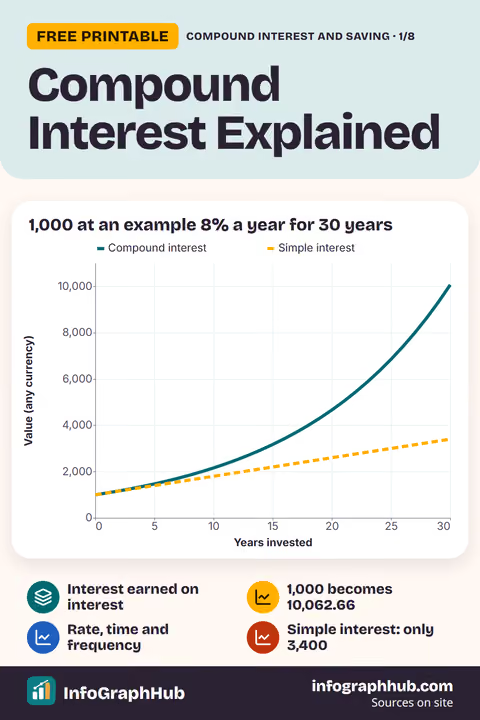
There are two ways to work it out. Simple interest is always calculated on the original amount, the principal, so it is the same every year. Compound interest is calculated on the principal plus any interest already added. Each time interest joins the balance, the next round of interest is worked out on a bigger number. In one phrase: interest earns interest.
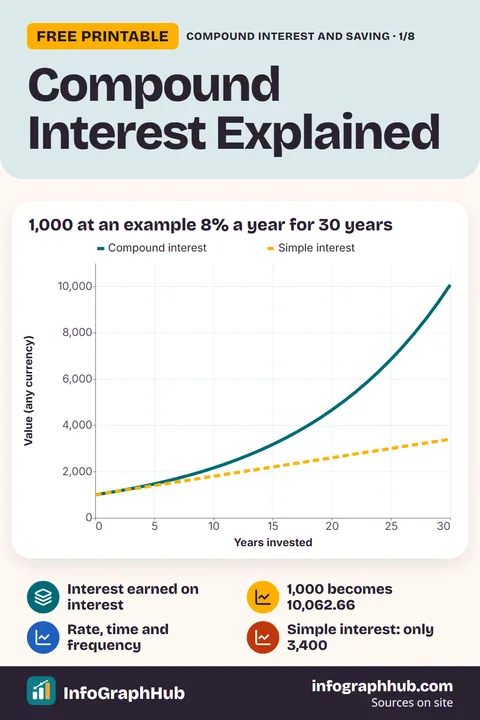
The effect is small at first and large later. Take 1,000 (in any currency) at an example fixed rate of 8% a year, with interest added once a year:
| After | Simple interest | Compound interest |
|---|---|---|
| 1 year | 1,080 | 1,080 |
| 10 years | 1,800 | 2,158.92 |
| 30 years | 3,400 | 10,062.66 |
In year 1 both methods pay 80. In year 30, the compound balance earns 745.38 in a single year, because 8% is now taken from more than 9,300. Because the balance is multiplied by the same factor, 1.08, every year, its graph curves upwards. Mathematicians call this exponential growth.
See the infographic: Part 1, Compound Interest Explained: How Money Grows Over Time →
How to calculate compound interest
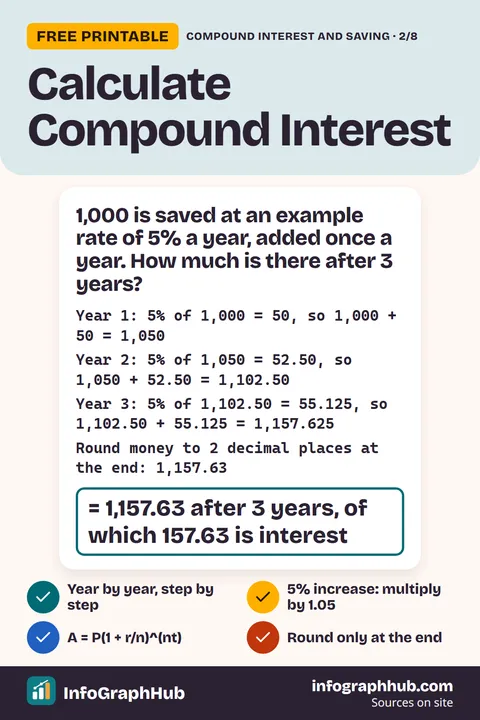
The clearest method is to go year by year. With 1,000 at an example 5% a year:
- Year 1: 5% of 1,000 = 50, so the balance is 1,050.
- Year 2: 5% of 1,050 = 52.50, so the balance is 1,102.50.
- Year 3: 5% of 1,102.50 = 55.125, so the balance is 1,157.625, or 1,157.63.
The quicker method uses a multiplier. A 5% increase is the same as multiplying by 1.05, so three years is 1,000 × 1.05³ = 1,157.63, exactly the same answer in one line.
When interest is added more than once a year, use the general formula:
A = P(1 + r/n)^(nt)
Here A is the final amount, P the principal, r the yearly rate as a decimal, n the number of times interest is added each year (12 for monthly) and t the number of years. r/n is the rate for one period and nt is the number of periods. For 1,000 at an example 6% a year added monthly for 3 years: r/n = 0.06 ÷ 12 = 0.005 and nt = 36, so A = 1,000 × 1.005^36 = 1,196.68. Added once a year instead, the same money would reach 1,191.02.
Two habits prevent most errors: keep every digit on the calculator until the last step, and subtract P at the end if the question asks only for the interest.
See the infographic: Part 2, How to Calculate Compound Interest: Worked Examples →
Simple interest vs compound interest
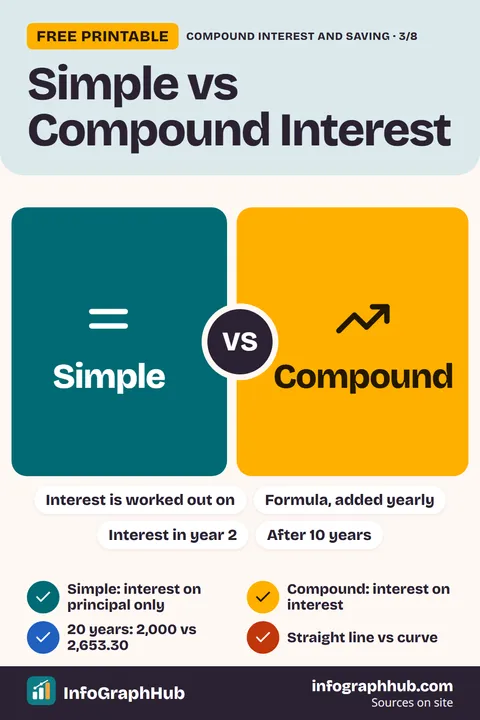
Simple interest uses one short formula: interest = principal × rate × time. For 1,000 at an example 5% a year for 20 years, that is 1,000 × 0.05 × 20 = 1,000 of interest, so 2,000 in total. Compound interest at the same rate gives 1,000 × 1.05²⁰ = 2,653.30.
| After | Simple | Compound |
|---|---|---|
| 2 years | 1,100 | 1,102.50 |
| 10 years | 1,500 | 1,628.89 |
| 20 years | 2,000 | 2,653.30 |
The gap starts tiny, only 2.50 after two years, then widens faster and faster. The reason is the shape of the growth. Simple interest grows by equal differences (+50 every year), which gives a straight line: linear growth. Compound interest grows by equal factors (× 1.05 every year), which gives a steepening curve: exponential growth. A quantity that grows by a fixed percentage always overtakes one that grows by a fixed amount in the end.
One practical point: if interest is paid out instead of being added to the balance, the balance grows like simple interest. Compounding needs the interest to stay in.
See the infographic: Part 3, Simple vs Compound Interest: What Is the Difference? →
How often interest is added, and what APR, AER and APY mean
Interest can be added yearly, quarterly, monthly or daily. The more often it is added, the sooner each piece of interest starts earning interest itself. For 1,000 at an example 6% a year over 3 years, yearly compounding gives 1,191.02, monthly gives 1,196.68 and daily gives 1,197.20. Frequency matters, but much less than the rate and the time.
Because of this, the headline or gross (nominal) rate does not tell the whole story, and banks quote other figures:
- AER (annual equivalent rate) is the UK term for a savings rate shown as if interest were paid and compounded once a year. It lets savers compare accounts that pay interest at different times.
- APY (annual percentage yield) is the US term for the same idea. An example 6% a year added monthly earns 61.68 on 1,000 in a year, so its AER or APY is 6.17%.
- APR (annual percentage rate) is used for borrowing. It shows the yearly cost of a loan or card and usually includes some fees as well as interest. Exactly what it includes, and whether compounding is built in, depends on the country and the product.
The rule is to compare like with like: AER with AER, APY with APY, APR with APR. A fixed rate stays the same for an agreed time; a variable rate can change, which is why every rate in this series is labelled an example.
See the infographic: Part 5, Compound Interest Key Terms: APR, AER, APY and More →
The Rule of 72: how long money takes to double
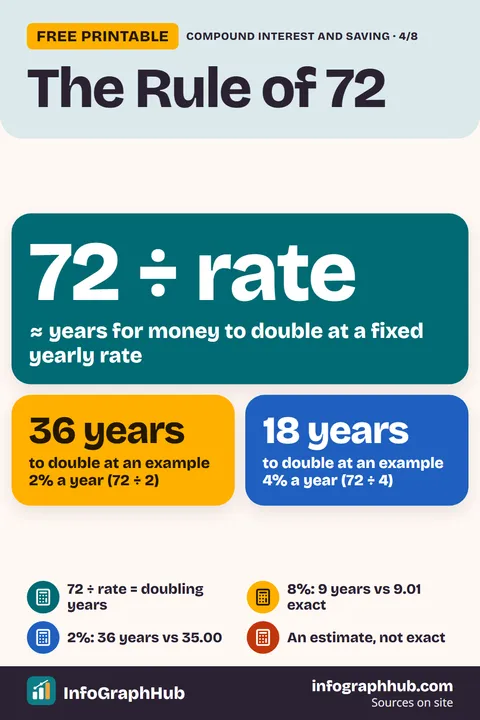
The Rule of 72 is a mental shortcut: divide 72 by the yearly rate in per cent to estimate how many years a balance takes to double. At an example 9% a year, 72 ÷ 9 = 8 years.
It is an approximation. The exact doubling time solves (1 + r)^t = 2, which gives t = log 2 ÷ log(1 + r):
| Example rate | Rule of 72 | Exact |
|---|---|---|
| 2% | 36 years | 35.00 years |
| 4% | 18 years | 17.67 years |
| 6% | 12 years | 11.90 years |
| 8% | 9 years | 9.01 years |
| 9% | 8 years | 8.04 years |
| 12% | 6 years | 6.12 years |
The rule is within 3% of the exact answer across this range. It is most accurate near 8%, slightly too high at low rates and slightly too low at high ones. 72 is used because it is close to the 'perfect' number for common rates and divides neatly by 2, 3, 4, 6, 8, 9 and 12. The same rule works for anything that grows by a fixed percentage, including prices: at an example 3% inflation, prices double in about 24 years.
See the infographic: Part 4, The Rule of 72: How Long Does Money Take to Double? →
Inflation and the real value of money
Inflation is the rate at which prices rise, and prices compound just as savings do. The Bank of England's simple picture is that at 2% inflation, a basket of goods that cost 100 a year ago costs 102 today.
So a growing balance does not always mean growing buying power. What matters is the real return: roughly the interest rate minus inflation, or exactly (1 + rate) ÷ (1 + inflation) − 1. With example figures of 5% interest and 3% inflation, the real return is about 2% (exactly 1.94%). With 3% interest and 4% inflation it is about −1%: the number in the account grows, but it buys less.
Over long periods the effect is large. At an example 3% inflation, 1,000 kept as cash for 10 years would buy only what about 744 buys today, because 1,000 ÷ 1.03¹⁰ = 744.09.
See the infographic: Part 5, Compound Interest Key Terms: APR, AER, APY and More →
Compound interest in everyday life
Compounding works for whoever is receiving the interest and against whoever is paying it.
- Savings accounts that add interest to the balance compound. At an example 3% a year, 1,000 becomes 1,343.92 after ten years if nothing is taken out.
- Time is the strongest ingredient. At an example 5% a year, 1,000 left for 40 years grows to 7,039.99, against 2,653.30 after 20 years. Starting earlier gives compounding more years to work.
- Loans charge interest on what is still owed. Repayments shrink the balance; unpaid interest added to the debt makes it grow.
- Credit cards often compound daily. The US Consumer Financial Protection Bureau explains that many issuers divide the APR by 360 or 365, charge that rate each day and add it to the balance. At an example 20% APR, an unpaid 1,000 with no payments would grow to about 1,221.34 in a year: 22.13%, not 20%. Real cards also require minimum payments and may add fees.
- Student loans in many countries charge interest. In some schemes, such as England's, it is added from the first payment, even while the student is still studying. The rules differ widely.
- Decay follows the same maths in reverse. A car worth 10,000 that loses an example 15% of its value each year is worth 10,000 × 0.85³ = 6,141.25 after 3 years.
See the infographic: Part 6, Compound Interest in Everyday Life →
Common mistakes to avoid
Most compound interest errors come from an input in the wrong form:
- Adding instead of multiplying. 1,000 at 5% for 3 years is not 1,000 + 3 × 50 = 1,150; it is 1,000 × 1.05³ = 1,157.63.
- Leaving the % as a whole number. In the formula, 5% must be 0.05. Using 5 turns the multiplier into 6 and gives an absurd 216,000.
- Mixing a yearly rate with monthly periods. For 6% a year added monthly over 2 years, use 1.005^24 (1,127.16 from 1,000), not 1.06^24 (4,048.93).
- Comparing unlike rates. 4.9% a year added monthly has an AER of 5.01%, so it beats a 5% AER account, even though 4.9 looks smaller. An APR belongs only with other APRs.
- Ignoring inflation. Savings that grow 3% while prices rise 4% buy about 1% less.
The best defence is an estimate before you calculate: three years at 5% should add a little more than 15%, not hundreds of times the starting amount.
See the infographic: Part 7, Common Compound Interest Mistakes and How to Avoid Them →
Why it matters, and what this series is not
Compound interest is one of the most useful pieces of maths for everyday life. It explains why time matters so much for savers, why unpaid debts can grow quickly, and why prices and the value of money change the way they do. It is also the classic example of exponential growth, which turns up across science, from bacteria multiplying to radioactive decay.
This series is financial education: it explains how the maths works using example rates and amounts in any currency. It is not financial advice, it does not recommend any product, and it makes no promise about future returns. Real interest rates change, and investments can fall in value as well as rise. For decisions about your own money, speak to a regulated, independent adviser in your country.
Ready to check what you have learned? The quiz covers every part of this guide.
See the infographic: Part 8, Compound Interest Quiz: Test Yourself →
Frequently asked questions
How do you calculate compound interest?
Use A = P(1 + r/n)^(nt): P is the starting amount, r the yearly rate as a decimal, n how many times a year interest is added and t the number of years. For 1,000 at an example 5% a year added yearly for 3 years, A = 1,000 × 1.05³ = 1,157.63, so the interest is 157.63.
What is the difference between simple and compound interest?
Simple interest is worked out only on the original amount, so it is the same every year. Compound interest is worked out on the original amount plus interest already added, so it grows every year. At an example 5% for 20 years, 1,000 becomes 2,000 with simple interest and 2,653.30 with compound interest.
What is the Rule of 72, and is it accurate?
It estimates how long money takes to double: divide 72 by the yearly rate in per cent. It is an approximation, within about 3% of the exact answer for rates from 2% to 12%. At 8% it gives 9 years against an exact 9.01; at 2% it gives 36 against 35.00.
What is the difference between APR, AER and APY?
APR is used for borrowing and shows the yearly cost of a loan or card, usually including some fees. AER (UK) and APY (US) are two names for the same savings idea: the yearly interest rate after compounding. Compare APR with APR and AER or APY with each other.
How does inflation affect savings?
Inflation means prices rise, so the same money buys less. If savings grow more slowly than prices, their real value falls even though the balance goes up. With example figures of 3% interest and 4% inflation, savings buy about 1% less after a year.
Is this series financial advice?
No. It is financial education that explains how the maths of interest works, using example rates and amounts in any currency. It does not recommend products or predict returns. For decisions about your own money, speak to a regulated, independent adviser in your country.
Sources & methodology
Every fact is checked against the sources below. We write original explanations and draw original graphics; no figures are copied from textbooks. Spotted an error? See our corrections policy.
- What is compound interest? (Investor.gov, US Securities and Exchange Commission, accessed 1 Oct 2026)
- Compound Interest Calculator (Investor.gov, US Securities and Exchange Commission, accessed 1 Oct 2026)
- Interest rates explained (MoneyHelper (UK Money and Pensions Service), accessed 1 Oct 2026)
- What is inflation? (Bank of England, accessed 1 Oct 2026)
- What are interest rates? (Bank of England, accessed 1 Oct 2026)
- Repeated percentage change, interest and exponential change (BBC Bitesize, accessed 1 Oct 2026)
- The rule of 72 for compound interest (Khan Academy, accessed 1 Oct 2026)
- Annual Equivalent Rate (AER) Practice Note (January 2025) (UK Finance and the Building Societies Association, accessed 1 Oct 2026)
- What is a "daily periodic rate" on a credit card? (US Consumer Financial Protection Bureau, accessed 1 Oct 2026)
- Appendix A to Part 1030 (Regulation DD): Annual Percentage Yield Calculation (US Consumer Financial Protection Bureau, accessed 1 Oct 2026)
Editorial review pending · Updated
For teachers and parents: new InfoGraphHub resources by email
One short email when new free resources go live. For adults (18+) only. No spam, no tracking in emails, unsubscribe anytime.