FinanceQuizPart 8 of 8, Compound Interest and SavingUpdated 1 October 2026
Compound Interest Quiz: Test Yourself
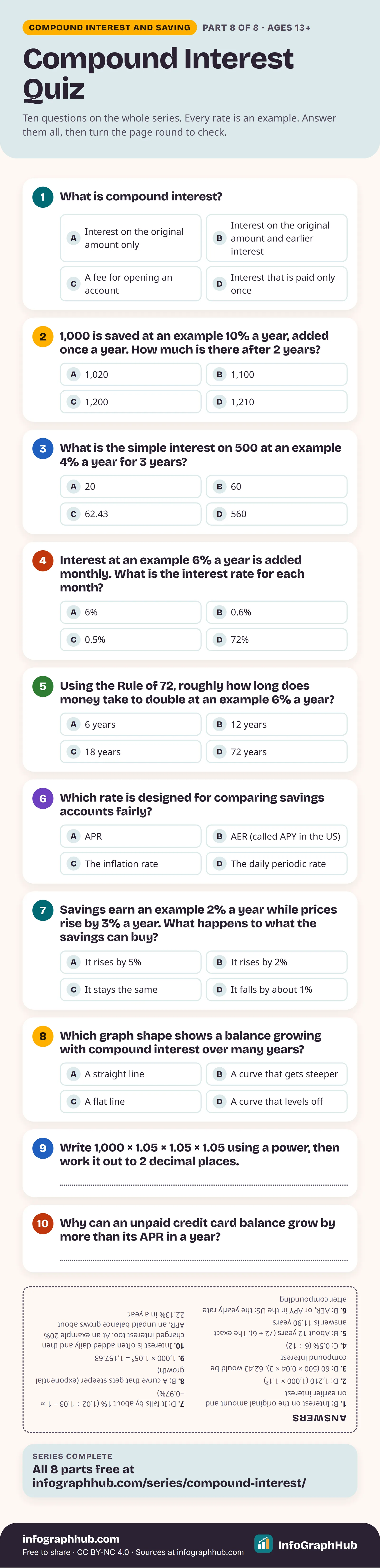
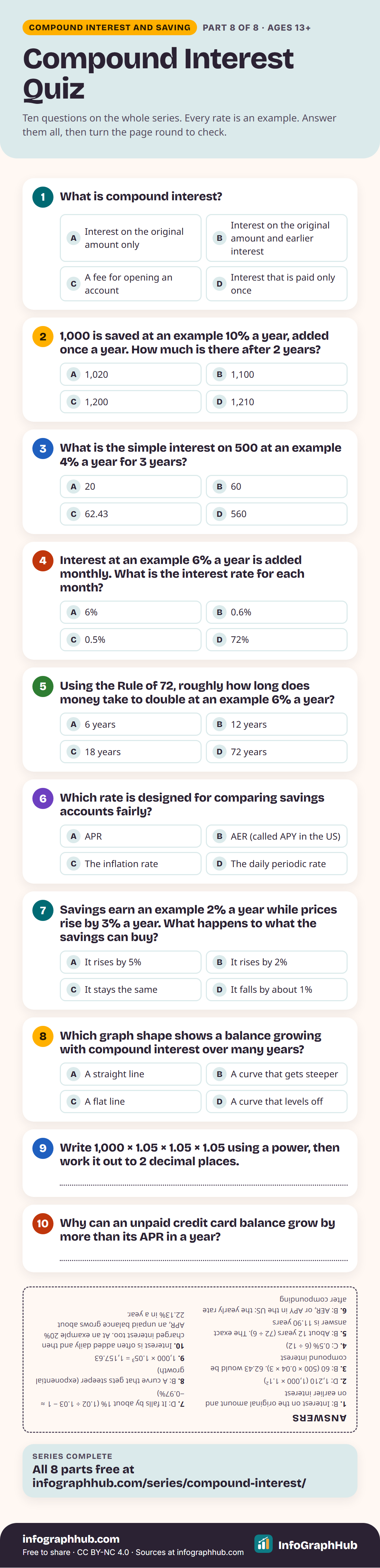
Ten questions covering the whole Compound Interest and Saving series: what compounding means, calculating balances, simple interest, monthly rates, the Rule of 72, AER and APY, inflation, growth curves and credit card debt, with worked answers.
Use this infographic
Free under CC BY-NC 4.0, with credit to InfoGraphHub.
How to use this quiz
Try all ten questions before you look at the answers. Questions 1 to 8 are multiple choice; questions 9 and 10 need a short written answer. The answers are printed upside down at the foot of the infographic. The worked answers below explain why each answer is right, and which part of the series to revisit if you got it wrong. Every rate in the quiz is an example, and amounts work in any currency.
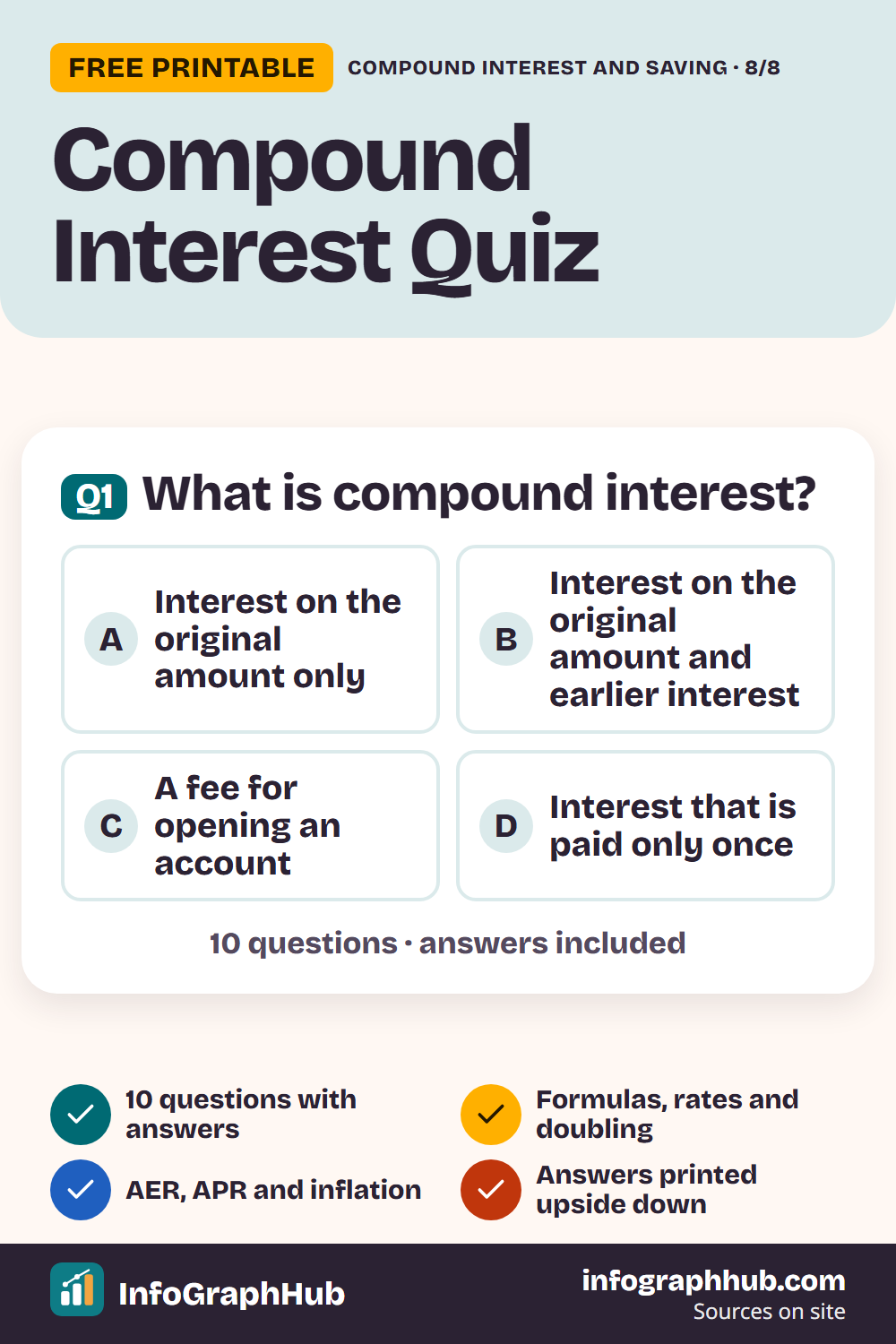
1. What compound interest is
Answer: B. Compound interest is worked out on the original amount and on the interest already added, so interest earns interest. Option A describes simple interest. Revisit Part 1, Compound Interest Explained.
2. Two years at 10%
Answer: D, 1,210. After one year, 1,000 grows by 100 to 1,100. In year 2 the interest is 10% of 1,100, which is 110, giving 1,210. In one step: 1,000 × 1.1² = 1,210. Option C, 1,200, is the simple interest answer. See Part 2, How to Calculate Compound Interest.
3. Simple interest
Answer: B, 60. Simple interest = principal × rate × time = 500 × 0.04 × 3 = 60, the same 20 every year. Option D, 560, is the total amount, not the interest. Option C, 62.43, is what compound interest would give: 500 × 1.04³ = 562.43. Part 3 compares the two methods side by side.
4. A monthly rate
Answer: C, 0.5%. When a yearly rate is added n times a year, the rate for each period is r ÷ n. Here 6% ÷ 12 = 0.5% a month, or 0.005 as a decimal. Using 6% every month is one of the mistakes in Part 7.
5. The Rule of 72
Answer: B, about 12 years. 72 ÷ 6 = 12. The exact doubling time, log 2 ÷ log 1.06, is 11.90 years, so the rule is a close estimate but not exact. Part 4 compares the rule with the exact answer at six rates.
6. Comparing savings rates
Answer: B, the AER. The annual equivalent rate (UK), called the annual percentage yield or APY in the US, shows the yearly rate as if interest were added once a year, so accounts that add interest at different times can be compared. An APR is for borrowing. See Part 5, Compound Interest Key Terms.
7. Interest and inflation
Answer: D, it falls by about 1%. The balance grows by 2%, but prices grow by 3%, so the money buys less. Exactly: 1.02 ÷ 1.03 − 1 ≈ −0.97%. This is a negative real return, covered in Parts 5 and 7.
8. The shape of the graph
Answer: B, a curve that gets steeper. Compound interest multiplies the balance by the same factor each period, which is exponential growth. A straight line (option A) is simple interest. See the chart in Part 1.
9. Writing it as a power
Model answer: 1,000 × 1.05³ = 1,157.625, which is 1,157.63 to 2 decimal places. This is 1,000 saved for 3 years at an example 5% a year with interest added yearly, the first worked example in Part 2.
10. Credit card debt
Model answer: Many card issuers divide the APR by 365 (or 360), charge that daily rate on the balance, and add the interest to the balance, so the next day's interest includes interest on interest. Over a year, an unpaid balance at an example 20% APR grows by about 22.13%, not 20%. A full answer mentions that interest is added to the balance and charged interest itself. See Part 6.
This quiz tests understanding of the maths. It is financial education, not financial advice.
Frequently asked questions
Which parts of the series does the quiz cover?
All of them: what compound interest is, how to calculate it, simple versus compound interest, the Rule of 72, key terms such as AER and APR, compound interest in everyday life and common mistakes.
How can teachers use this quiz in class?
As a starter or plenary, as a check at the end of a percentages or financial-maths unit, or as homework. Students can mark each other's answers using the answer strip, then use the worked answers to discuss any they got wrong.
Do I need a calculator?
Most questions can be done in your head or with quick written working. A calculator helps with question 9 and with checking the exact figures mentioned in the worked answers.
What should I do if I get a question wrong?
Read the worked answer, then go back to the part of the series it points to. For example, a wrong answer on the monthly rate points to Part 2 (how to calculate) and Part 7 (common mistakes).
Sources & methodology
Every fact is checked against the sources below. We write original explanations and draw original graphics; no figures are copied from textbooks. Spotted an error? See our corrections policy.
- What is compound interest? (Investor.gov, US Securities and Exchange Commission, accessed 1 Oct 2026)
- Repeated percentage change, interest and exponential change (BBC Bitesize, accessed 1 Oct 2026)
- The rule of 72 for compound interest (Khan Academy, accessed 1 Oct 2026)
- Annual Equivalent Rate (AER) Practice Note (January 2025) (UK Finance and the Building Societies Association, accessed 1 Oct 2026)
- What is a "daily periodic rate" on a credit card? (US Consumer Financial Protection Bureau, accessed 1 Oct 2026)
- What is inflation? (Bank of England, accessed 1 Oct 2026)
Editorial review pending · Updated
Made by the InfoGraphHub editorial team (how we research and check: editorial and AI policy). First published 2 October 2026, last reviewed 1 October 2026. Found a mistake? Tell the editors.
For teachers: ages and curriculum fit
Ages 13+ · Grades 8–12 (US) · Years 9–13 (UK) · Classes 8–12 (India)
Embed this on your site
Paste this HTML into your page. Keep the credit line: it is required by the CC BY-NC 4.0 license.
Related infographics


For teachers and parents: new InfoGraphHub resources by email
One short email when new free resources go live. For adults (18+) only. No spam, no tracking in emails, unsubscribe anytime.