FinanceWorked examplePart 2 of 8, Compound Interest and SavingUpdated 1 October 2026
How to Calculate Compound Interest: Worked Examples
Three worked examples of calculating compound interest: 1,000 at an example 5% year by year for 3 years, the multiplier shortcut for 10 years, and the formula A = P(1 + r/n)^(nt) with interest added monthly.
Use this infographic
Free under CC BY-NC 4.0, with credit to InfoGraphHub.
Two ways to do the same calculation
There are two ways to work out compound interest, and they always give the same answer.
- Year by year. Work out the interest for one period, add it to the balance, then repeat with the new balance. This shows exactly what is happening, but it is slow for long periods.
- With a multiplier. Turn the percentage into a single number, then multiply by it once for every period. On a calculator this takes one line, however many years there are.
Learn the first method to understand compounding and the second to calculate quickly. Use the first to check the second when you are unsure.
The year-by-year method
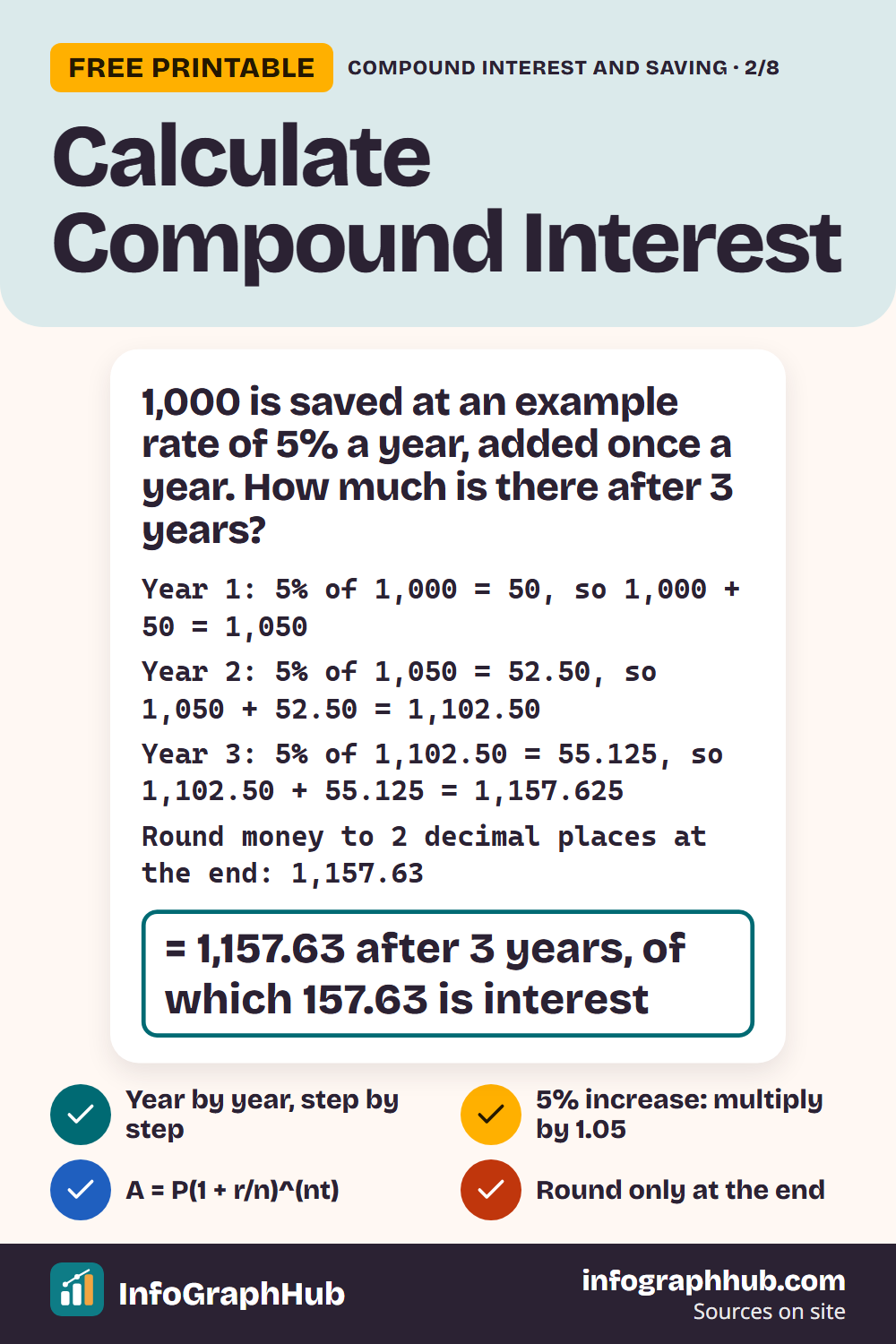
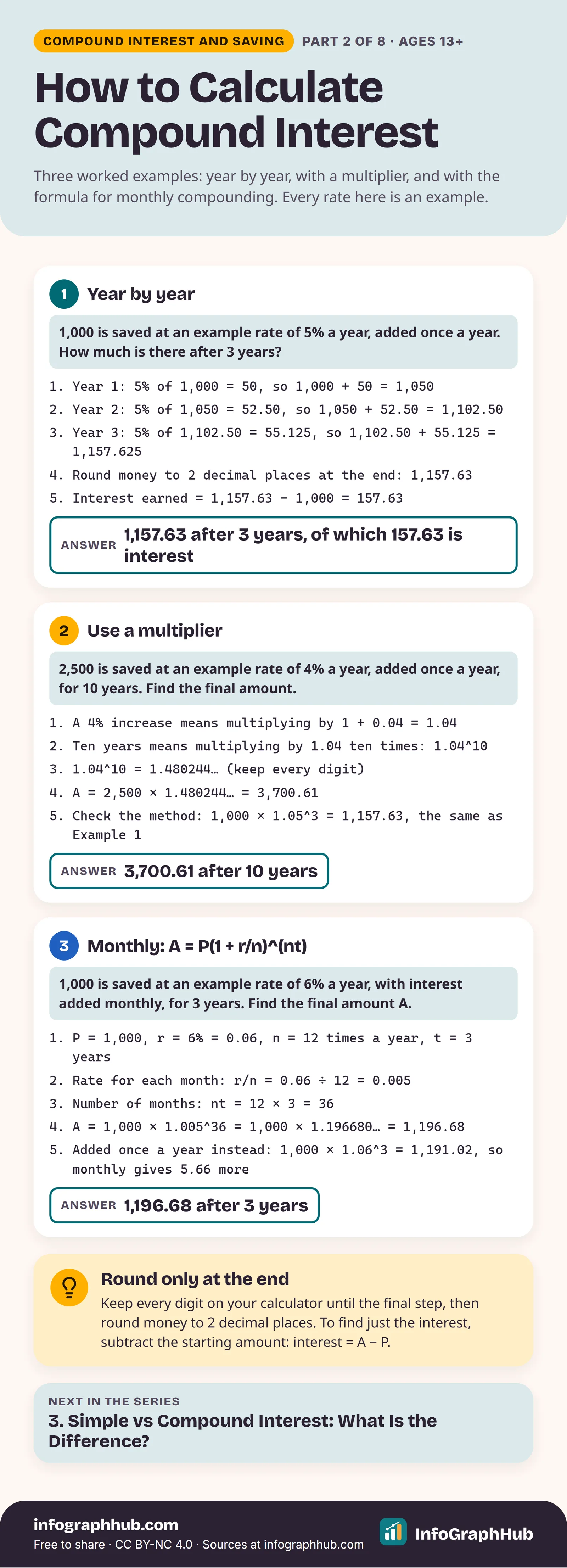
In Example 1, 1,000 earns an example 5% a year. In the first year, the interest is 5% of 1,000, which is 50. The new balance, 1,050, is what earns interest in year 2, so the second year's interest is 52.50, not 50. In year 3 it is 55.125.
That growing interest, 50, then 52.50, then 55.125, is compounding at work: each year's interest is a little bigger because it is worked out on a bigger balance. After 3 years the total is 1,157.625, which rounds to 1,157.63.
Turning a percentage into a multiplier
Increasing an amount by 5% is the same as multiplying it by 1.05: the 1 keeps the amount you already have, and the 0.05 adds 5%. To find the multiplier for any rate, divide the percentage by 100 and add 1.
| Example rate | As a decimal | Multiplier |
|---|---|---|
| 2% | 0.02 | 1.02 |
| 4% | 0.04 | 1.04 |
| 5% | 0.05 | 1.05 |
| 12.5% | 0.125 | 1.125 |
Repeated multiplication is written with a power. Three years at 5% is 1.05 × 1.05 × 1.05 = 1.05³, so the amount is 1,000 × 1.05³ = 1,157.63, exactly as in the year-by-year table. In general, with interest added once a year, A = P × (1 + r)^t, where r is the yearly rate as a decimal and t is the number of years.
The general formula
Interest is often added more than once a year. The general formula is:
A = P(1 + r/n)^(nt)
- A is the final amount.
- P is the principal, the amount you start with.
- r is the yearly interest rate as a decimal (6% is 0.06).
- n is how many times a year interest is added: 1 for yearly, 2 for half-yearly, 4 for quarterly, 12 for monthly and 365 for daily.
- t is the time in years.
The two parts work together. r/n is the rate for one period, and nt is the number of periods. In Example 3, 6% a year added monthly means 0.5% a month for 36 months.
How much difference does adding interest more often make?
Here is 1,000 at an example 6% a year for 3 years, with only the frequency changed:
| Interest added | Final amount |
|---|---|
| Yearly (n = 1) | 1,191.02 |
| Half-yearly (n = 2) | 1,194.05 |
| Quarterly (n = 4) | 1,195.62 |
| Monthly (n = 12) | 1,196.68 |
| Daily (n = 365) | 1,197.20 |
More frequent compounding always gives a little more, because each piece of interest starts earning sooner. But the gains shrink: going from monthly to daily adds only 0.52 here. The rate and the time matter far more than the frequency.
Working backwards
Because compounding is multiplication, you can undo it by dividing. How much must be saved today to reach 1,157.63 in 3 years at an example 5% a year? Divide by the multiplier: 1,157.63 ÷ 1.05³ = 1,000.00 (to the nearest hundredth).
These examples use fixed example rates so the maths is clear; real rates change. This page is financial education, not financial advice.
Frequently asked questions
What is the formula for compound interest?
A = P(1 + r/n)^(nt), where A is the final amount, P the starting amount, r the yearly rate as a decimal, n the number of times interest is added each year and t the number of years. With interest added once a year it simplifies to A = P(1 + r)^t.
How do I calculate compound interest monthly?
Divide the yearly rate by 12 to get the monthly rate, and multiply the number of years by 12 to get the number of months. For an example 6% a year over 3 years: 1,000 × (1 + 0.06/12)^36 = 1,000 × 1.005^36 = 1,196.68.
How do I find just the interest, not the total?
Work out the final amount A, then subtract the starting amount P. For 1,000 at 5% a year for 3 years, A = 1,157.63, so the interest is 1,157.63 − 1,000 = 157.63.
Should I round each year's answer?
It is better not to. Keep every digit on your calculator and round only the final answer to 2 decimal places. Rounding at each step can make the final amount slightly wrong, especially over many periods.
Sources & methodology
Every fact is checked against the sources below. We write original explanations and draw original graphics; no figures are copied from textbooks. Spotted an error? See our corrections policy.
- Repeated percentage change, interest and exponential change (BBC Bitesize, accessed 1 Oct 2026)
- Compound Interest Calculator (Investor.gov, US Securities and Exchange Commission, accessed 1 Oct 2026)
- Compound interest introduction (Khan Academy, accessed 1 Oct 2026)
Editorial review pending · Updated
Made by the InfoGraphHub editorial team (how we research and check: editorial and AI policy). First published 2 October 2026, last reviewed 1 October 2026. Found a mistake? Tell the editors.
For teachers: ages and curriculum fit
Ages 13+ · Grades 8–12 (US) · Years 9–13 (UK) · Classes 8–12 (India)
Common Core State Standards © Copyright 2010 National Governors Association Center for Best Practices and Council of Chief State School Officers. All rights reserved. Names and codes are used only to describe curriculum fit; InfoGraphHub is not endorsed by these organisations.
Embed this on your site
Paste this HTML into your page. Keep the credit line: it is required by the CC BY-NC 4.0 license.
Related infographics


For teachers and parents: new InfoGraphHub resources by email
One short email when new free resources go live. For adults (18+) only. No spam, no tracking in emails, unsubscribe anytime.