FinanceVisual listPart 6 of 8, Compound Interest and SavingUpdated 1 October 2026
Compound Interest in Everyday Life
Seven places compound growth shows up in real life, with illustrative numbers: savings accounts, loans, credit card debt that compounds against you, student loans, inflation eating savings, starting early versus late, and things that lose value.
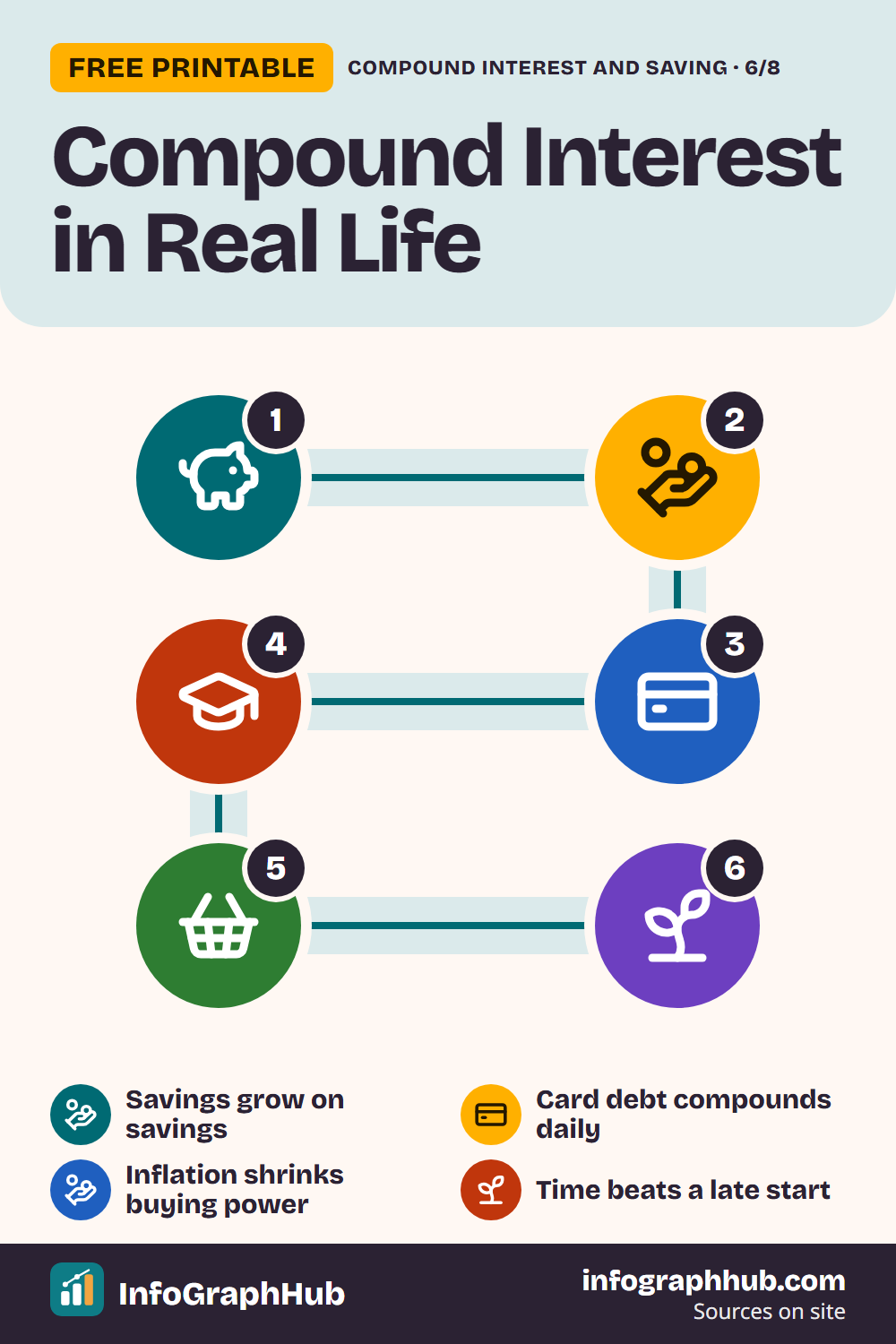
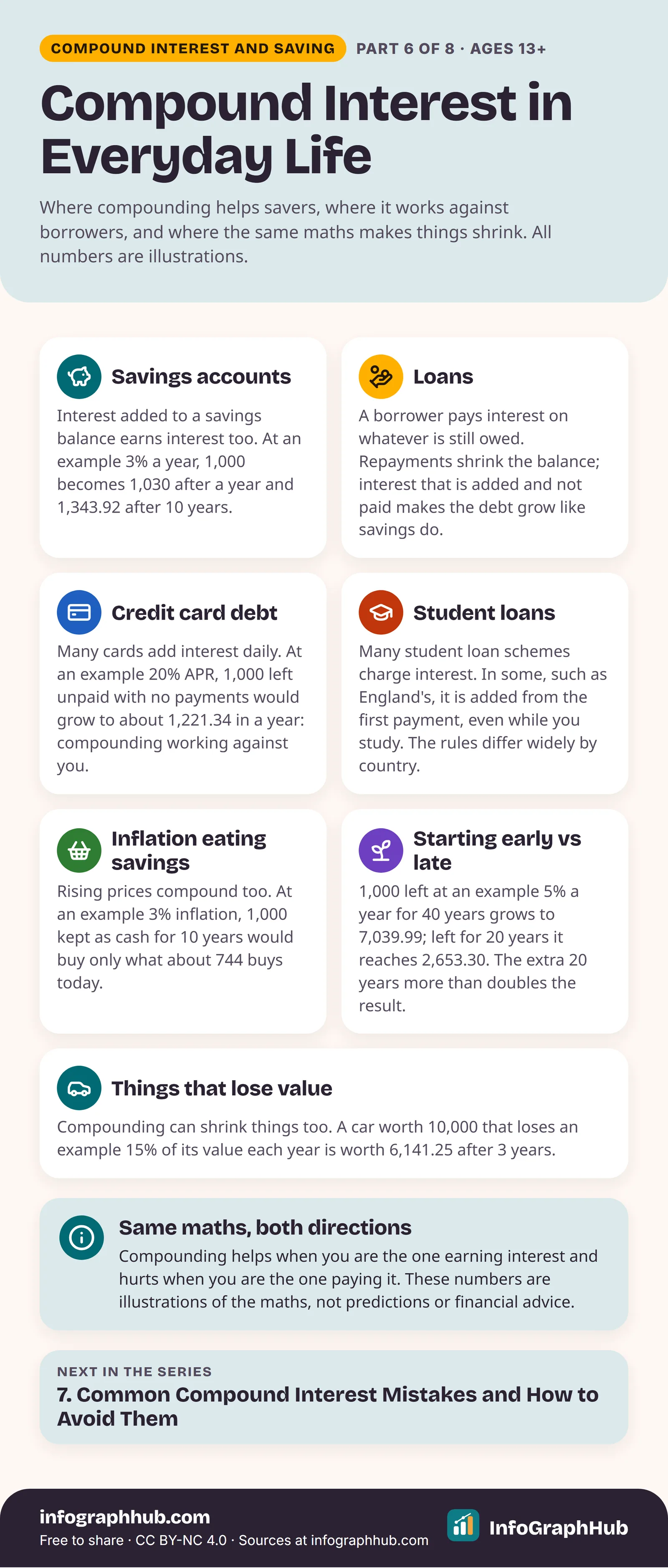
Use this infographic
Free under CC BY-NC 4.0, with credit to InfoGraphHub.
Compounding is all around you
Compound interest is not just a topic in a maths textbook. The same rule, a fixed percentage applied again and again to a changing amount, decides how savings grow, how debts build up, what money is worth in the future and how fast some things lose value.
Every number on this page is an illustration with an example rate, chosen to show how the maths behaves. Real rates differ between countries and products, and they change over time.
Saving: compounding on your side
When a savings account adds interest to the balance, that interest earns interest in later years. At an example 3% a year, 1,000 grows to 1,030 after one year and 1,343.92 after ten years, provided nothing is taken out. The longer the money stays, the more of the growth comes from interest on earlier interest.
The US Securities and Exchange Commission's teaching page on compound interest makes the same point for young people: starting young gives compounding longer to work. Here, 1,000 left for 40 years at an example 5% a year becomes 7,039.99, while the same 1,000 left for 20 years becomes 2,653.30.
Borrowing: compounding against you
When you borrow, the lender charges interest on the amount still owed. Regular repayments reduce that amount, so each later interest charge is smaller. If interest is added to the debt and not paid off, the opposite happens: the borrower pays interest on interest.
Credit cards show this clearly. The US Consumer Financial Protection Bureau explains that many issuers divide the yearly rate (APR) by 360 or 365 to get a daily rate, charge it on the balance each day, and add it to the next day's balance, so interest compounds daily. With an example APR of 20% and daily compounding, 1,000 left completely unpaid would grow to about 1,221.34 after a year, a rise of 22.13%, not 20%. This is only an illustration: real cards also require minimum payments and can add fees.
Student loans work differently in different countries. In England, for example, the government explains that interest is added to the amount owed even when a borrower's income is too low to make repayments, and on some plans it is charged while the student is still studying.
Inflation: the quiet compounding
Prices compound too. The Bank of England describes inflation as the rate at which prices rise. If prices rise by an example 3% every year, something that costs 1,000 today costs 1,000 × 1.03¹⁰ = 1,343.92 in ten years. Turned around, 1,000 kept as cash would then buy only what about 744.09 buys today, because 1,000 ÷ 1.03¹⁰ = 744.09.
That is why savers look at the real return: interest that grows more slowly than prices still leaves the money buying less.
Compound decay
The same maths works in reverse when something loses a fixed percentage each year. A car worth 10,000 that loses an example 15% of its value a year is multiplied by 0.85 each year: 10,000 × 0.85³ = 6,141.25 after 3 years. Mathematicians call this exponential decay, and you meet it in science too, with radioactive decay and cooling drinks.
The lesson from every example is the same: the rate and the time matter, and a small percentage repeated many times adds up to a large change. This page is financial education about how compounding works, not financial advice.
Frequently asked questions
Where is compound interest used in real life?
In savings accounts that add interest to the balance, in loans and credit cards when interest is added to what is owed, in student loans in many countries, and in anything that changes by a fixed percentage each period, such as prices rising with inflation or a car losing value.
How does compound interest work on a credit card?
Many card issuers turn the yearly APR into a daily rate and add interest to the balance every day, so interest is charged on earlier interest. With an example 20% APR, an unpaid 1,000 would grow by about 22.13% in a year, not 20%.
How does inflation affect savings?
Inflation means prices rise, so the same money buys less. At an example 3% inflation, 1,000 kept as cash for 10 years would buy only what about 744 buys today. Savings keep their buying power only if they grow at least as fast as prices.
Why does starting early make such a difference?
Because compounding multiplies the balance again every year, the last years add the most. At an example 5% a year, 1,000 left for 40 years becomes 7,039.99, compared with 2,653.30 after 20 years.
Sources & methodology
Every fact is checked against the sources below. We write original explanations and draw original graphics; no figures are copied from textbooks. Spotted an error? See our corrections policy.
- What is compound interest? (Investor.gov, US Securities and Exchange Commission, accessed 1 Oct 2026)
- What is a "daily periodic rate" on a credit card? (US Consumer Financial Protection Bureau, accessed 1 Oct 2026)
- Repaying your student loan: what you pay (GOV.UK, accessed 1 Oct 2026)
- What is inflation? (Bank of England, accessed 1 Oct 2026)
- Repeated percentage change, interest and exponential change (BBC Bitesize, accessed 1 Oct 2026)
Editorial review pending · Updated
Made by the InfoGraphHub editorial team (how we research and check: editorial and AI policy). First published 2 October 2026, last reviewed 1 October 2026. Found a mistake? Tell the editors.
For teachers: ages and curriculum fit
Ages 13+ · Grades 8–12 (US) · Years 9–13 (UK) · Classes 8–12 (India)
Embed this on your site
Paste this HTML into your page. Keep the credit line: it is required by the CC BY-NC 4.0 license.
Related infographics


For teachers and parents: new InfoGraphHub resources by email
One short email when new free resources go live. For adults (18+) only. No spam, no tracking in emails, unsubscribe anytime.