9-part series · Ages 11–16
World War I
Nine infographics on the war of 1914–1918: why it began, how it unfolded, who fought it and what it changed.
Complete pack: all 9 parts in one PDF
Printable, with the quiz answers. Free under CC BY-NC 4.0.
The 9 parts
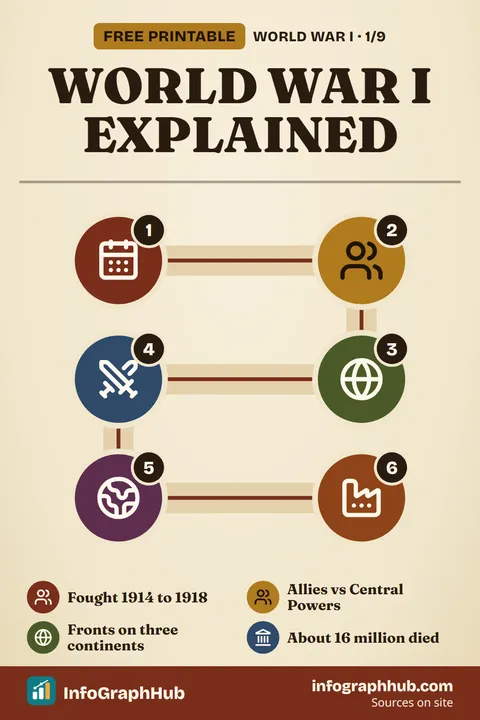 Overview
World War I Explained
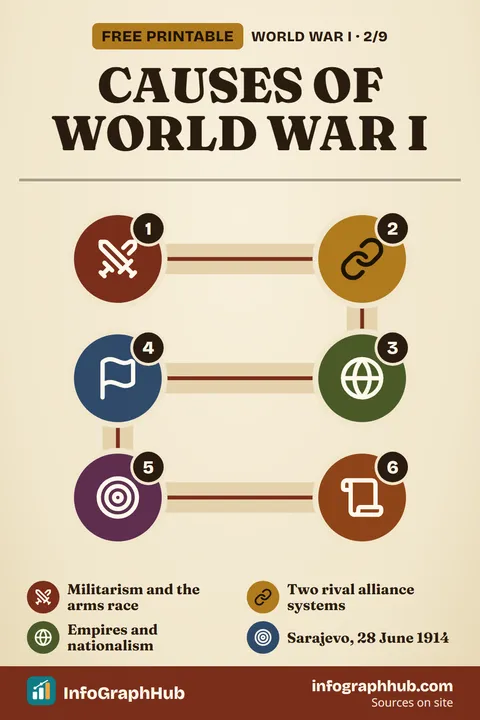 Causes
 of World War I
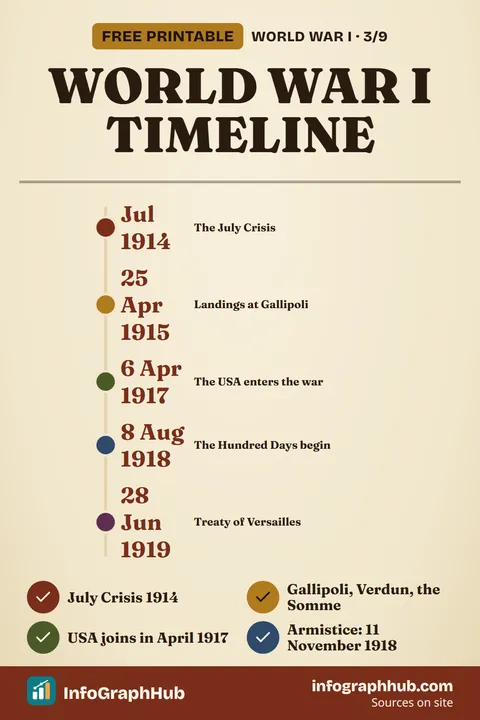 Timeline
World War I Timeline
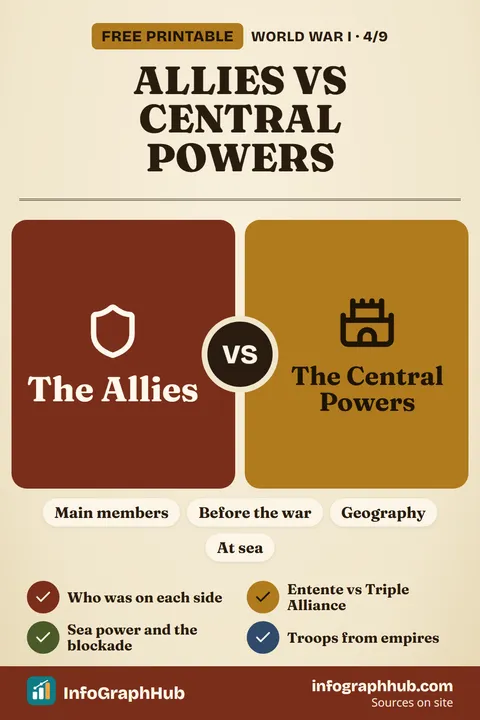 Compare
The Allies vs the Central Powers
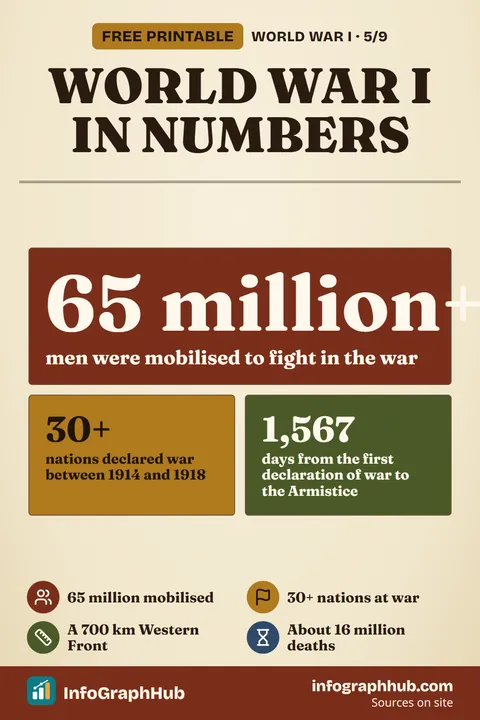 Key numbers
World War I by the Numbers
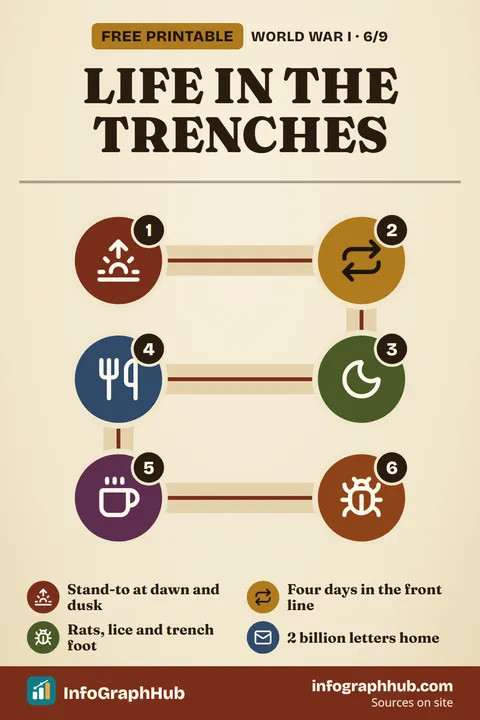 In everyday life
Life in the Trenches in World War I
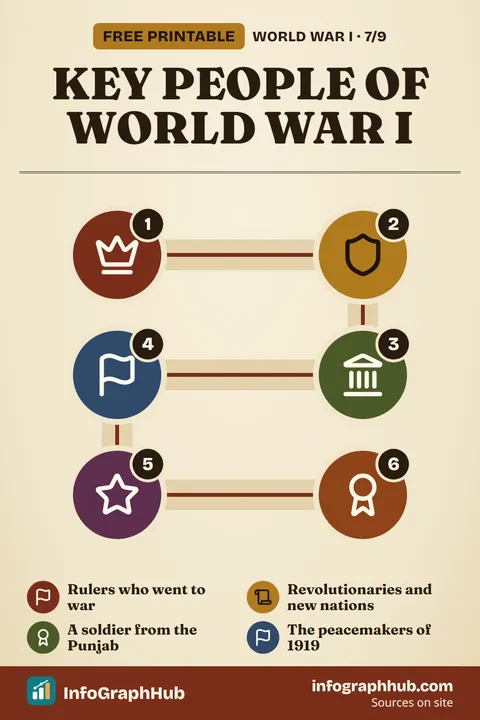 Key people
Key People of World War I
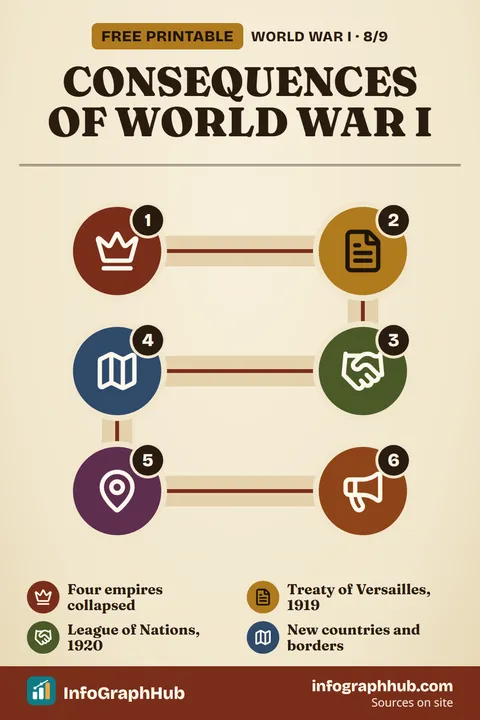 Consequences
 of World War I
 Quiz
World War I Quiz: Test Yourself


Watch the whole series

The complete guide
World War I explained
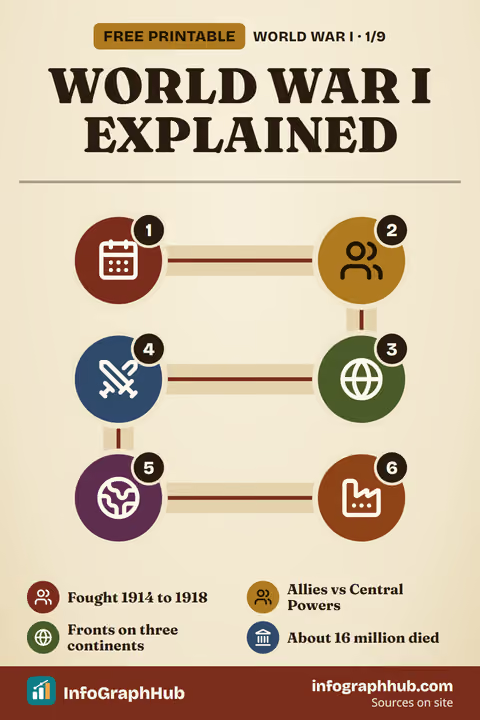
World War I, the Great War of 1914–1918, drew in more than 30 nations and soldiers from every inhabited continent. This series takes it one question at a time: why it started, how it unfolded year by year, who was on each side, how big it really was, what daily life in the trenches was like, which people shaped it and how it changed the world.
Each part is a printable infographic with named sources, written for ages 11–16 and their teachers. It tells the story from many sides, including Ottoman, Russian, Indian, African and Asian experiences as well as British, French, German and American ones. Work through the parts in order or jump to the one you need, then test yourself with the quiz at the end.
What World War I was
World War I, also called the First World War or the Great War, was fought between 28 July 1914, when Austria-Hungary declared war on Serbia, and 11 November 1918, when an armistice stopped the fighting on the Western Front at 11am. The main peace treaty, the Treaty of Versailles, was signed on 28 June 1919.
It began as a quarrel in south-east Europe but became a world war within days, because the great powers that joined in ruled empires across the globe. According to the Imperial War Museums (IWM), more than 30 nations declared war and more than 65 million men were mobilised. Fighting took place in Western and Eastern Europe, Italy, the Balkans, the Middle East and Africa, at sea and, on a large scale for the first time, in the air.
It was also a total war. Governments took control of industry, food and transport; women took on work that men had left; and civilians faced blockade, occupation, hunger and air raids. Historians use the war to explain much of what followed in the twentieth century.
Why the war began
Historians separate long-term causes from the trigger. The long-term causes are often remembered as MAIN:
- Militarism: the great powers built huge armies and planned for a short war, and Britain and Germany raced to build battleships after HMS Dreadnought was launched in 1906.
- Alliances: Germany allied with Austria-Hungary in 1879 and Italy joined them in 1882; France and Russia allied in the 1890s; Britain reached agreements with France in 1904 and Russia in 1907.
- Imperialism: Britain and France ruled vast empires, while Germany, united only in 1871, wanted colonies too. Crises over Morocco in 1905 and 1911 raised tension.
- Nationalism: in the Balkans, Serbia's hopes of uniting the South Slavs threatened Austria-Hungary, which had annexed Bosnia in 1908.
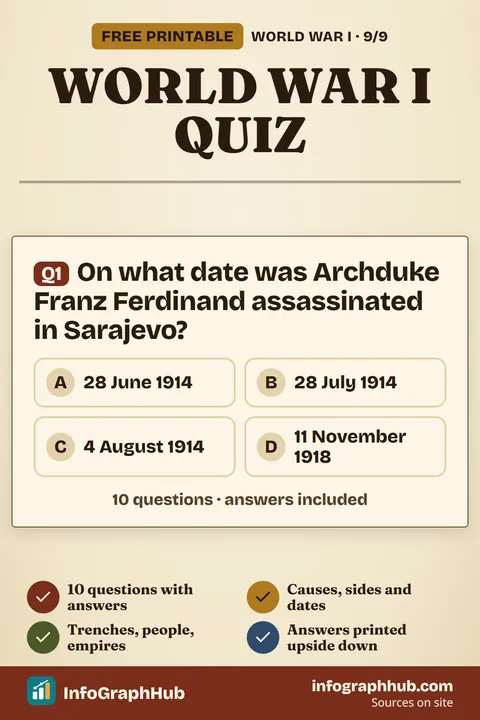
The trigger came on 28 June 1914, when Gavrilo Princip, a 19-year-old Bosnian Serb nationalist, shot Archduke Franz Ferdinand, heir to Austria-Hungary's throne, and his wife Sophie in Sarajevo. In the July Crisis that followed, Germany promised Austria-Hungary its support on 5 July, Austria-Hungary sent Serbia an ultimatum on 23 July and declared war on 28 July, and Russia began to mobilise. Germany declared war on Russia on 1 August and France on 3 August, and its plan to defeat France quickly took its armies through neutral Belgium. Britain, which had guaranteed Belgian neutrality in 1839, declared war on 4 August.
Historians still argue about who was most to blame. IWM stresses that the war was neither inevitable nor accidental but the result of decisions made by leaders in several capitals.
How the war unfolded, 1914–1919
1914. Germany's advance through Belgium was stopped at the Battle of the Marne in September. Both sides dug in, and trenches soon ran from the Channel coast to Switzerland. In the east, Russia was heavily defeated at Tannenberg.
1915. The Allies tried to break the deadlock elsewhere. On 25 April British, French, Australian and New Zealand troops landed at Gallipoli, but Ottoman forces held them, and the last Allied troops left on 9 January 1916. Italy joined the Allies in May and Bulgaria joined the Central Powers in October.
1916. Germany attacked Verdun on 21 February, and the battle lasted until December. Britain and France attacked on the Somme on 1 July; in 141 days more than a million men were killed, wounded or captured. The British and German fleets fought at Jutland.
1917. Germany's unrestricted submarine warfare and the Zimmermann Telegram brought the United States into the war on 6 April. Russia had two revolutions: the first, in March, ended the Tsar's rule, and in the second, on 7 November, Lenin's Bolsheviks took power. (Russia's old calendar is why these are called the February and October Revolutions.)
1918. Russia made peace at Brest-Litovsk on 3 March. Germany's spring offensives gained ground but stalled, and from 8 August the Allied Hundred Days Offensive pushed the German army back. Bulgaria, the Ottoman Empire and Austria-Hungary stopped fighting, the Kaiser abdicated on 9 November, and the Armistice began at 11am on 11 November.
1919. The Paris Peace Conference opened in January, and Germany signed the Treaty of Versailles on 28 June 1919, five years to the day after the Sarajevo assassination.
The two sides
The Allies began as France, the British Empire, Russia, Serbia, Belgium and Japan, joined by Italy in 1915 and the United States in 1917, which fought as an 'associated power'. The Treaty of Versailles lists 27 Allied and Associated Powers, including Brazil, China, Liberia and Siam. The Central Powers were Germany, Austria-Hungary, the Ottoman Empire and Bulgaria.
The Central Powers held a connected block of land across the middle of Europe to the Middle East, but had to fight on several fronts and were cut off from the oceans. The Allies had more people and resources, and British sea power allowed a blockade that cut the food and materials reaching Germany. Both sides drew on empires: IWM gives 1.5 million as the size of the Indian Army, and the National WWI Museum and Memorial says at least four million non-white troops served on the two sides. Sides could change: Italy switched in 1915, and Russia left in 1918.
See the infographic: Part 4, The Allies vs the Central Powers →
The war in numbers
Almost every figure for this war is an estimate, so it matters which source you use:
| Measure | Figure | Source |
|---|---|---|
| Men mobilised | more than 65 million | IWM |
| Nations that declared war | more than 30 | IWM |
| Military deaths | more than 9 million | National WWI Museum and Memorial |
| Soldiers and civilians killed | about 16 million | IWM |
| Western Front | about 640–765 km | BBC Bitesize, National WWI Museum |
| Africans drawn into the war | more than 2 million | National WWI Museum |
Figures differ because records were lost, borders changed, and historians count different things, such as deaths from disease or among prisoners. Two IWM pages even give different totals for Verdun.
Percentages help to compare. The Australian War Memorial records that 416,809 Australians enlisted and more than 60,000 were killed: 60,000 ÷ 416,809 ≈ 0.14, so about 1 in 7 of those who enlisted died.
Life in the trenches
On the Western Front, soldiers lived in systems of front-line, support and reserve trenches linked by communication trenches, facing the enemy across no man's land. Most of their time was routine. In British units the day began and ended with stand-to, when every man manned the fire step at dawn and dusk. In between came weapon cleaning, sentry duty, sleep and repairs, and at night men climbed out to mend wire and patrol.
IWM says most soldiers spent an average of four days at a time in a front-line trench before rotating back to support, reserve and rest. Food was often tinned stew and hard biscuits, and water arrived in old petrol cans and was mostly drunk as tea. Rats, lice and trench fever were constant problems, and trench foot, caused by standing for days in cold water and mud, was prevented with dry socks, whale oil and foot inspections. Letters were the lifeline to home: the British Army Postal Service handled around 2 billion. On other fronts the dangers were different, from flies and disease at Gallipoli to malaria in the Middle East and East Africa.
See the infographic: Part 6, Life in the Trenches in World War I →
People who shaped the war
Some of the key people were rulers: Franz Ferdinand, whose murder set off the crisis; Kaiser Wilhelm II of Germany, who backed Austria-Hungary in 1914 and abdicated in 1918; and Tsar Nicholas II of Russia, who took command of his army in 1915 and was overthrown in 1917. Vladimir Lenin led the Bolshevik revolution and took Russia out of the war. Mustafa Kemal rose to prominence defending Gallipoli and later founded the Republic of Turkey.
Others made the peace: Woodrow Wilson of the USA, whose Fourteen Points proposed a League of Nations, and Georges Clemenceau of France, who wanted Germany kept weak. Together with David Lloyd George of Britain and Vittorio Orlando of Italy, they made up the 'Big Four' at the Paris Peace Conference.
Ordinary people mattered too. Khudadad Khan, a machine gunner from the Punjab, became the first Indian-born soldier to win the Victoria Cross, for holding his position at Hollebeke in Belgium on 31 October 1914.
What the war changed
Four empires collapsed: the German, Austro-Hungarian, Russian and Ottoman. New states appeared, including Poland, Czechoslovakia, Yugoslavia, Finland, Estonia and Latvia, and Ottoman lands in the Middle East came under British and French control, from which Iraq, Jordan, Syria and Lebanon later emerged.
The Treaty of Versailles made Germany accept responsibility for the war, pay reparations, return Alsace-Lorraine to France and cut its army to 100,000 men. Germany had not been allowed to take part in the negotiations, and many Germans resented the treaty. The League of Nations came into existence on 10 January 1920 to settle disputes peacefully, but the United States never joined.
The war's violence did not end neatly in 1918. In 1915 the Ottoman government began the deportation and mass killing of its Armenian population; the National WWI Museum gives an estimate of 1.2 million Armenian deaths. After the Armistice, civil wars and border wars continued in Europe until 1923, and a flu pandemic in 1918–1919 infected about a third of the world's people and killed at least 50 million, according to the CDC.
Colonial peoples who had served expected more say in their own future, and IWM notes that the war sharpened the desire for independence in India. In Germany, resentment of the peace helped the Nazi Party win support, and on 1 September 1939 Germany's invasion of Poland began a second world war.
Remembering the war and testing yourself
The war is still remembered every year. In the UK and other countries, a two-minute silence is held at 11am on 11 November, the moment the Armistice began, and the red poppy that grew on the battlefields became a symbol of remembrance. In Australia and New Zealand, the Gallipoli landing of 25 April 1915 is remembered as Anzac Day.
Ready to check what you have learned? The quiz covers every part of this series, from the trigger in Sarajevo to the empires that fell.
See the infographic: Part 9, World War I Quiz: Test Yourself →
Frequently asked questions
What started World War I?
The trigger was the assassination of Archduke Franz Ferdinand, heir to Austria-Hungary's throne, in Sarajevo on 28 June 1914. Long-term causes, often remembered as MAIN (militarism, alliances, imperialism and nationalism), meant that a quarrel between Austria-Hungary and Serbia turned into a war between the great powers within five weeks.
When did World War I start and end?
It started on 28 July 1914, when Austria-Hungary declared war on Serbia. The fighting on the Western Front ended with the Armistice at 11am on 11 November 1918, and the Treaty of Versailles was signed on 28 June 1919.
Who won World War I?
The Allies, including France, the British Empire, Italy and the United States, defeated the Central Powers: Germany, Austria-Hungary, the Ottoman Empire and Bulgaria. Russia, an original Ally, had made a separate peace with Germany in March 1918.
How many people died in World War I?
Estimates differ. The Imperial War Museums estimate about 16 million soldiers and civilians, and the National WWI Museum and Memorial says more than 9 million combatants died. Civilian deaths are the hardest to count.
Why is it called a world war?
Because the countries at war ruled empires around the globe, so soldiers and workers came from Europe, Asia, Africa, Australia and the Americas, and fighting took place in Europe, the Middle East, Africa and on the oceans. More than 30 nations declared war.
How did World War I lead to World War II?
The peace settlement left many Germans resentful, especially of the war guilt clause, reparations and military limits in the Treaty of Versailles, and the Nazi Party used that anger to win support. The League of Nations was too weak to stop aggression in the 1930s. Historians debate how much blame the treaty deserves.
Sources & methodology
Every fact is checked against the sources below. We write original explanations and draw original graphics; no figures are copied from textbooks. Spotted an error? See our corrections policy.
- First World War (Imperial War Museums (IWM), accessed 1 Oct 2026)
- Outbreak of the First World War (Imperial War Museums (IWM), accessed 1 Oct 2026)
- First World War key battles (Imperial War Museums (IWM), accessed 1 Oct 2026)
- Key Dates (National WWI Museum and Memorial, accessed 1 Oct 2026)
- WWI and the Middle East (National WWI Museum and Memorial, accessed 1 Oct 2026)
- World War One (KS3 History) (BBC Bitesize, accessed 1 Oct 2026)
- First World War 1914–18 (Australian War Memorial, accessed 1 Oct 2026)
- The Treaty of Versailles (The National Archives (UK), accessed 1 Oct 2026)
- League of Nations: overview (United Nations Office at Geneva, accessed 1 Oct 2026)
- 1918 Pandemic (H1N1 virus) (US Centers for Disease Control and Prevention (CDC), accessed 1 Oct 2026)
- Anzac Day traditions (Australian War Memorial, accessed 1 Oct 2026)
Editorial review pending · Updated
For teachers and parents: new InfoGraphHub resources by email
One short email when new free resources go live. For adults (18+) only. No spam, no tracking in emails, unsubscribe anytime.