History & GeographyTimelinePart 3 of 9, World War IUpdated 1 October 2026
World War I Timeline
The key events of World War I in order, from the July Crisis of 1914 to the Treaty of Versailles on 28 June 1919: the Marne, Gallipoli, Verdun and the Somme, the USA's entry, Russia's revolutions, the Hundred Days and the Armistice.
Interactive
Explore it step by step
9 events: The July Crisis → Battle of the Marne → Landings at Gallipoli → Verdun and the Somme → The USA enters the war → Russia leaves the war → The Hundred Days begin → The Armistice → Treaty of Versailles. Press play, or choose a number to explore.
Jul 1914Event 1 of 9: The July Crisis
After the Sarajevo assassination, Austria-Hungary declared war on Serbia on 28 July. By 4 August Germany, Russia, France and Britain were at war.
Sept 1914Event 2 of 9: Battle of the Marne
French and British troops stopped the German advance on Paris. Both sides dug in, and trenches soon ran from the Channel coast to Switzerland.
25 Apr 1915Event 3 of 9: Landings at Gallipoli
British, French, Australian and New Zealand troops landed in Ottoman Turkey. Ottoman forces held firm, and the last Allied troops left on 9 January 1916.
1916Event 4 of 9: Verdun and the Somme
Germany attacked Verdun on 21 February; Britain and France attacked on the Somme on 1 July. Both battles lasted months and cost hundreds of thousands of lives.
6 Apr 1917Event 5 of 9: The USA enters the war
Unrestricted German submarine warfare and the Zimmermann Telegram led the United States to declare war on Germany.
1917–1918Event 6 of 9: Russia leaves the war
Revolutions in March and November 1917 ended the Tsar's rule and put Lenin's Bolsheviks in power. They made peace at Brest-Litovsk on 3 March 1918.
8 Aug 1918Event 7 of 9: The Hundred Days begin
After Germany's spring offensives stalled, the Allies attacked at Amiens and kept advancing, pushing German forces back to the battlefields of 1914.
11 Nov 1918Event 8 of 9: The Armistice
Germany signed an armistice and the guns fell silent at 11am. Bulgaria, the Ottoman Empire and Austria-Hungary had already stopped fighting.
28 Jun 1919Event 9 of 9: Treaty of Versailles
Germany signed the main peace treaty at Versailles, near Paris, five years to the day after Franz Ferdinand was killed.
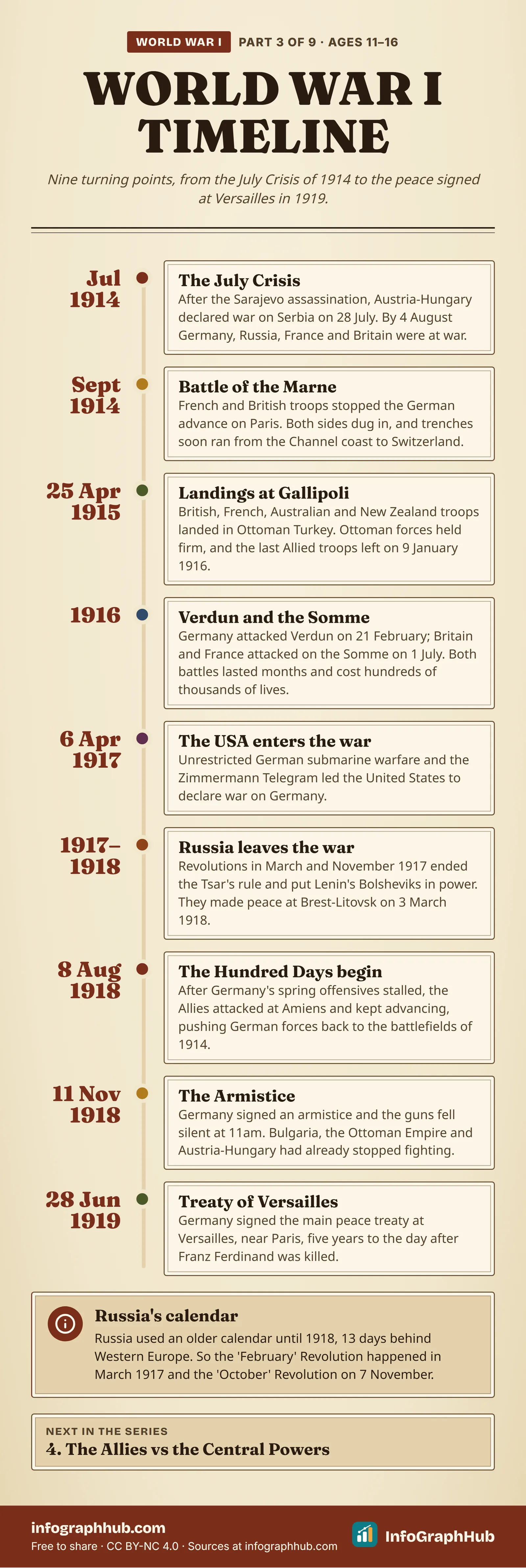
Use this infographic
Free under CC BY-NC 4.0, with credit to InfoGraphHub.
1914: from a war of movement to stalemate
Austria-Hungary declared war on Serbia on 28 July 1914, and by 4 August Germany, Russia, France and Britain were at war. Germany's armies swept through Belgium into northern France, aiming to win in the west within weeks. In September, French and British forces counter-attacked at the Battle of the Marne and drove the Germans back. IWM dates the battle 6–10 September; some accounts run it to 12 September.
Neither side could then outflank the other, so both dug in. By the end of 1914 a line of trenches ran from the Channel coast to Switzerland. In the east, Russia invaded Germany but was heavily defeated at Tannenberg in August 1914. Losses on all fronts in 1914 alone topped five million killed, wounded and captured.
1915: the war widens
With the Western Front deadlocked, the Allies looked elsewhere. On 25 April 1915 British, French, Australian and New Zealand troops landed on the Gallipoli peninsula, hoping to open the Dardanelles and knock the Ottoman Empire out of the war. Ottoman forces held them on the slopes above the beaches, and the last Allied troops left on 9 January 1916.
The war spread in other ways too. Germany used poison gas on a major scale at the Second Battle of Ypres in April 1915, and a German submarine sank the liner Lusitania on 7 May. Italy joined the Allies on 23 May, and Bulgaria joined the Central Powers in October, helping to overrun Serbia.
1916: battles of attrition
1916 was a year of huge, grinding battles. Germany attacked the French fortress town of Verdun on 21 February, and fighting went on until December, making it the longest battle of the war. To relieve the pressure, British and French forces attacked on the Somme on 1 July. In 141 days more than a million men on all sides were killed, wounded or captured, and tanks were used for the first time.
At sea, the British and German fleets met at Jutland (31 May–1 June). In the east, Russia's Brusilov Offensive from 4 June was its most successful attack of the war.
1917: revolution and a new ally
Germany resumed unrestricted submarine warfare in early 1917. Together with the Zimmermann Telegram, in which Germany proposed an alliance with Mexico against the USA, this brought the United States into the war on 6 April 1917.
Russia, exhausted by defeat and hunger, had two revolutions. The first, in March 1917, ended the rule of Tsar Nicholas II. In the second, on 7 November, Lenin's Bolsheviks seized power. Russia used an older calendar at the time, so these are still called the February and October Revolutions. The Bolsheviks made peace with Germany in the Treaty of Brest-Litovsk on 3 March 1918. Meanwhile the British-led offensive at Passchendaele (31 July–10 November 1917) cost both sides heavily.
1918: the final year
Free to move troops from the east, Germany launched its Spring Offensives on 21 March 1918, gaining more ground than in years. But the attacks lost momentum, and the Allies appointed the French general Ferdinand Foch to coordinate their armies. On 8 August the Battle of Amiens began the Hundred Days Offensive, in fact 95 days, which pushed the German army back towards the battlefields of 1914.
Germany's allies gave up one by one: Bulgaria, then the Ottoman Empire, whose armistice was signed at Mudros on 30 October, then Austria-Hungary. Kaiser Wilhelm II abdicated on 9 November, and the Armistice with Germany came into force at 11am on 11 November 1918.
1919: making peace
The Paris Peace Conference opened on 18 January 1919. Germany signed the Treaty of Versailles on 28 June 1919, five years to the day after the assassination in Sarajevo. Treaties with Germany's allies followed; the last, with Turkey, was not settled until 1923.
Frequently asked questions
What are the most important dates of World War I?
28 June 1914 (assassination in Sarajevo), 28 July 1914 (Austria-Hungary declares war on Serbia), 4 August 1914 (Britain enters), 6 April 1917 (USA enters), 3 March 1918 (Treaty of Brest-Litovsk), 11 November 1918 (Armistice) and 28 June 1919 (Treaty of Versailles).
When did the United States enter World War I?
On 6 April 1917, after Germany resumed unrestricted submarine warfare and British intelligence intercepted the Zimmermann Telegram, in which Germany proposed an alliance with Mexico. President Woodrow Wilson had asked Congress to declare war on 2 April.
Why are Russia's 1917 revolutions called February and October?
Russia still used the older Julian calendar, which was 13 days behind the calendar used in most of Europe. The February Revolution happened in March by the modern calendar, and the October Revolution on 7 November.
What was the Hundred Days Offensive?
A run of Allied victories on the Western Front that began with the Battle of Amiens on 8 August 1918 and lasted until the Armistice on 11 November, 95 days in all. It pushed the German army back to the battlefields of 1914.

Sources & methodology
Every fact is checked against the sources below. We write original explanations and draw original graphics; no figures are copied from textbooks. Spotted an error? See our corrections policy.
- Key Dates (National WWI Museum and Memorial, accessed 1 Oct 2026)
- First World War key battles (Imperial War Museums (IWM), accessed 1 Oct 2026)
- The Hundred Days Offensive (Imperial War Museums (IWM), accessed 1 Oct 2026)
- Armistice (Imperial War Museums (IWM), accessed 1 Oct 2026)
- Russian February Revolution (Imperial War Museums (IWM), accessed 1 Oct 2026)
- Gallipoli (Australian War Memorial, accessed 1 Oct 2026)
- Paris Peace Conference (National WWI Museum and Memorial, accessed 1 Oct 2026)
- The Treaty of Versailles (The National Archives (UK), accessed 1 Oct 2026)
- Zimmermann Telegram (National WWI Museum and Memorial, accessed 1 Oct 2026)
- Christmas, Soviet Style (Russia's 1918 calendar change) (Library of Congress, In Custodia Legis blog, accessed 1 Oct 2026)
Editorial review pending · Updated
Made by the InfoGraphHub editorial team (how we research and check: editorial and AI policy). First published 2 October 2026, last reviewed 1 October 2026. Found a mistake? Tell the editors.
For teachers: ages and curriculum fit
Ages 11–16 · Grades 6–10 (US) · Years 7–11 (UK) · Classes 6–10 (India)
Embed this on your site
Paste this HTML into your page. Keep the credit line: it is required by the CC BY-NC 4.0 license.
Related infographics


For teachers and parents: new InfoGraphHub resources by email
One short email when new free resources go live. For adults (18+) only. No spam, no tracking in emails, unsubscribe anytime.