History & GeographyVisual listPart 1 of 9, World War IUpdated 1 October 2026
World War I Explained
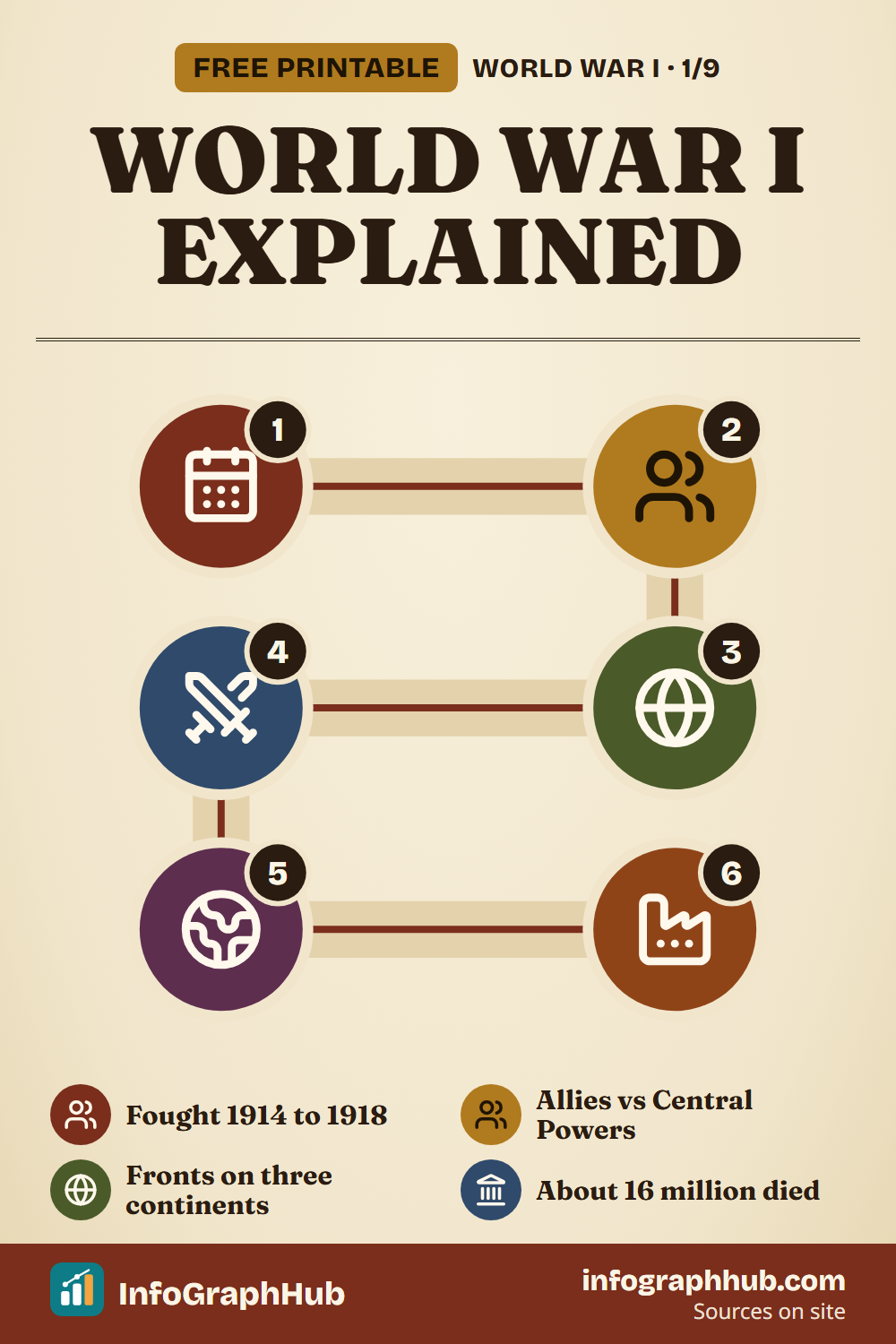
World War I in one page: when it was fought (1914–1918), who fought on each side, where the fronts were, how new weapons changed warfare, how whole societies were drawn in, and why a war that killed about 16 million people still matters.
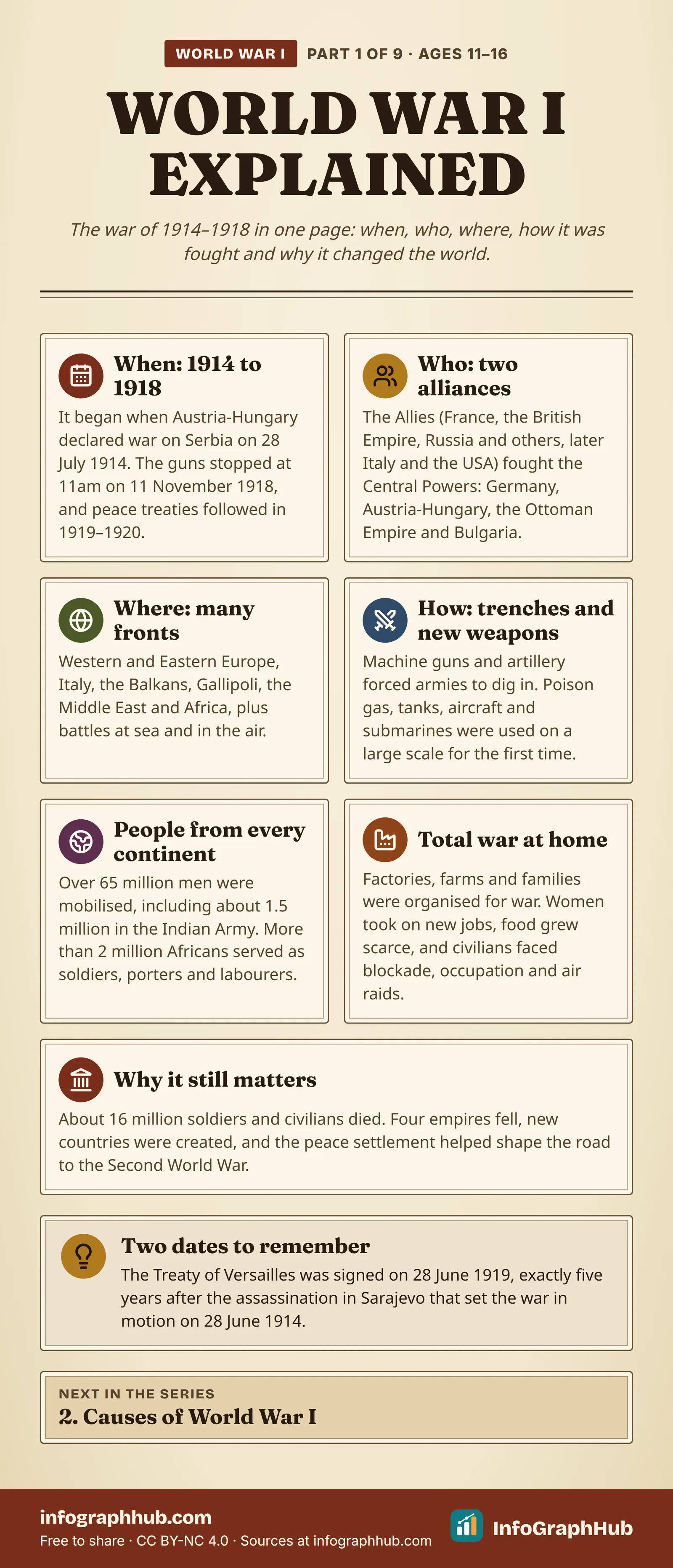
Use this infographic
Free under CC BY-NC 4.0, with credit to InfoGraphHub.
A war between empires
World War I, also called the First World War or the Great War, was fought from 1914 to 1918. It started as a quarrel in south-east Europe between Austria-Hungary and Serbia, but within a week Europe's largest powers had joined in. Britain, France, Russia and Germany ruled or controlled land on almost every continent, so their war quickly became a global one.
The fighting began when Austria-Hungary declared war on Serbia on 28 July 1914. On the Western Front it stopped at 11am on 11 November 1918, when an armistice came into force. Formal peace took longer: Germany signed the Treaty of Versailles on 28 June 1919, and separate treaties with the other defeated powers followed.
Two alliances
More than 30 nations declared war between 1914 and 1918. Most joined the Allies, led by France, the British Empire and Russia, with Serbia, Belgium and Japan from 1914, Italy from 1915 and the United States from 1917. Against them stood the Central Powers: Germany, Austria-Hungary, the Ottoman Empire and Bulgaria.
Empires brought their peoples into the war. About 1.5 million men served in the Indian Army, and more than two million Africans were drawn in as soldiers, porters and labourers. Canada, Australia, New Zealand and South Africa sent their own forces, and labourers were recruited from as far away as China.
Where the war was fought
The Western Front, a line of trenches through Belgium and France, is the best-known front, but it was only one of many:
- Eastern Front: Russia fought Germany and Austria-Hungary across wide plains, forests and mountains, in a war of much greater movement than in the west.
- Italy: Italy fought Austria-Hungary along their mountain border from 1915.
- The Balkans: Serbia held out until a Central Powers invasion in late 1915; Allied troops then fought from Salonika in Greece.
- The Middle East: the Ottoman Empire defended Gallipoli and fought British, Indian, Australian and other forces in Egypt, Sinai, Palestine and Mesopotamia (modern Iraq).
- Africa: campaigns against Germany's colonies drew in huge numbers of African soldiers and carriers.
- At sea and in the air: fleets met at Jutland in 1916, submarines attacked shipping, and aircraft were used in war on a large scale for the first time.
A new kind of war
Weapons had become far deadlier than most generals expected. Machine guns and heavy artillery made attacks across open ground extremely costly, so by the end of 1914 soldiers on the Western Front had dug in. Both sides then searched for a way to break the deadlock: poison gas was first used on a major scale in 1915, tanks appeared at the Battle of the Somme in 1916, aircraft scouted the enemy's lines, and submarines tried to cut off supplies.
Medicine changed too. According to IWM, this was the first major war in which more British soldiers died in battle than from disease.
Total war
The war reached far beyond the battlefield, which is why historians call it a total war. Governments took control of factories, food and transport. By 1918 British industry alone had produced around 250,000 machine guns and 52,000 aeroplanes, according to IWM. Women took on jobs that men had left, from munitions work to farming. Civilians suffered as well: people in occupied areas lived under harsh rule, naval blockades caused hunger, and air raids reached cities far from the front.
Why it still matters
IWM estimates that about 16 million soldiers and civilians died. Four empires collapsed: the German, Austro-Hungarian, Russian and Ottoman. New countries appeared in Europe and the Middle East, the League of Nations was set up to keep the peace, and anger over the peace terms helped open the road to the Second World War.
The other parts of this series take one question at a time: the causes, the timeline, the two sides, the numbers, life in the trenches, the key people, the consequences, and a quiz to finish.
Frequently asked questions
When did World War I start and end?
It started on 28 July 1914, when Austria-Hungary declared war on Serbia, and the fighting on the Western Front ended at 11am on 11 November 1918, when the Armistice came into force. The Treaty of Versailles with Germany was signed on 28 June 1919.
Who fought in World War I?
The Allies, led by France, the British Empire and Russia and later joined by Italy and the United States, fought the Central Powers: Germany, Austria-Hungary, the Ottoman Empire and Bulgaria. More than 30 nations declared war in total.
Why is it called a world war?
Because the fighting and the people involved came from across the globe. The warring powers ruled empires on several continents, so soldiers and workers came from India, Africa, Australia, Canada, New Zealand, China and elsewhere, and battles were fought in Europe, the Middle East, Africa and at sea.
How many people died in World War I?
Nobody knows exactly. The Imperial War Museums estimate about 16 million soldiers and civilians, and the National WWI Museum and Memorial says more than 9 million combatants died. Civilian deaths from hunger, disease and violence are the hardest to count.
Sources & methodology
Every fact is checked against the sources below. We write original explanations and draw original graphics; no figures are copied from textbooks. Spotted an error? See our corrections policy.
- First World War (Imperial War Museums (IWM), accessed 1 Oct 2026)
- 5 Facts You Need To Know About The First World War (Imperial War Museums (IWM), accessed 1 Oct 2026)
- Key Dates (National WWI Museum and Memorial, accessed 1 Oct 2026)
- First World War key battles (Imperial War Museums (IWM), accessed 1 Oct 2026)
- India and the First World War (Imperial War Museums (IWM), accessed 1 Oct 2026)
- Forgotten Fronts: Africa and the Global Impact of World War I (National WWI Museum and Memorial, accessed 1 Oct 2026)
- The Treaty of Versailles (The National Archives (UK), accessed 1 Oct 2026)
Editorial review pending · Updated
Made by the InfoGraphHub editorial team (how we research and check: editorial and AI policy). First published 2 October 2026, last reviewed 1 October 2026. Found a mistake? Tell the editors.
For teachers: ages and curriculum fit
Ages 11–16 · Grades 6–10 (US) · Years 7–11 (UK) · Classes 6–10 (India)
Embed this on your site
Paste this HTML into your page. Keep the credit line: it is required by the CC BY-NC 4.0 license.
Related infographics


For teachers and parents: new InfoGraphHub resources by email
One short email when new free resources go live. For adults (18+) only. No spam, no tracking in emails, unsubscribe anytime.