History & GeographyVisual listPart 2 of 9, World War IUpdated 1 October 2026
Causes of World War I
Why did World War I start? The long-term causes (militarism, alliances, imperialism and nationalism, remembered as MAIN), the assassination of Archduke Franz Ferdinand on 28 June 1914, and the five-week July Crisis that turned a Balkan quarrel into a world war.
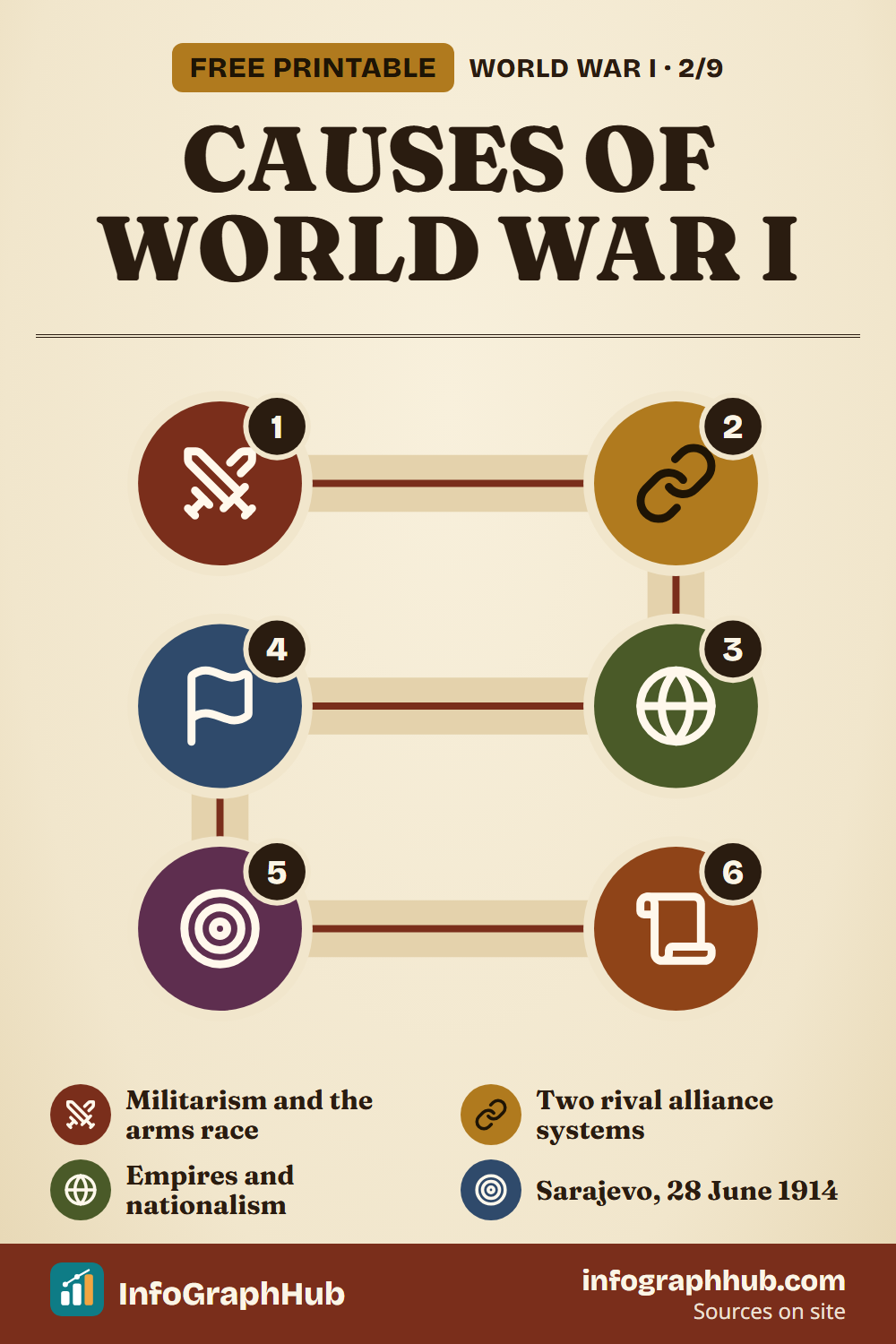
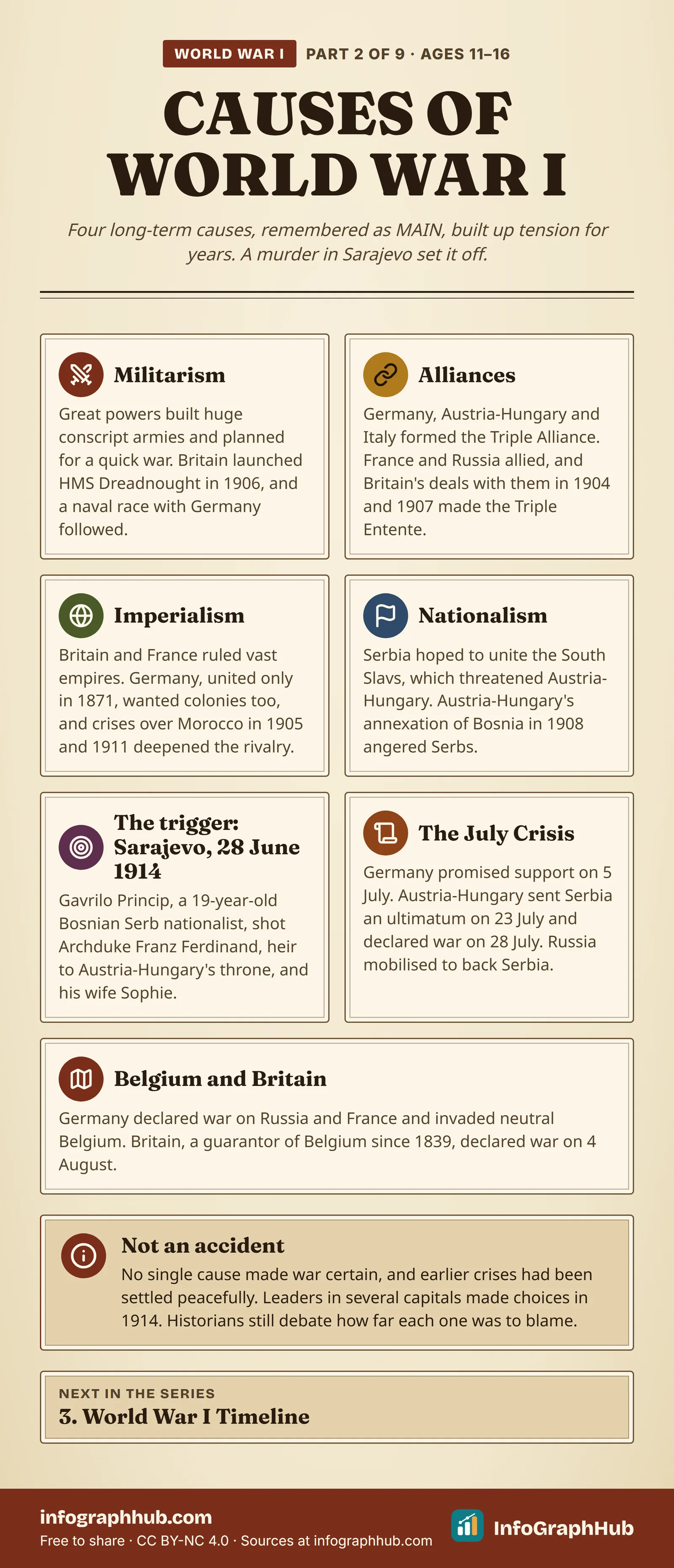
Use this infographic
Free under CC BY-NC 4.0, with credit to InfoGraphHub.
Long-term causes and a trigger
Historians usually separate the causes of World War I into two kinds. Long-term causes built up tension between the great powers over decades. The trigger, or short-term cause, was a single event that turned that tension into war: the murder of Archduke Franz Ferdinand in Sarajevo on 28 June 1914.
A handy way to remember the long-term causes is the word MAIN: Militarism, Alliances, Imperialism and Nationalism. None of them made war certain on its own. Earlier crises had been settled without a European war. What mattered was how the four combined in 1914, and the choices leaders made.
Militarism: the arms race
Before 1914 most European leaders saw a big army and navy as a sign of a great power. France, Germany, Russia and Austria-Hungary kept huge armies of conscripts, and their generals drew up detailed plans for a short, fast war. Britain, an island with a small army, relied on the Royal Navy.
When Germany began building a large battle fleet, Britain saw a threat to the navy that protected its empire and trade. Britain launched HMS Dreadnought in 1906, a battleship so advanced that it made older ships look outdated, and both countries raced to build more.
Alliances: two armed camps
After Germany was united in 1871, it allied with Austria-Hungary in 1879, and Italy joined them in 1882, forming the Triple Alliance. Worried by this new bloc, France and Russia agreed their own alliance in the 1890s.
Britain had long been a rival of both France and Russia, but it settled its colonial disputes with France in the Entente Cordiale of 1904 and with Russia in 1907. The three became known as the Triple Entente. This was a looser friendship than an alliance: Britain was not obliged to fight. Even so, Germany felt surrounded, and any quarrel between two powers now risked pulling in the others.
Imperialism: rivalry for empire
Britain and France ruled vast empires across Africa, Asia and beyond; the BBC notes that the British Empire alone ruled over 400 million people. Germany, a newer country, wanted colonies too. In 1911 Germany sent a gunboat, the Panther, to Agadir in Morocco to challenge French control there. Germany backed down, but crises like this, in 1905 and 1911, pushed Britain and France closer together and deepened distrust of Germany.
Nationalism and the Balkans
Nationalism, a strong loyalty to one's own nation, ran high across Europe. In the Balkans it was explosive. Austria-Hungary ruled many different peoples and feared that Serbia wanted to unite the South Slavs, including those inside its own borders. In 1908 Austria-Hungary annexed Bosnia, angering Serbs. Serbia then grew larger after the Balkan Wars of 1912–1913, and Russia saw itself as Serbia's protector.
From murder to world war in five weeks
On 28 June 1914, Gavrilo Princip, a 19-year-old Bosnian Serb nationalist, shot Franz Ferdinand and his wife Sophie in Sarajevo. Austria-Hungary blamed Serbia. On 5 July Germany promised its full support, often called the 'blank cheque'. On 23 July Austria-Hungary sent Serbia a harsh ultimatum. Serbia accepted almost every demand, but Austria-Hungary declared war on 28 July.
Russia began to mobilise to support Serbia on 30 July. Germany's only war plan, the Schlieffen Plan, was to defeat France quickly through Belgium before Russia was ready, so Germany declared war on Russia on 1 August and on France on 3 August, and invaded neutral Belgium. Britain had promised in a treaty of 1839 to protect Belgium's neutrality, and it declared war on Germany on 4 August. Its empire was now at war too.
Who was to blame?
The Treaty of Versailles in 1919 made Germany accept responsibility for the war, but historians still argue about blame. IWM stresses that the war was neither inevitable nor accidental: it came from decisions taken by leaders in Vienna, Berlin, St Petersburg, Paris and London. A strong answer weighs several causes and explains how they were linked.
Frequently asked questions
What are the 4 main causes of World War I?
Militarism, alliances, imperialism and nationalism, often remembered with the word MAIN. They built up tension between the great powers for years before the assassination of Archduke Franz Ferdinand on 28 June 1914 triggered the war.
Who killed Archduke Franz Ferdinand?
Gavrilo Princip, a 19-year-old Bosnian Serb nationalist, shot the Archduke and his wife Sophie in Sarajevo, Bosnia, on 28 June 1914. Franz Ferdinand was the heir to the throne of Austria-Hungary.
What was the July Crisis?
The five weeks between the assassination on 28 June 1914 and Britain's declaration of war on 4 August. In that time Germany promised to back Austria-Hungary, Austria-Hungary sent Serbia an ultimatum and declared war, Russia mobilised, Germany declared war on Russia and France, and Germany invaded Belgium.
Why did Britain join World War I?
Germany invaded neutral Belgium as part of its plan to defeat France quickly. Britain had guaranteed Belgian neutrality in a treaty of 1839, and it also feared German control of Europe and the Channel coast. Britain declared war on Germany on 4 August 1914.
Sources & methodology
Every fact is checked against the sources below. We write original explanations and draw original graphics; no figures are copied from textbooks. Spotted an error? See our corrections policy.
- Outbreak of the First World War (Imperial War Museums (IWM), accessed 1 Oct 2026)
- Causes of World War One (BBC Bitesize (KS3 History), accessed 1 Oct 2026)
- 5 Facts You Need To Know About The First World War (Imperial War Museums (IWM), accessed 1 Oct 2026)
- Key Dates (National WWI Museum and Memorial, accessed 1 Oct 2026)
- GCSE History 8145: Understanding the modern world (section BA) (AQA, accessed 1 Oct 2026)
Editorial review pending · Updated
Made by the InfoGraphHub editorial team (how we research and check: editorial and AI policy). First published 2 October 2026, last reviewed 1 October 2026. Found a mistake? Tell the editors.
For teachers: ages and curriculum fit
Ages 11–16 · Grades 6–10 (US) · Years 7–11 (UK) · Classes 6–10 (India)
Embed this on your site
Paste this HTML into your page. Keep the credit line: it is required by the CC BY-NC 4.0 license.
Related infographics


For teachers and parents: new InfoGraphHub resources by email
One short email when new free resources go live. For adults (18+) only. No spam, no tracking in emails, unsubscribe anytime.