History & GeographyVisual listPart 8 of 9, World War IUpdated 1 October 2026
Consequences of World War I
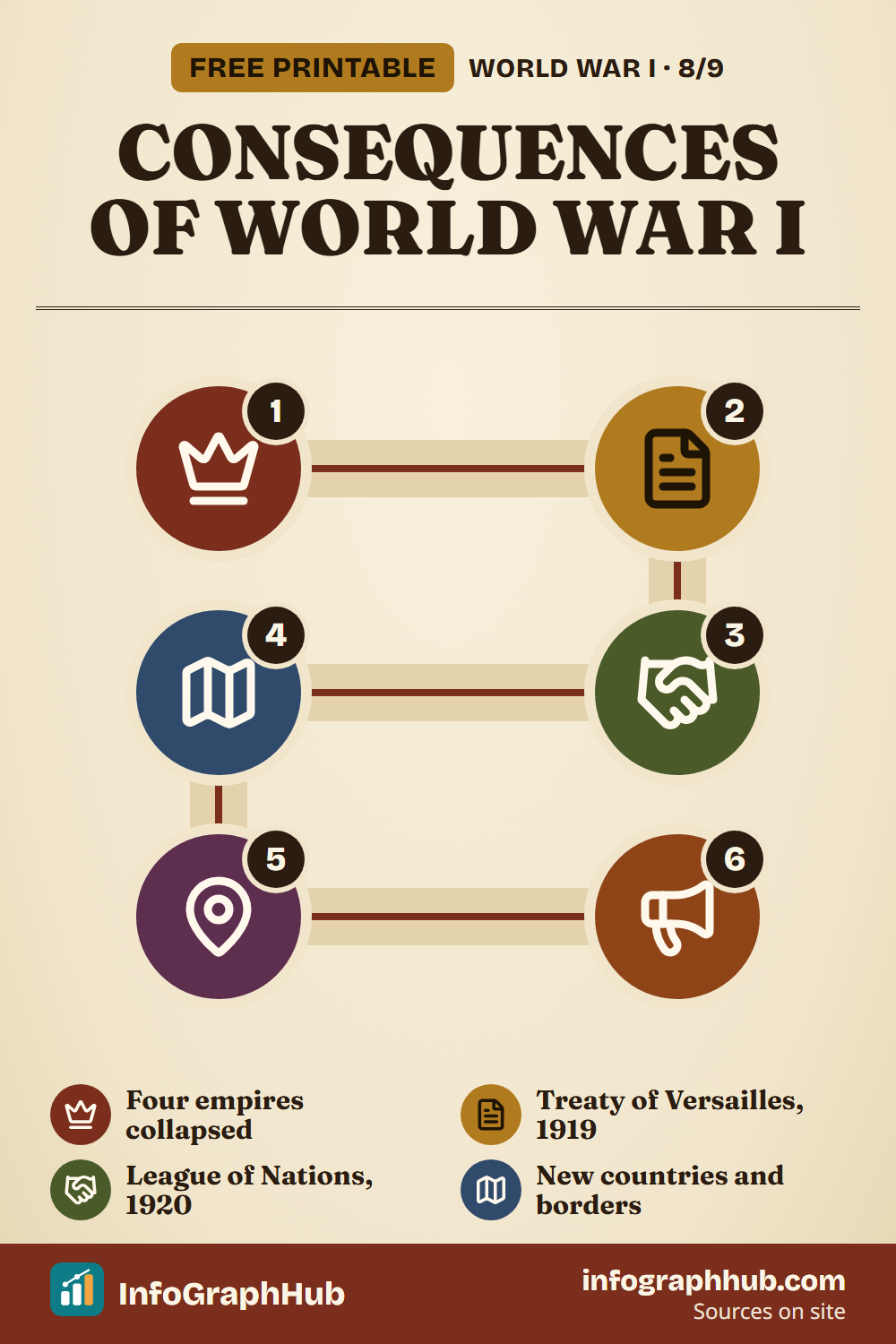
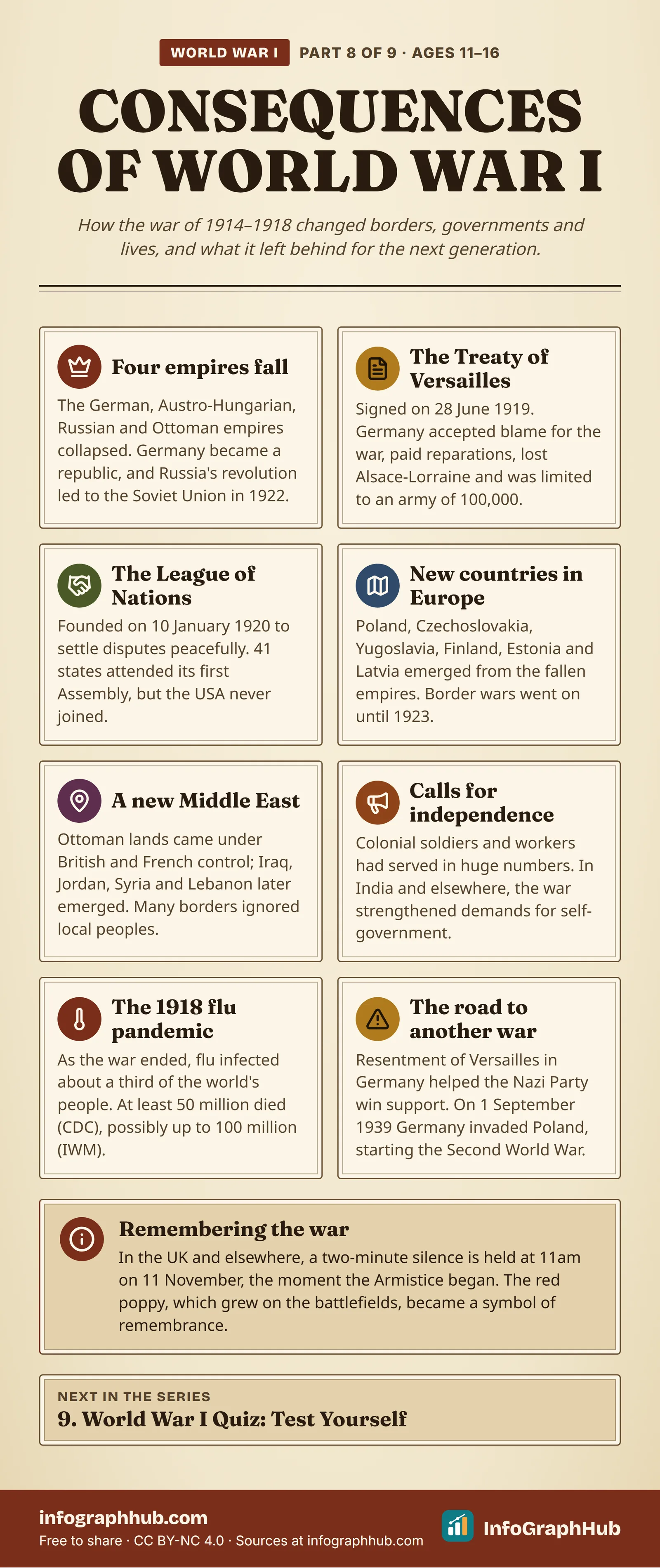
What World War I changed: the fall of four empires, the Treaty of Versailles, the League of Nations, new countries and borders in Europe and the Middle East, years of further fighting, the 1918 flu pandemic, new demands for independence and the road to the Second World War.
Use this infographic
Free under CC BY-NC 4.0, with credit to InfoGraphHub.
A changed world
When the guns fell silent on 11 November 1918, the world was a very different place from the one of 1914. IWM estimates that about 16 million soldiers and civilians had died, and countless more were wounded in body or mind. Countries on both sides were deeply in debt, and the cost of rebuilding damaged the economies of winners and losers alike. The consequences of the war shaped the rest of the twentieth century.
Four empires fall
The war destroyed four empires. In Russia the Tsar was overthrown in 1917 and the Bolsheviks took power; after a civil war, the Soviet Union was created in December 1922. In Germany the Kaiser abdicated on 9 November 1918 and a republic, later called the Weimar Republic, took his place. Austria-Hungary broke apart into separate states in 1918. The Ottoman Empire surrendered in October 1918 and was divided up; the Republic of Turkey grew from its heartland.
The Treaty of Versailles
The Paris Peace Conference opened on 18 January 1919, and its key decisions were made by the leaders of Britain, France, Italy and the United States. Germany was not allowed to take part in the talks. The Treaty of Versailles, signed on 28 June 1919, had 440 articles. Among its terms, Germany:
- accepted responsibility for the war and the damage it caused (the 'war guilt' clause);
- agreed to pay reparations;
- returned Alsace-Lorraine to France;
- was limited to an army of 100,000 men, with no tanks and no air force;
- had to keep its troops out of the Rhineland, next to France, and was forbidden to unite with Austria.
Separate treaties dealt with Austria, Hungary, Bulgaria and the Ottoman Empire. The last of these was not settled until 1923.
The League of Nations
US President Woodrow Wilson's idea of a League of Nations, a body where countries would settle disputes by talking rather than fighting, became part of the treaty. The League officially came into existence on 10 January 1920, with its headquarters in Geneva, and 41 member states met at its first Assembly that November. But the US Senate refused to ratify the treaty, so the United States never joined. The League was the forerunner of today's United Nations.
New countries and new borders
Self-determination, the idea that peoples should govern themselves, helped create new states from the old empires, including Poland, Czechoslovakia, the Kingdom of Serbs, Croats and Slovenes (later Yugoslavia), Finland, Estonia and Latvia. Fighting did not stop at once: IWM notes that civil wars and border wars went on, and peace did not return to Europe until 1923.
In the Middle East, Ottoman lands became territories run by Britain and France under the League, from which Iraq, Jordan, Syria and Lebanon later emerged. The National WWI Museum notes that many new borders were drawn without regard for the region's ethnic, religious and language groups, with consequences that are still felt.
Empires, colonies and the 1918 flu
People in the colonies had served and sacrificed, and many now expected more say in their own government. IWM's curators note that the war sharpened the desire for independence in India.
As the war ended, a deadly flu pandemic swept the world in 1918–1919. The US Centers for Disease Control and Prevention estimates that about 500 million people, a third of the world's population, were infected and at least 50 million died; IWM gives a figure of up to 100 million. Unlike normal flu, it hit young adults hardest.
The road to the Second World War
Many Germans saw the Treaty of Versailles as a dictated peace, and resentment of it helped the Nazi Party win support. Historians still debate how much the treaties were to blame: IWM points out that the terms were not unduly harsh, but that they contained many compromises and their long-term success was limited. Twenty years after Versailles, on 1 September 1939, Germany invaded Poland and a second world war began.
Frequently asked questions
What were the main consequences of World War I?
About 16 million deaths, the collapse of the German, Austro-Hungarian, Russian and Ottoman empires, the Treaty of Versailles, the founding of the League of Nations, new countries and borders in Europe and the Middle East, years of further fighting, and resentments that helped lead to the Second World War.
What did the Treaty of Versailles do to Germany?
It made Germany accept responsibility for the war, pay reparations, return Alsace-Lorraine to France, cut its army to 100,000 men with no tanks or air force, keep troops out of the Rhineland and stay separate from Austria.
Which empires collapsed after World War I?
Four: the German Empire, Austria-Hungary, the Russian Empire and the Ottoman Empire. Their lands became republics or new countries, or were placed under British and French control.
Did World War I cause the 1918 flu pandemic?
The pandemic was caused by a flu virus, not by the war, but it spread around the world in 1918–1919 as the war was ending. It infected about a third of the world's population and killed at least 50 million people, according to the CDC.
Sources & methodology
Every fact is checked against the sources below. We write original explanations and draw original graphics; no figures are copied from textbooks. Spotted an error? See our corrections policy.
- The Peace Treaties That Ended The First World War (Imperial War Museums (IWM), accessed 1 Oct 2026)
- The Treaty of Versailles (The National Archives (UK), accessed 1 Oct 2026)
- The end of World War One and the Treaty of Versailles (BBC Bitesize (KS3 History), accessed 1 Oct 2026)
- League of Nations: overview (United Nations Office at Geneva, accessed 1 Oct 2026)
- Europe After The First World War: Continuing Conflict (Imperial War Museums (IWM), accessed 1 Oct 2026)
- WWI and the Middle East (National WWI Museum and Memorial, accessed 1 Oct 2026)
- 1918 Pandemic (H1N1 virus) (US Centers for Disease Control and Prevention (CDC), accessed 1 Oct 2026)
- Spanish Flu: The Unseen Enemy (Imperial War Museums (IWM), accessed 1 Oct 2026)
- India and the First World War (Imperial War Museums (IWM), accessed 1 Oct 2026)
- 5 Facts You Need To Know About The First World War (Imperial War Museums (IWM), accessed 1 Oct 2026)
Editorial review pending · Updated
Made by the InfoGraphHub editorial team (how we research and check: editorial and AI policy). First published 2 October 2026, last reviewed 1 October 2026. Found a mistake? Tell the editors.
For teachers: ages and curriculum fit
Ages 11–16 · Grades 6–10 (US) · Years 7–11 (UK) · Classes 6–10 (India)
Embed this on your site
Paste this HTML into your page. Keep the credit line: it is required by the CC BY-NC 4.0 license.
Related infographics


For teachers and parents: new InfoGraphHub resources by email
One short email when new free resources go live. For adults (18+) only. No spam, no tracking in emails, unsubscribe anytime.