History & GeographyComparisonPart 4 of 9, World War IUpdated 2 October 2026
The Allies vs the Central Powers
The two sides of World War I compared: who belonged to the Allies and the Central Powers, how their alliances formed, where they were, their strengths at sea, the people they drew from their empires, and how each side's war ended.
Interactive
Explore it step by step
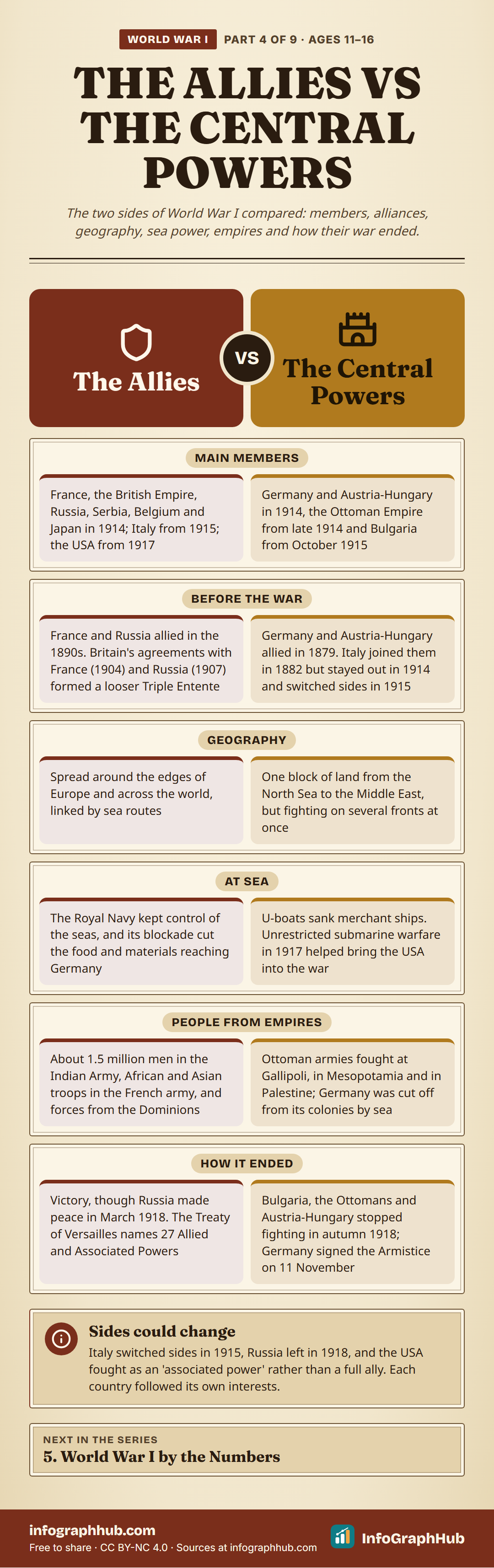
- Main members
The Allies: France, the British Empire, Russia, Serbia, Belgium and Japan in 1914; Italy from 1915; the USA from 1917
The Central Powers: Germany and Austria-Hungary in 1914, the Ottoman Empire from late 1914 and Bulgaria from October 1915
- Before the war
The Allies: France and Russia allied in the 1890s. Britain's agreements with France (1904) and Russia (1907) formed a looser Triple Entente
The Central Powers: Germany and Austria-Hungary allied in 1879. Italy joined them in 1882 but stayed out in 1914 and switched sides in 1915
- Geography
The Allies: Spread around the edges of Europe and across the world, linked by sea routes
The Central Powers: One block of land from the North Sea to the Middle East, but fighting on several fronts at once
- At sea
The Allies: The Royal Navy kept control of the seas, and its blockade cut the food and materials reaching Germany
The Central Powers: U-boats sank merchant ships. Unrestricted submarine warfare in 1917 helped bring the USA into the war
- People from empires
The Allies: About 1.5 million men in the Indian Army, African and Asian troops in the French army, and forces from the Dominions
The Central Powers: Ottoman armies fought at Gallipoli, in Mesopotamia and in Palestine; Germany was cut off from its colonies by sea
- How it ended
The Allies: Victory, though Russia made peace in March 1918. The Treaty of Versailles names 27 Allied and Associated Powers
The Central Powers: Bulgaria, the Ottomans and Austria-Hungary stopped fighting in autumn 1918; Germany signed the Armistice on 11 November
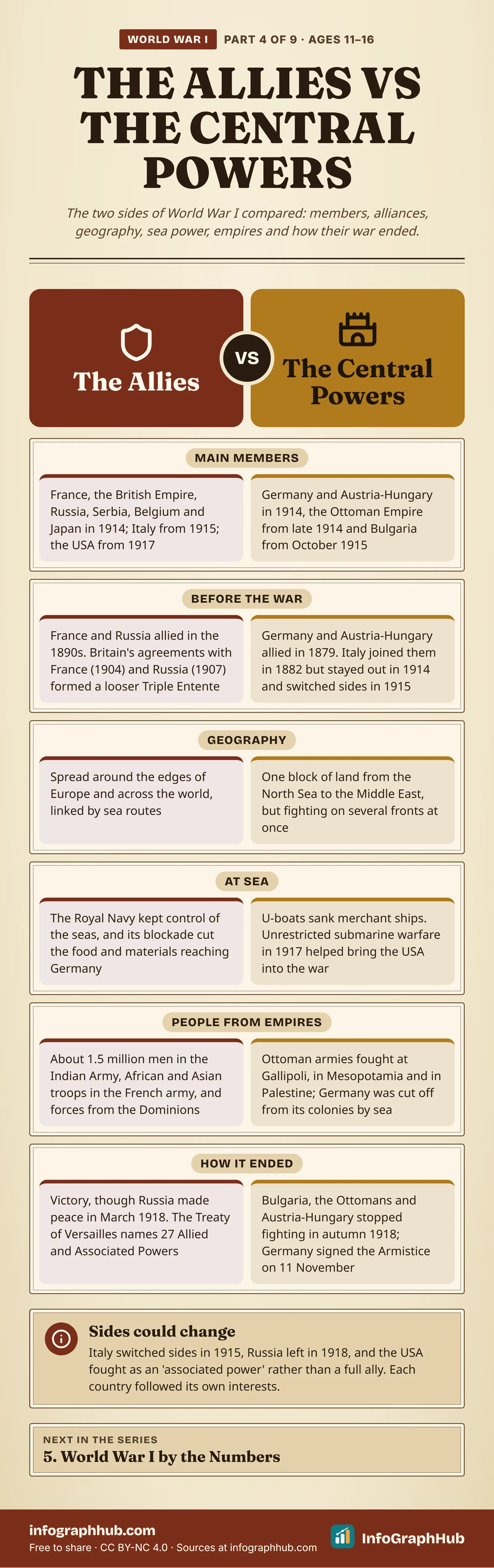
Use this infographic
Free under CC BY-NC 4.0, with credit to InfoGraphHub.
Two sides, many members
World War I was fought between two coalitions. The Allies, also called the Entente Powers, began in 1914 as France, the British Empire, Russia, Serbia and Belgium, with Japan joining in August. The Central Powers were Germany and Austria-Hungary, joined by the Ottoman Empire late in 1914 and Bulgaria in October 1915. The name comes from their position in the middle of Europe.
The Allied side grew much larger. Italy joined it in 1915, the United States in 1917, and many other countries in Europe, Asia, Africa and the Americas declared war on Germany. The Treaty of Versailles opens by listing 27 'Allied and Associated Powers', from Brazil, China and Cuba to Liberia, Siam (now Thailand) and the Hedjaz in Arabia.
How the alliances formed
The Central Powers grew from the alliance Germany made with Austria-Hungary in 1879. Italy joined them three years later, forming the Triple Alliance, but the treaty was defensive: when Austria-Hungary attacked Serbia in 1914, Italy stayed out. In May 1915 it joined the Allies, who had promised to support it in taking frontier lands from Austria-Hungary.
The Allies grew from the Franco-Russian alliance of the 1890s and Britain's agreements with France in 1904 and Russia in 1907. These ties were looser than the Triple Alliance. Britain went to war in 1914 mainly because Germany invaded neutral Belgium, not because a treaty with France or Russia forced it to.
Geography and the sea
The Central Powers formed one connected block of land stretching from the North Sea and the Baltic to the Ottoman lands of the Middle East. That made it easier to send help between allies, but it also meant fighting on several fronts at once and being cut off from the oceans.
The Allies were spread around this block and across the world. Their great advantage was sea power. After the Battle of Jutland in 1916, the German fleet never again seriously challenged Britain in the North Sea, and the British blockade reduced the food and raw materials reaching Germany. Germany's answer was the U-boat. By 1917 its campaign of sinking merchant ships without warning was threatening Britain's supplies, but it also brought the United States into the war in April 1917.
People from empires
Both sides drew on empires, but the Allies could draw on far more. About 1.5 million men served in the Indian Army, and IWM's curators judge India's soldiers, money and materials indispensable to British victory. France brought soldiers from its colonies to fight in Europe, among them West African tirailleurs sénégalais and Algerian spahi cavalry. Canada, Australia, New Zealand and South Africa raised their own forces, and labourers came from China and southern Africa.
On the other side, the Ottoman Empire raised large armies that fought at Gallipoli, in Mesopotamia and in Sinai and Palestine. Germany, cut off from its colonies by the British navy, could bring few overseas troops to Europe. According to the National WWI Museum, at least four million non-white troops served on the two sides in combat and support roles.
How each side's war ended
The Allies lost a major member when Russia, after its revolutions, made peace at Brest-Litovsk on 3 March 1918. Germany moved troops west and attacked in spring 1918, but American soldiers were now arriving in large numbers, and the Allied Hundred Days Offensive from 8 August broke German resistance. By November the Central Powers had collapsed one after another: Bulgaria, the Ottoman Empire, Austria-Hungary and finally Germany signed armistices.
It is best not to treat either side as a single team. Each member fought for its own aims, and those aims later clashed at the peace conference.
Frequently asked questions
Who were the Allies in World War I?
The main Allies were France, the British Empire, Russia, Serbia, Belgium and Japan from 1914, Italy from 1915 and the United States from 1917, which called itself an 'associated power'. Many smaller countries also joined, including Romania, Greece, Portugal, Brazil, China and Siam.
Who were the Central Powers?
Germany, Austria-Hungary, the Ottoman Empire (from late 1914) and Bulgaria (from October 1915). They were called the Central Powers because they lay in the middle of Europe, between France and Britain to the west and Russia to the east.
Why did Italy change sides?
Italy had joined Germany and Austria-Hungary in the Triple Alliance in 1882, but the alliance was defensive, so Italy stayed neutral in 1914 when Austria-Hungary attacked Serbia. In May 1915 it joined the Allies, after Britain and France promised to support its claim to frontier lands held by Austria-Hungary.
Why did the Allies win World War I?
Historians point to several reasons: the Allies' larger populations and resources, including their empires; British sea power and the blockade of Germany; the entry of the United States in 1917; and improved tactics that made the Hundred Days Offensive of 1918 a success.
Sources & methodology
Every fact is checked against the sources below. We write original explanations and draw original graphics; no figures are copied from textbooks. Spotted an error? See our corrections policy.
- 5 Facts You Need To Know About The First World War (Imperial War Museums (IWM), accessed 1 Oct 2026)
- Outbreak of the First World War (Imperial War Museums (IWM), accessed 1 Oct 2026)
- First World War key battles (Imperial War Museums (IWM), accessed 1 Oct 2026)
- India and the First World War (Imperial War Museums (IWM), accessed 1 Oct 2026)
- Experiences of Colonial Troops (National WWI Museum and Memorial, accessed 1 Oct 2026)
- Key Dates (National WWI Museum and Memorial, accessed 1 Oct 2026)
- The Treaty of Versailles (The National Archives (UK), accessed 1 Oct 2026)
- Italy Enters World War I (National WWI Museum and Memorial, accessed 1 Oct 2026)
- Algerian Spahis in Artois (National WWI Museum and Memorial, accessed 1 Oct 2026)
Editorial review pending · Updated
Made by the InfoGraphHub editorial team (how we research and check: editorial and AI policy). First published 2 October 2026, last reviewed 2 October 2026. Found a mistake? Tell the editors.
For teachers: ages and curriculum fit
Ages 11–16 · Grades 6–10 (US) · Years 7–11 (UK) · Classes 6–10 (India)
Embed this on your site
Paste this HTML into your page. Keep the credit line: it is required by the CC BY-NC 4.0 license.
Related infographics


For teachers and parents: new InfoGraphHub resources by email
One short email when new free resources go live. For adults (18+) only. No spam, no tracking in emails, unsubscribe anytime.