MathsWorked examplePart 6 of 8, PercentagesUpdated 1 October 2026
Common Percentage Mistakes and How to Avoid Them
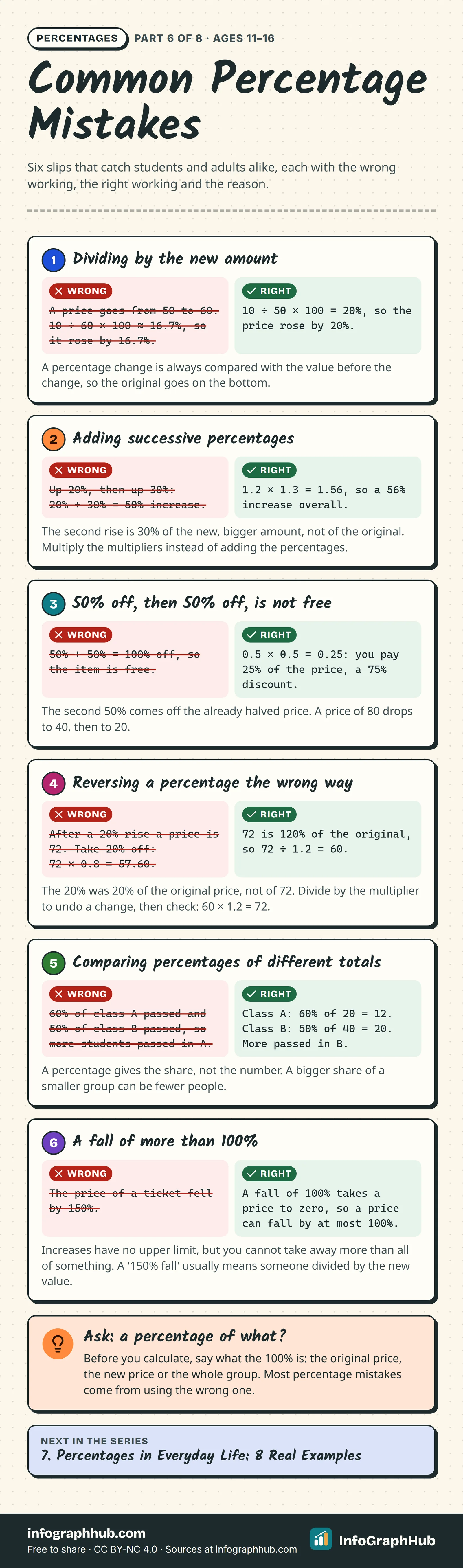
Six common percentage mistakes with the wrong working, the right working and why: dividing by the new amount, adding successive percentages, thinking 50% off twice is free, reversing a percentage the wrong way, comparing different totals and falls of over 100%.
Use this infographic
Free under CC BY-NC 4.0, with credit to InfoGraphHub.
Why percentage mistakes happen
Almost every percentage mistake comes from one question that was not asked: a percentage of what? A percentage on its own is a share of some whole. If you take it from the wrong whole, the original price instead of the sale price or the new value instead of the old one, the arithmetic can be perfect and the answer still wrong.
Dividing by the new amount
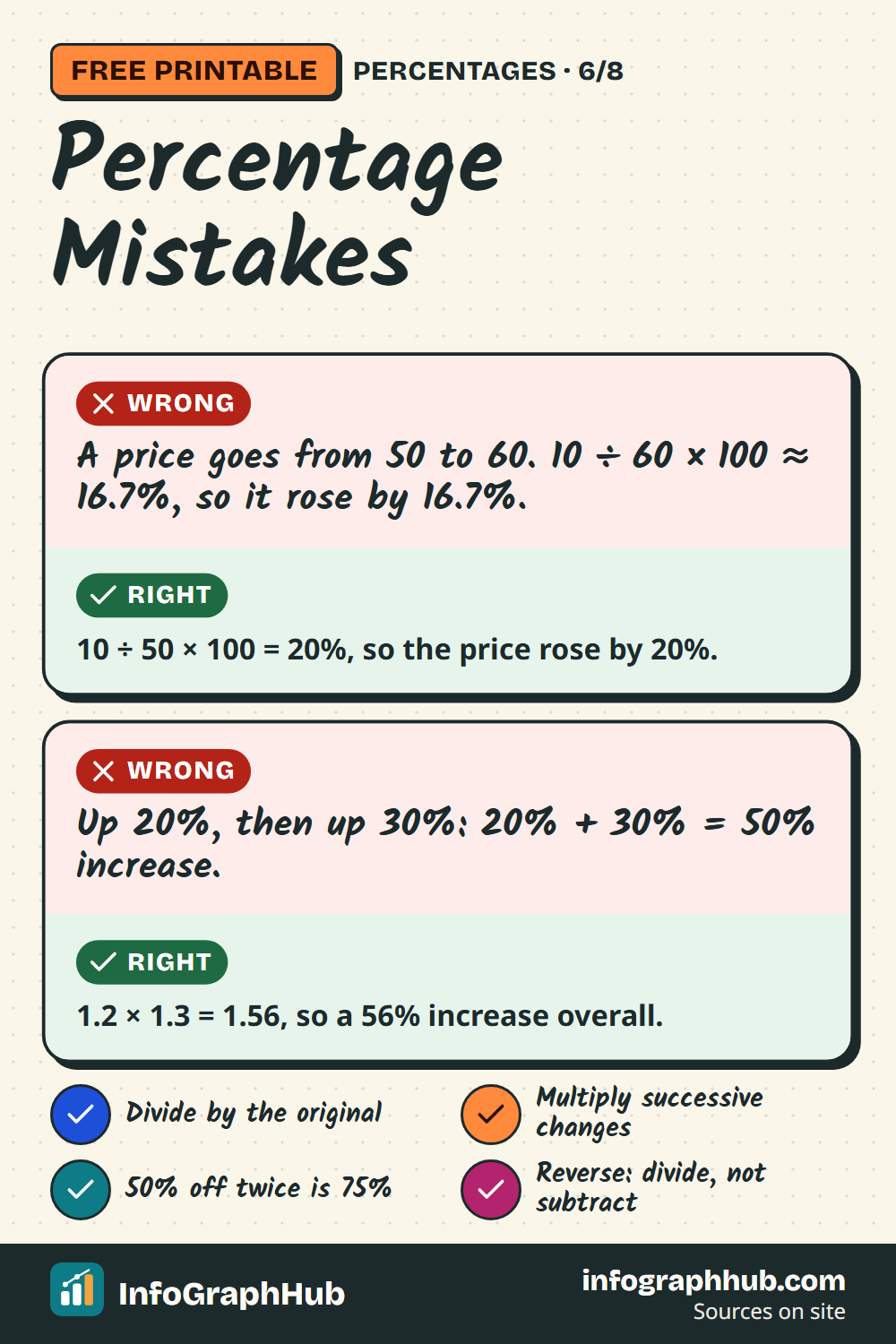
When a price rises from 50 to 60, the change is 10. Divided by the original price it is 10 ÷ 50 × 100 = 20%. Divided by the new price it is 10 ÷ 60 × 100 ≈ 16.7%, which is wrong. The same error in reverse produces impossible claims such as a "150% fall": a fall from 300 to 120 is a change of 180, and 180 ÷ 120 = 1.5, but the correct figure is 180 ÷ 300 × 100 = 60%.
Successive changes multiply
When one percentage change follows another, the second is worked out on the new amount. That is why you multiply the multipliers:
- Up 20%, then up 30%: 1.2 × 1.3 = 1.56, a 56% rise, not 50%.
- 50% off, then 50% off: 0.5 × 0.5 = 0.25, so you pay 25%, a 75% discount, not 100%.
- Up 10%, then down 10%: 200 × 1.1 = 220, and 220 × 0.9 = 198. The two changes do not cancel, because the 10% fall is taken from the larger amount.
Reverse percentages
To undo a change, divide by the multiplier that made it. If a price is 72 after a 20% rise, then 72 = original × 1.2, so the original is 72 ÷ 1.2 = 60. Taking 20% off 72 gives 57.60, which is wrong: that would be 20% of 72, not 20% of the original. A quick forward check, 60 × 1.2 = 72, shows the right answer at once.
Percentages of different totals
Percentages are good for comparing shares, but they hide the size of the group. If 60% of a class of 20 pass, that is 12 students; if 50% of a class of 40 pass, that is 20 students. The class with the higher pass rate had fewer passes. When the totals differ, work out the actual numbers before comparing.
Limits on increases and decreases
An amount can increase by any percentage: 100% doubles it and 150% multiplies it by 2.5. A decrease, though, cannot go past 100%, because a 100% fall leaves nothing. NRICH's problem Percentage Unchanged gives a related surprise: if a rectangle's base grows by 10% and its area stays the same, the other side must shrink by 1 − 1 ÷ 1.1 ≈ 9.09%, not by 10%.
Frequently asked questions
Why is percentage change divided by the original value?
Because a percentage change says how big the change is compared with where you started. A price rising from 50 to 60 has risen by 10 ÷ 50 × 100 = 20%.
Is a 20% rise followed by a 30% rise a 50% rise?
No. The second rise is 30% of a bigger amount. Multiply the multipliers: 1.2 × 1.3 = 1.56, which is a 56% rise overall.
Is 50% off and then another 50% off the same as free?
No. After the first 50% you pay half; the second 50% halves that again, so you pay a quarter of the price. The total discount is 75%.
Can something decrease by more than 100%?
Not if it starts as a positive amount: a 100% decrease already takes it to zero. Increases, by contrast, can be any size.
Sources & methodology
Every fact is checked against the sources below. We write original explanations and draw original graphics; no figures are copied from textbooks. Spotted an error? See our corrections policy.
- Repeated percentage change, interest and exponential change (BBC Bitesize, accessed 1 Oct 2026)
- Percentage change (BBC Bitesize, accessed 1 Oct 2026)
- Percentage Change (Maths is Fun, accessed 1 Oct 2026)
- Percentage Unchanged (NRICH, University of Cambridge, accessed 1 Oct 2026)
Editorial review pending · Updated
Made by the InfoGraphHub editorial team (how we research and check: editorial and AI policy). First published 1 October 2026, last reviewed 1 October 2026. Found a mistake? Tell the editors.
For teachers: ages and curriculum fit
Ages 11–16 · Grades 6–10 (US) · Years 7–11 (UK) · Classes 6–10 (India)
Common Core State Standards © Copyright 2010 National Governors Association Center for Best Practices and Council of Chief State School Officers. All rights reserved. Names and codes are used only to describe curriculum fit; InfoGraphHub is not endorsed by these organisations.
Embed this on your site
Paste this HTML into your page. Keep the credit line: it is required by the CC BY-NC 4.0 license.
Related infographics


For teachers and parents: new InfoGraphHub resources by email
One short email when new free resources go live. For adults (18+) only. No spam, no tracking in emails, unsubscribe anytime.