MathsCheat sheetPart 4 of 8, PercentagesUpdated 1 October 2026
Percentage Change and Reverse Percentages: The Rules
The rules for percentage change and reverse percentages: divide the change by the original and multiply by 100, use new ÷ original as a shortcut, work out percentage profit, and find the value before a change by dividing by the multiplier.
Use this infographic
Free under CC BY-NC 4.0, with credit to InfoGraphHub.
What percentage change measures
A percentage change describes a change compared with the starting value. A rise of 12 means a lot for something that started at 80, and very little for something that started at 8,000. Writing the change as a percentage of the original makes changes of different sizes easy to compare.
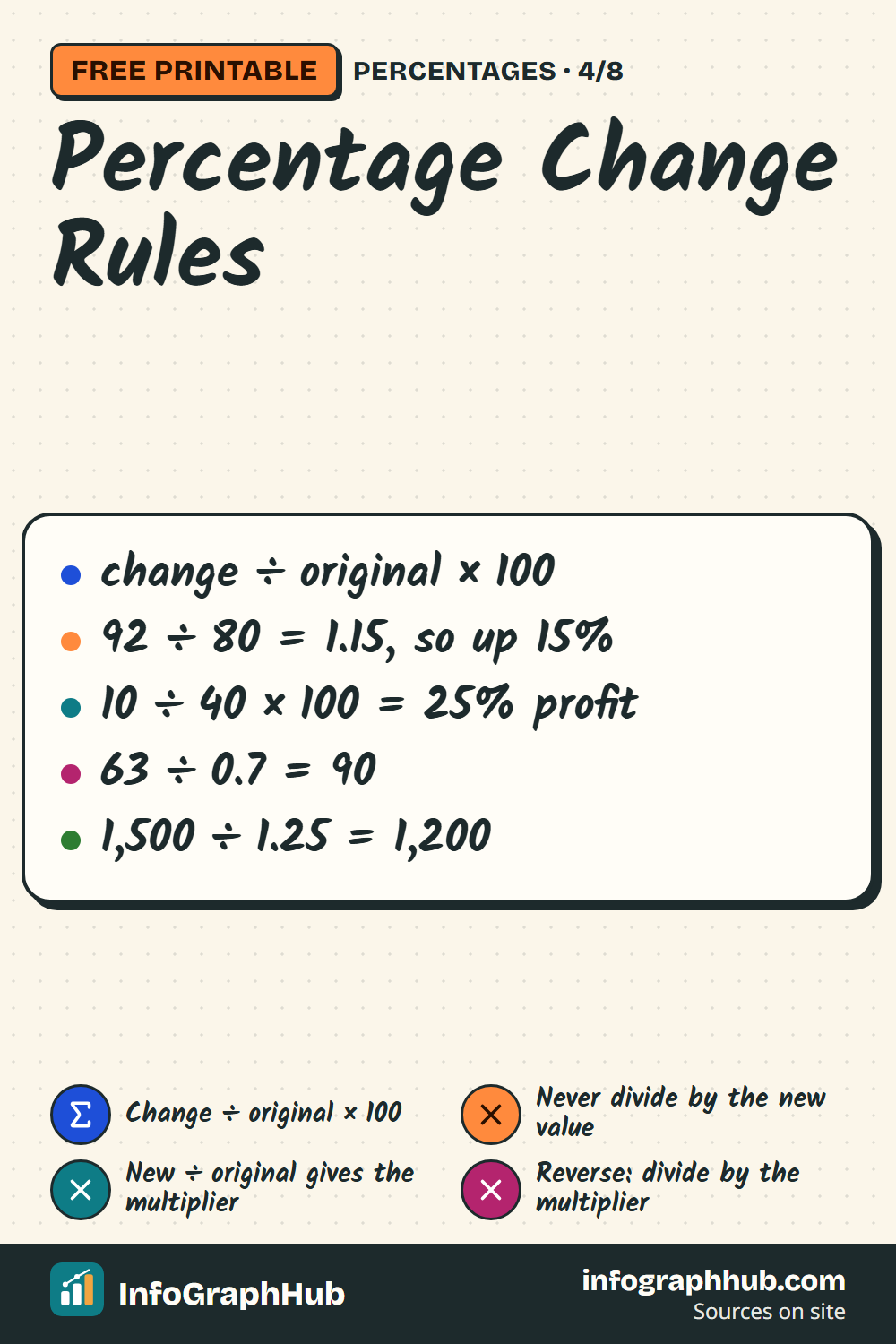
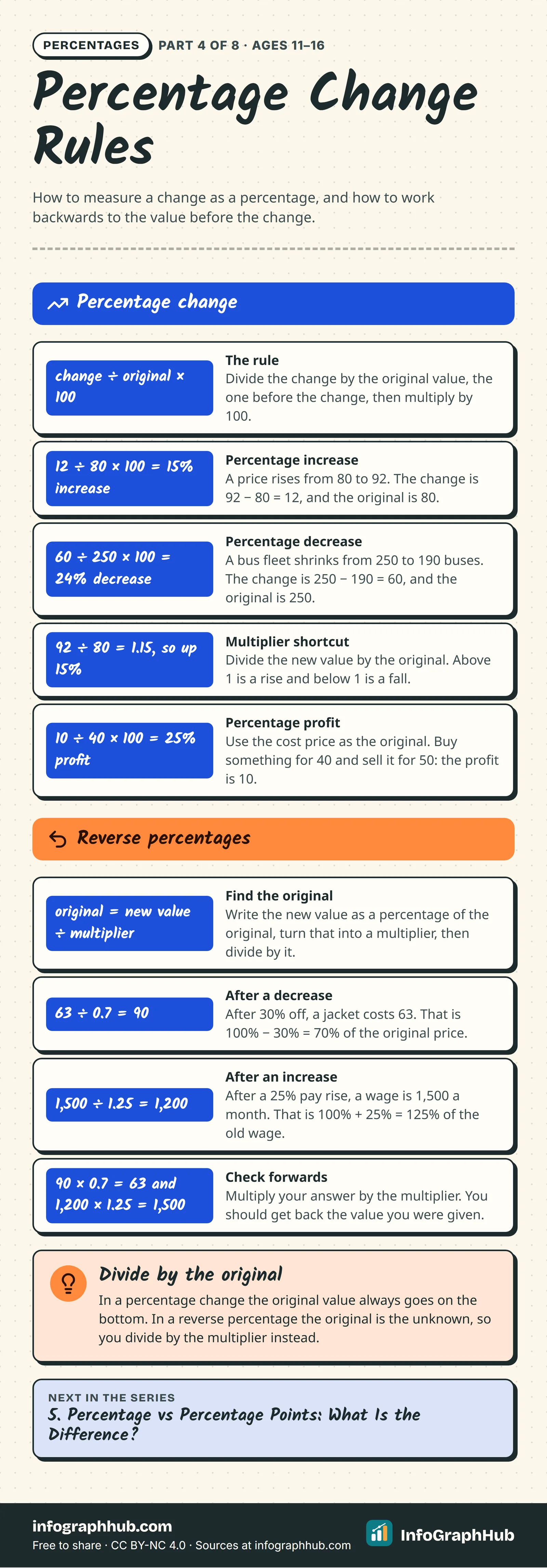
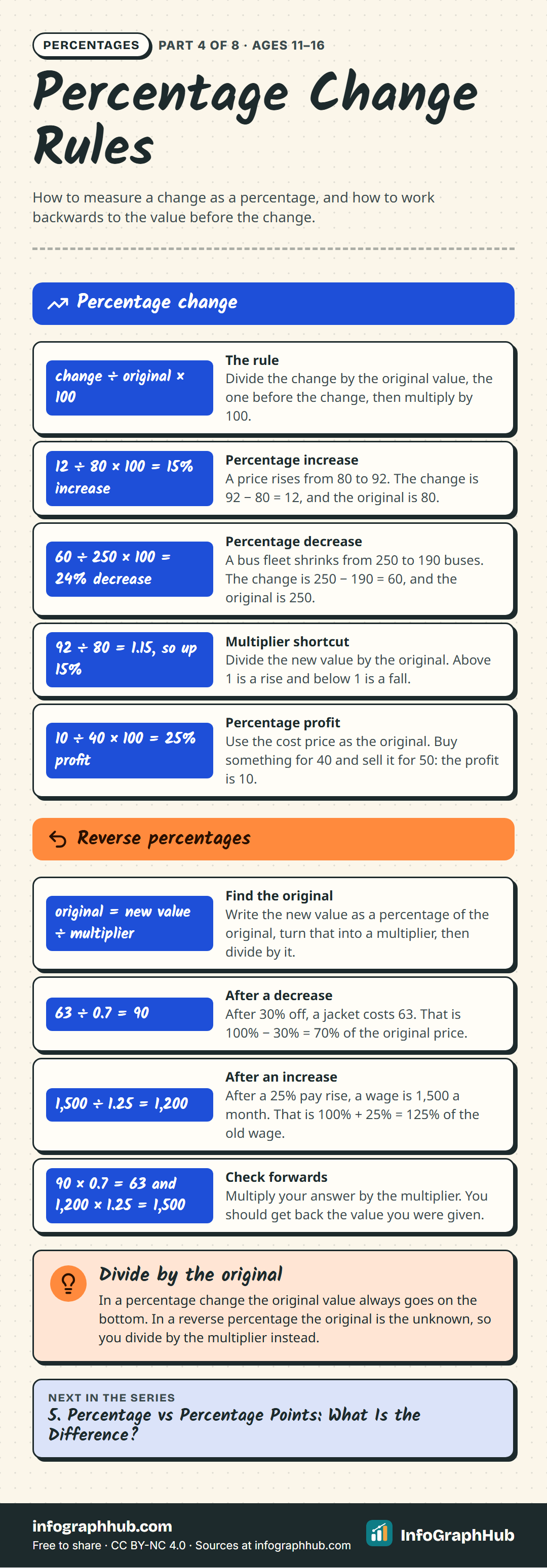
Percentage change = change ÷ original value × 100
The original value is the value before the change. Dividing by the new value is the most common mistake in this topic.
Increases and decreases
For an increase, the change is new − original. A price that goes from 80 to 92 changes by 12, so the increase is 12 ÷ 80 × 100 = 15%.
For a decrease, the change is original − new. A bus company whose fleet falls from 250 to 190 buses has lost 60, so the decrease is 60 ÷ 250 × 100 = 24%.
Say whether the change is an increase or a decrease; a bare "24%" does not tell the reader which way the value moved.
The multiplier shortcut
You can also divide the new value by the original. 92 ÷ 80 = 1.15, which is the multiplier for a 15% increase. 190 ÷ 250 = 0.76, which is the multiplier for a 24% decrease, because 1 − 0.76 = 0.24. This route links percentage change straight to the multipliers used for increasing and decreasing amounts.
Profit, loss and percentage error
The same rule has other names in other places. Percentage profit or loss compares the profit or loss with the cost price: buy for 40, sell for 50, and the profit is 10 ÷ 40 × 100 = 25%. Percentage error compares an error with the exact value: if you estimate 52 and the true value is 50, the error is 2 ÷ 50 × 100 = 4%. In every case, the value you compare with goes on the bottom.
Reverse percentages
In a reverse percentage problem you know the value after a change and want the value before it. Three steps:
- Write the new value as a percentage of the original: after 30% off, the price is 70% of the original.
- Turn it into a multiplier: 70% → 0.7.
- Divide: 63 ÷ 0.7 = 90.
For an increase it works the same way. After a 25% pay rise to 1,500 a month, 1,500 is 125% of the old wage, so the old wage was 1,500 ÷ 1.25 = 1,200. Check by multiplying forwards: 1,200 × 1.25 = 1,500.
Which rule do I need?
- You know the value before and after, and want the percentage: use the percentage change rule.
- You know the value before and the percentage, and want the value after: multiply by the multiplier.
- You know the value after and the percentage, and want the value before: divide by the multiplier.
Frequently asked questions
What is the formula for percentage change?
Percentage change = change ÷ original value × 100. A price going from 80 to 92 changes by 12, so the increase is 12 ÷ 80 × 100 = 15%.
Do you divide by the old or the new value?
Always the old (original) value, the one before the change. Dividing by the new value gives the wrong percentage.
How do you find the original amount before a percentage decrease?
Work out what percentage is left, turn it into a multiplier and divide. After 30% off, 63 is 70% of the original, so the original is 63 ÷ 0.7 = 90.
How do you work out percentage profit?
Divide the profit by the cost price and multiply by 100. Buying for 40 and selling for 50 gives a profit of 10, and 10 ÷ 40 × 100 = 25%.
Sources & methodology
Every fact is checked against the sources below. We write original explanations and draw original graphics; no figures are copied from textbooks. Spotted an error? See our corrections policy.
- Percentage change (BBC Bitesize, accessed 1 Oct 2026)
- Working with reverse percentages (National 5 Maths) (BBC Bitesize, accessed 1 Oct 2026)
- Percentage Change (Maths is Fun, accessed 1 Oct 2026)
- Prealgebra 2e, 6.2 Solve General Applications of Percent (OpenStax (Rice University), accessed 1 Oct 2026)
Editorial review pending · Updated
Made by the InfoGraphHub editorial team (how we research and check: editorial and AI policy). First published 1 October 2026, last reviewed 1 October 2026. Found a mistake? Tell the editors.
For teachers: ages and curriculum fit
Ages 11–16 · Grades 6–10 (US) · Years 7–11 (UK) · Classes 6–10 (India)
Common Core State Standards © Copyright 2010 National Governors Association Center for Best Practices and Council of Chief State School Officers. All rights reserved. Names and codes are used only to describe curriculum fit; InfoGraphHub is not endorsed by these organisations.
Embed this on your site
Paste this HTML into your page. Keep the credit line: it is required by the CC BY-NC 4.0 license.
Related infographics


For teachers and parents: new InfoGraphHub resources by email
One short email when new free resources go live. For adults (18+) only. No spam, no tracking in emails, unsubscribe anytime.