MathsWorked examplePart 2 of 8, PercentagesUpdated 1 October 2026
Finding a Percentage of an Amount: Worked Examples
Three worked examples of finding a percentage of an amount: building 35% from 10% and 5% and building 23% from 10% and 1% without a calculator, then the one-step calculator method that turns the percentage into a decimal and multiplies.
Use this infographic
Free under CC BY-NC 4.0, with credit to InfoGraphHub.
Two ways to find a percentage
Finding a percentage of an amount means finding that many hundredths of it. 35% of 260 is 35 hundredths of 260. There are two good ways to do it:
- In your head or on paper, by building the percentage from easy pieces such as 10%, 5% and 1%.
- On a calculator, by turning the percentage into a decimal and multiplying.
Both give exactly the same answer. The mental method is quicker for friendly numbers and is the one you need in a non-calculator exam; the calculator method works for any percentage at all.
The building blocks: 10%, 5% and 1%
A few percentages are easy to find straight away:
- 50%: halve the amount.
- 25%: halve it, then halve again.
- 10%: divide by 10.
- 5%: halve the 10%.
- 1%: divide by 100.
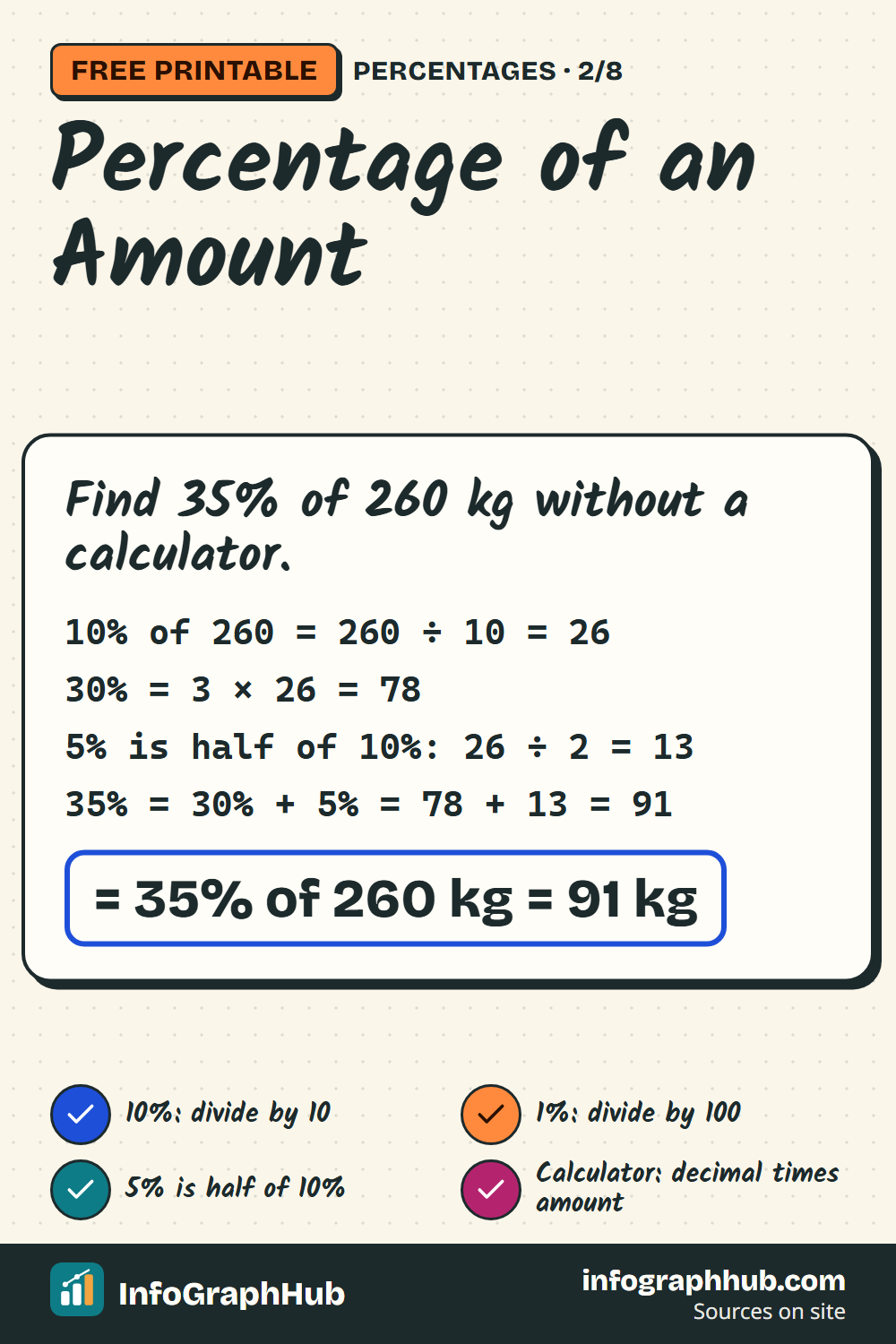
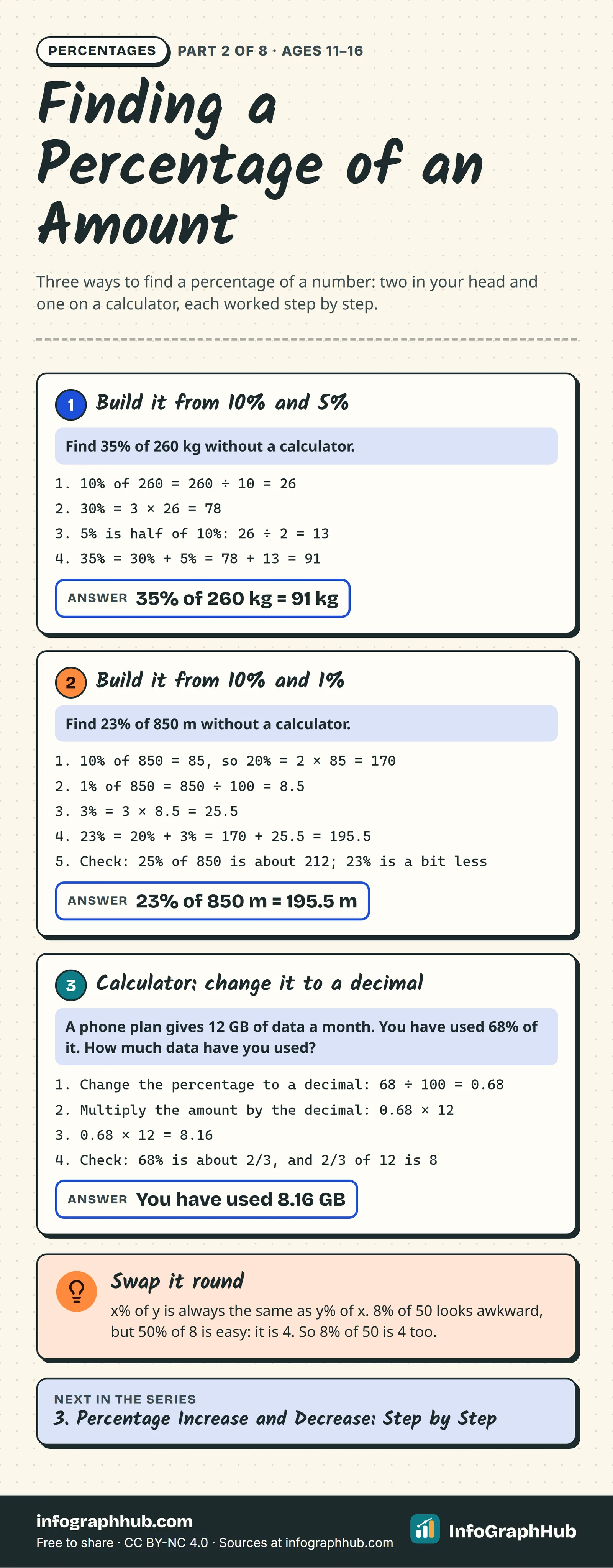
Any other percentage can be built from these. 35% is 10% + 10% + 10% + 5%. 23% is 10% + 10% + 1% + 1% + 1%. 17.5% is 10% + 5% + 2.5%: for 640 that is 64 + 32 + 16 = 112. Write each piece down as you go, then add them; most errors come from losing one of the pieces.
The calculator method
Divide the percentage by 100 to get a decimal, then multiply the amount by it:
- 68% of 12 GB → 0.68 × 12 = 8.16 GB.
- 12.5% of 46.80 → 0.125 × 46.80 = 5.85.
- 4% of 250 → 0.04 × 250 = 10.
The decimal is called a multiplier. Getting it right is the whole method, so take care with small percentages: 4% is 0.04, not 0.4. With money, round the final answer to two decimal places, not the steps in between.
Using fractions and bar models
Some percentages are simple fractions: 50% = 1/2, 25% = 1/4, 20% = 1/5 and 12.5% = 1/8. So 12.5% of 46.80 is 46.80 ÷ 8 = 5.85, the same answer as the calculator.
A bar model helps when the numbers feel abstract. Draw a bar for the whole amount and label it 100%. Split it into 10 equal parts, so each part is 10%. To find 30% of 260, each part is 26 and three parts are 78.
Checking your answer
Always estimate first. 23% is a bit less than a quarter, and a quarter of 850 is about 212, so an answer of 195.5 is sensible but 1,955 or 19.55 is not. Another check: a percentage under 100% must give an answer smaller than the amount you started with.
The swap trick is a useful shortcut and a check: x% of y equals y% of x, because both are x × y ÷ 100. NRICH uses it in its problem Valuable Percentages: 50% of 10 and 10% of 50 are both 5.
Frequently asked questions
How do you find 10% of a number?
Divide it by 10. 10% of 260 is 26 and 10% of 850 is 85. From 10% you can build many others: double it for 20%, or halve it for 5%.
How do you find 1% of a number?
Divide it by 100. 1% of 850 is 8.5. Multiply the 1% to get small percentages such as 3% (25.5), then add them to other pieces.
How do you find a percentage of an amount on a calculator?
Divide the percentage by 100 to make a decimal, then multiply by the amount. 68% of 12 is 0.68 × 12 = 8.16.
How do you find 17.5% without a calculator?
Build it from 10%, 5% and 2.5%. For 640: 10% is 64, 5% is 32 and 2.5% is 16, so 17.5% is 64 + 32 + 16 = 112.
Sources & methodology
Every fact is checked against the sources below. We write original explanations and draw original graphics; no figures are copied from textbooks. Spotted an error? See our corrections policy.
- How to work out a percentage of an amount (BBC Bitesize, accessed 1 Oct 2026)
- How to work out a percentage of an amount (1% method) (BBC Bitesize, accessed 1 Oct 2026)
- How to find a percentage of an amount using bar models (BBC Bitesize, accessed 1 Oct 2026)
- Introduction to Percents (Maths is Fun, accessed 1 Oct 2026)
- Valuable Percentages (NRICH, University of Cambridge, accessed 1 Oct 2026)
Editorial review pending · Updated
Made by the InfoGraphHub editorial team (how we research and check: editorial and AI policy). First published 1 October 2026, last reviewed 1 October 2026. Found a mistake? Tell the editors.
For teachers: ages and curriculum fit
Ages 11–16 · Grades 6–10 (US) · Years 7–11 (UK) · Classes 6–10 (India)
Common Core State Standards © Copyright 2010 National Governors Association Center for Best Practices and Council of Chief State School Officers. All rights reserved. Names and codes are used only to describe curriculum fit; InfoGraphHub is not endorsed by these organisations.
Embed this on your site
Paste this HTML into your page. Keep the credit line: it is required by the CC BY-NC 4.0 license.
Related infographics


For teachers and parents: new InfoGraphHub resources by email
One short email when new free resources go live. For adults (18+) only. No spam, no tracking in emails, unsubscribe anytime.