MathsVisual listPart 7 of 8, PercentagesUpdated 1 October 2026
Percentages in Everyday Life: 8 Real Examples
Eight places percentages turn up every day, each with the maths: sale discounts, VAT, GST and sales tax, tips, interest on savings and loans, food labels, statistics in the news, phone battery levels and test scores.
Use this infographic
Free under CC BY-NC 4.0, with credit to InfoGraphHub.
Shopping: discounts and taxes
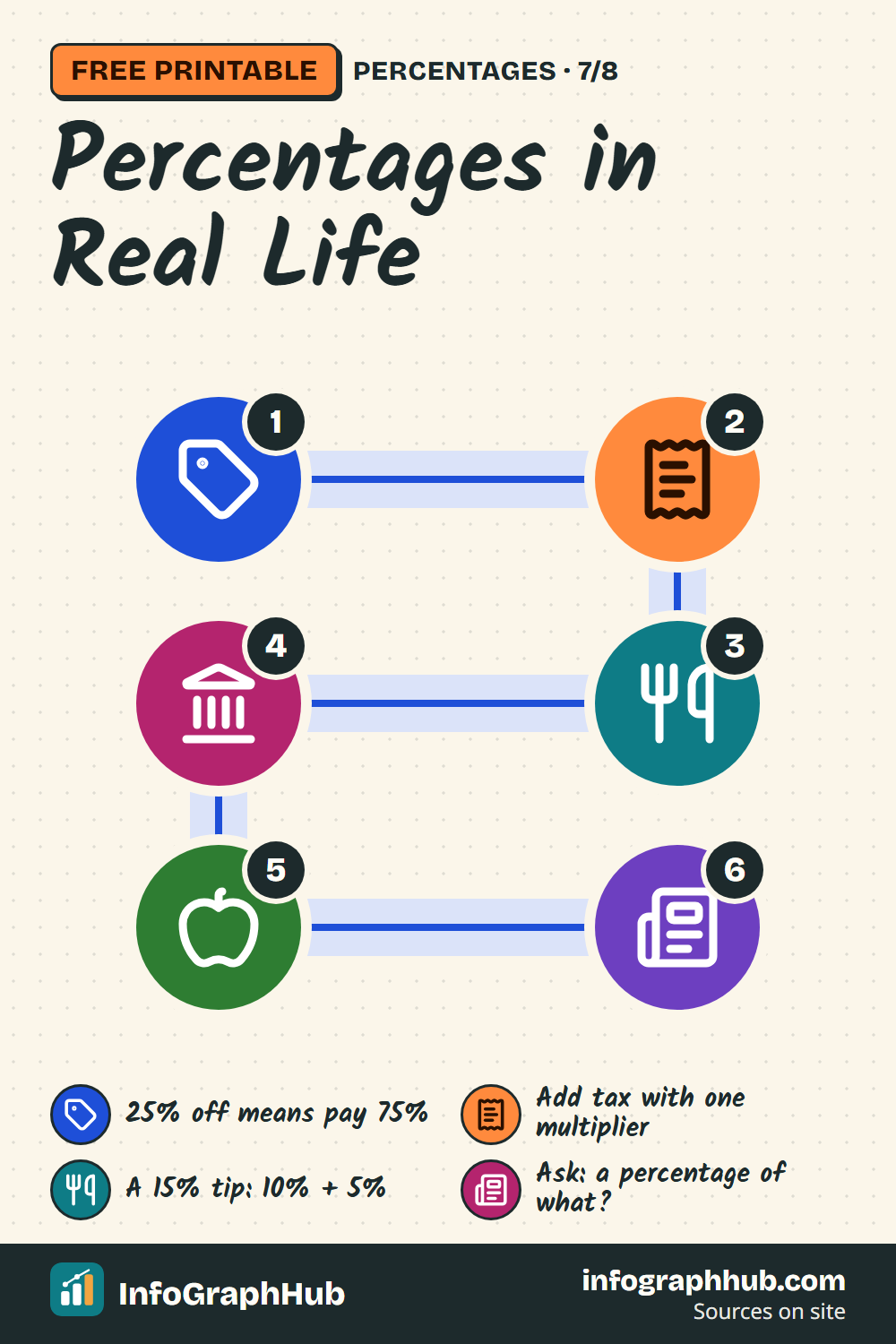
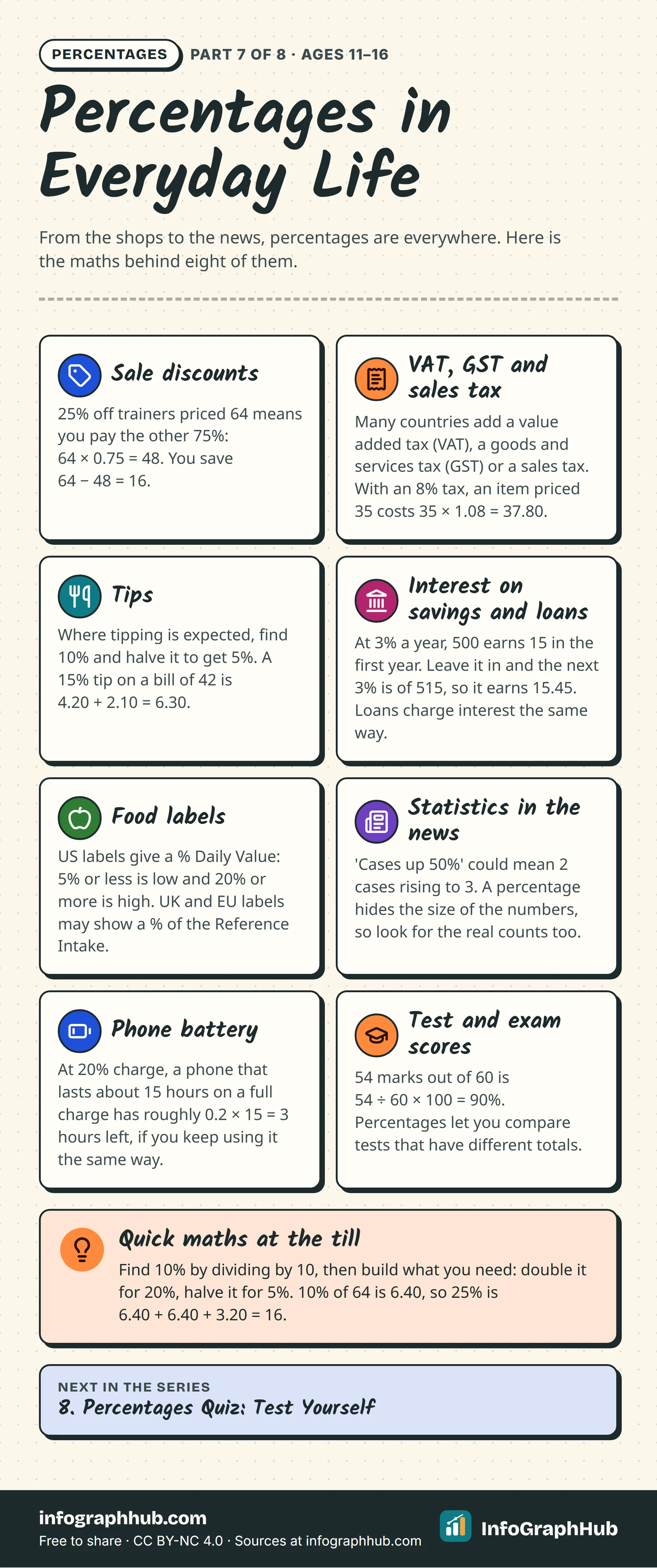
A discount takes a percentage off the price. The quickest way to find the sale price is to work out what you still pay: 25% off means paying 75%, so trainers priced 64 cost 64 × 0.75 = 48 and you save 16.
Taxes on spending add a percentage instead. Depending on where you live this is called a value added tax (VAT), a goods and services tax (GST) or a sales tax, and the rate depends on the country, and sometimes on the region or the type of goods. In some places shop prices already include the tax; in others it is added when you pay. With an 8% tax, an item priced 35 costs 35 × 1.08 = 37.80.
Tips and service charges
In countries where tipping is expected, a tip is usually a percentage of the bill. Mental maths works well: 10% of 42 is 4.20, 5% is half of that, 2.10, so a 15% tip is 6.30 and the total is 48.30. Some restaurants add a fixed service charge, which is worked out the same way.
Interest on savings and loans
Banks describe interest as a percentage of the money, usually per year. Savings of 500 at 3% a year earn 500 × 0.03 = 15 in the first year. If the interest is left in the account, the second year's interest is 3% of 515, which is 15.45: interest is now being earned on interest. This is compound interest, and it works the same way, against you, on loans and credit cards.
Food labels
Nutrition labels compare a portion with a daily amount. In the US, the Nutrition Facts label gives a % Daily Value, and the FDA treats 5% or less of a nutrient per serving as low and 20% or more as high. In the UK and the EU, labels may show the amount as a percentage of the Reference Intake, a guide to the daily amount an average adult needs.
Statistics in the news
Headlines love percentages because they make changes easy to compare, but they can also mislead. "Cases up 50%" sounds dramatic, yet a rise from 2 cases to 3 is a 50% rise. A survey that says "80% of people agree" may have asked only 10 people. When you meet a percentage in the news, ask two questions: a percentage of what? and how many is that? Watch for the difference between per cent and percentage points too.
Batteries, downloads and scores
A phone's battery icon shows the charge left as a percentage of a full charge. If a full charge lasts about 15 hours of your normal use, 20% leaves roughly 3 hours. Download and progress bars work the same way: 45% of a 2 GB file is 0.9 GB. And test scores become percentages so that different tests can be compared: 54 out of 60 is 90%, which beats 40 out of 50, which is 80%.
Frequently asked questions
How do you work out a discount?
Find what percentage you still pay and multiply. 25% off means you pay 75%, so a price of 64 becomes 64 × 0.75 = 48. The saving is 64 − 48 = 16.
What is the difference between VAT, GST and sales tax?
They are names used in different countries for taxes charged as a percentage of the price of goods and services. Rates vary from place to place. The maths is the same: multiply by 1 plus the rate, so 8% tax means × 1.08.
How do you work out a 15% tip?
Find 10% of the bill by dividing by 10, halve it to get 5%, and add the two. For a bill of 42: 4.20 + 2.10 = 6.30.
What does % Daily Value mean on a food label?
It shows how much of a nutrient one serving gives compared with a daily amount. The US FDA says 5% or less is low and 20% or more is high.
Sources & methodology
Every fact is checked against the sources below. We write original explanations and draw original graphics; no figures are copied from textbooks. Spotted an error? See our corrections policy.
- Prealgebra 2e, 6.3 Solve Sales Tax, Commission, and Discount Applications (OpenStax (Rice University), accessed 1 Oct 2026)
- 7th grade math, Unit 2: Rates and percentages (Khan Academy, accessed 1 Oct 2026)
- Working out percentages of an amount and price discounts (BBC Bitesize, accessed 1 Oct 2026)
- Repeated percentage change, interest and exponential change (BBC Bitesize, accessed 1 Oct 2026)
- How to Understand and Use the Nutrition Facts Label (U.S. Food and Drug Administration (FDA), accessed 1 Oct 2026)
- How to read food labels (NHS, accessed 1 Oct 2026)
Editorial review pending · Updated
Made by the InfoGraphHub editorial team (how we research and check: editorial and AI policy). First published 1 October 2026, last reviewed 1 October 2026. Found a mistake? Tell the editors.
For teachers: ages and curriculum fit
Ages 11–16 · Grades 6–10 (US) · Years 7–11 (UK) · Classes 6–10 (India)
Common Core State Standards © Copyright 2010 National Governors Association Center for Best Practices and Council of Chief State School Officers. All rights reserved. Names and codes are used only to describe curriculum fit; InfoGraphHub is not endorsed by these organisations.
Embed this on your site
Paste this HTML into your page. Keep the credit line: it is required by the CC BY-NC 4.0 license.
Related infographics


For teachers and parents: new InfoGraphHub resources by email
One short email when new free resources go live. For adults (18+) only. No spam, no tracking in emails, unsubscribe anytime.