MathsQuizPart 8 of 8, PercentagesUpdated 1 October 2026
Percentages Quiz: Test Yourself
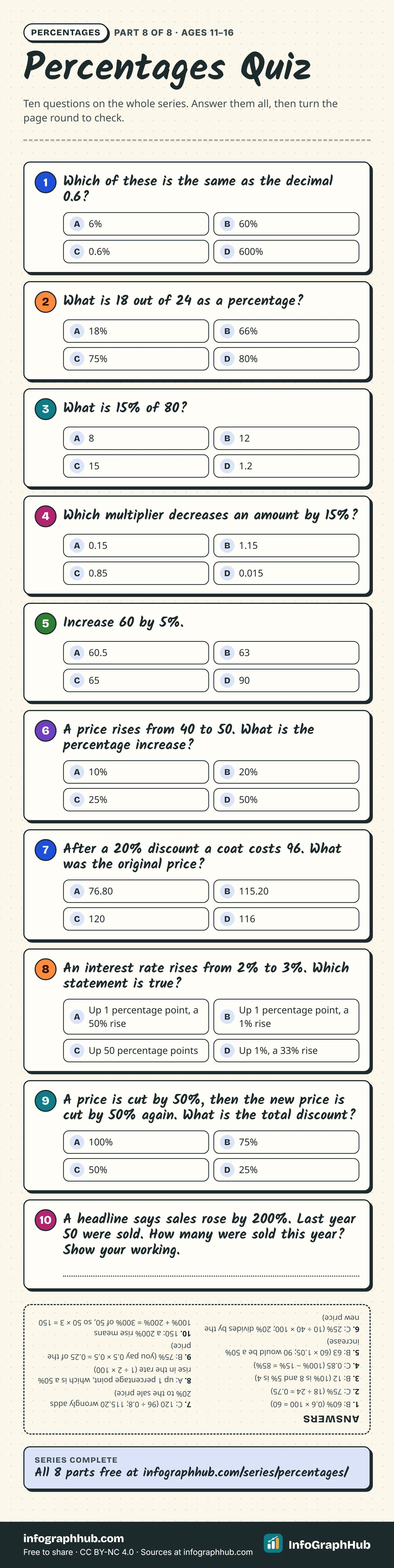
Ten questions covering the whole percentages series: converting decimals, one amount as a percentage of another, percentage of an amount, multipliers, percentage change, reverse percentages, percentage points, successive discounts and a news headline, with worked answers.
Use this infographic
Free under CC BY-NC 4.0, with credit to InfoGraphHub.
How to use this quiz
Try all ten questions before you look at the answers. Questions 1 to 9 are multiple choice; question 10 needs a short written answer with working. The answers are printed upside down at the foot of the infographic. The worked answers below explain why each answer is right and why the tempting wrong options are wrong, which is where most of the learning happens.
1–2. What a percentage is
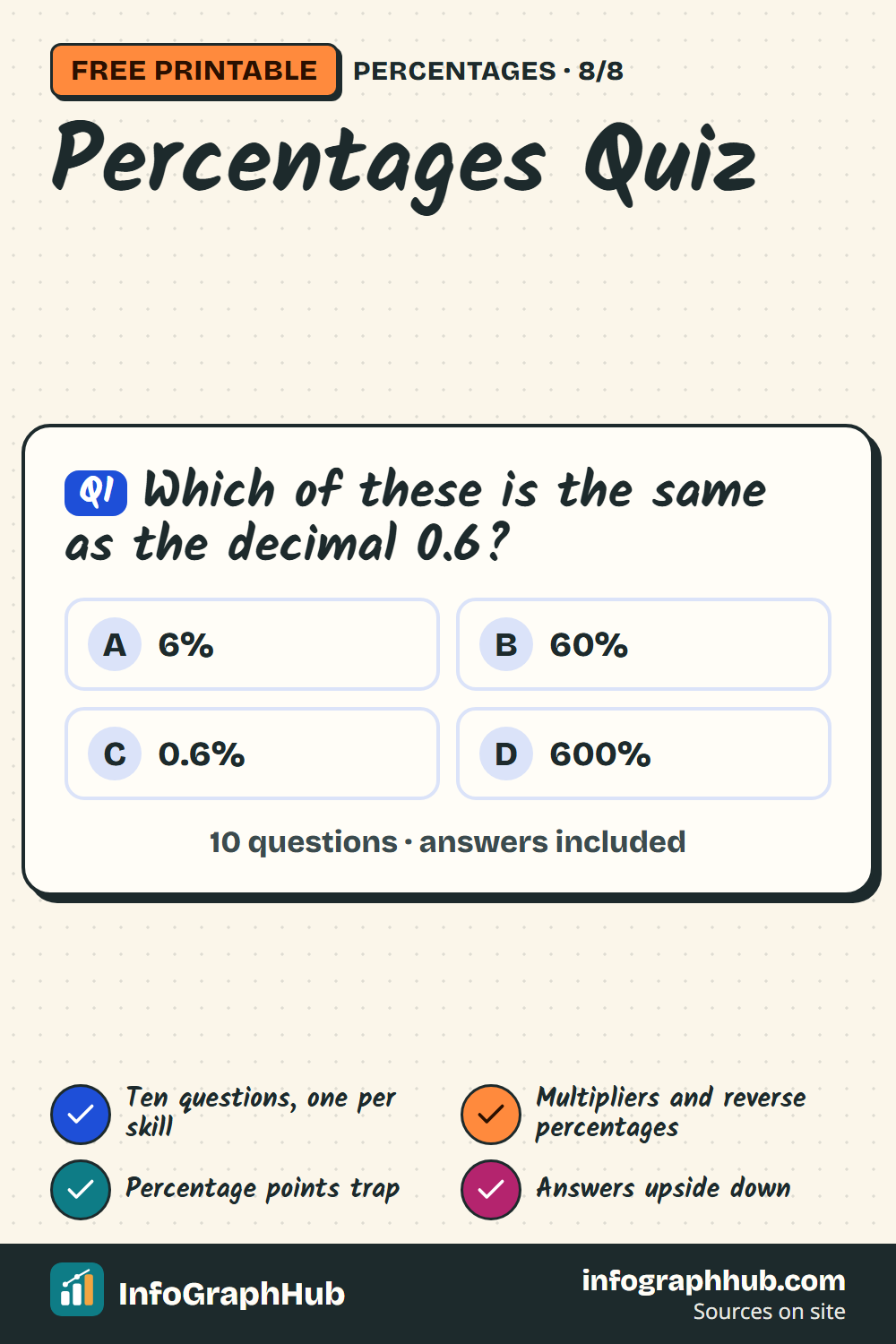
1. Answer: B, 60%. To change a decimal to a percentage, multiply by 100: 0.6 × 100 = 60. 6% would be 0.06, and 0.6% would be 0.006.
2. Answer: C, 75%. Write the score as a fraction and divide: 18 ÷ 24 = 0.75, then × 100 = 75%. A test with 30 out of 40 gives the same percentage, which is why percentages are good for comparing.
3. Percentage of an amount
Answer: B, 12. Build 15% from easy pieces. 10% of 80 is 8 and 5% is half of that, 4, so 15% is 8 + 4 = 12. On a calculator: 0.15 × 80 = 12.
4–5. Multipliers
4. Answer: C, 0.85. A 15% decrease leaves 100% − 15% = 85% of the amount, and 85% as a decimal is 0.85. 0.15 would find 15% of the amount, not decrease it, and 1.15 is the multiplier for an increase.
5. Answer: B, 63. A 5% increase leaves 105%, so the multiplier is 1.05 and 60 × 1.05 = 63. Option D, 90, is what you get with × 1.5, which is a 50% increase: watch the zero.
6–7. Percentage change and reverse percentages
6. Answer: C, 25%. The change is 50 − 40 = 10, and you divide by the original price: 10 ÷ 40 × 100 = 25%. Dividing by the new price, 10 ÷ 50 × 100, gives the wrong answer of 20%.
7. Answer: C, 120. After a 20% discount the coat costs 80% of the original, so 96 = original × 0.8 and the original is 96 ÷ 0.8 = 120. Check: 120 × 0.8 = 96. Option B adds 20% to 96, but the 20% was of the original price, not the sale price.
8. Percentage points
Answer: A. The rate has gone up by 3 − 2 = 1 percentage point. Compared with the starting rate that is 1 ÷ 2 × 100 = a 50% rise. Both descriptions are correct; they just measure different things.
9. Successive discounts
Answer: B, 75%. The second 50% is taken from the already halved price. Multiplying the multipliers, 0.5 × 0.5 = 0.25, so you pay a quarter of the original price and the total discount is 75%. A price of 80 becomes 40, then 20.
10. Reading a headline
Model answer: 150. A 200% rise means this year's sales are the original 100% plus another 200%, which is 300% of last year's. 300% as a multiplier is 3, so 50 × 3 = 150. A common wrong answer is 100, which treats "a 200% rise" as "200% of".
Frequently asked questions
How can teachers use this quiz in class?
As a starter or plenary, as a check at the end of the percentages topic, or as homework. Students can mark each other's work with the answer strip, then use the worked answers to talk through any they got wrong.
Which parts of the series does the quiz cover?
All of them: what a percentage is, percentage of an amount, increase and decrease with multipliers, percentage change and reverse percentages, percentage points, common mistakes and percentages in everyday life.
Can I use a calculator?
Try the quiz without one first: every question can be done with mental methods such as 10%, 5% and simple multipliers. Then use a calculator to check your answers.
What should I do if I get a question wrong?
Read the worked answer for that question, then go back to the matching part of the series. For example, a wrong answer on question 7 points to the percentage change and reverse percentages part.
Sources & methodology
Every fact is checked against the sources below. We write original explanations and draw original graphics; no figures are copied from textbooks. Spotted an error? See our corrections policy.
- Percentage change (BBC Bitesize, accessed 1 Oct 2026)
- Repeated percentage change, interest and exponential change (BBC Bitesize, accessed 1 Oct 2026)
- Percentage Points (Maths is Fun, accessed 1 Oct 2026)
- 7th grade math, Unit 2: Rates and percentages (Khan Academy, accessed 1 Oct 2026)
- Percentages (problem collection) (NRICH, University of Cambridge, accessed 1 Oct 2026)
Editorial review pending · Updated
Made by the InfoGraphHub editorial team (how we research and check: editorial and AI policy). First published 1 October 2026, last reviewed 1 October 2026. Found a mistake? Tell the editors.
For teachers: ages and curriculum fit
Ages 11–16 · Grades 6–10 (US) · Years 7–11 (UK) · Classes 6–10 (India)
Common Core State Standards © Copyright 2010 National Governors Association Center for Best Practices and Council of Chief State School Officers. All rights reserved. Names and codes are used only to describe curriculum fit; InfoGraphHub is not endorsed by these organisations.
Embed this on your site
Paste this HTML into your page. Keep the credit line: it is required by the CC BY-NC 4.0 license.
Related infographics


For teachers and parents: new InfoGraphHub resources by email
One short email when new free resources go live. For adults (18+) only. No spam, no tracking in emails, unsubscribe anytime.