MathsProcessPart 3 of 8, PercentagesUpdated 1 October 2026
Percentage Increase and Decrease: Step by Step
How to increase or decrease an amount by a percentage in one step with a multiplier: start from 100%, add or take away the change, divide by 100 and multiply. Worked through with a price of 240 going up and down by 15% (× 1.15 and × 0.85).
Interactive
Explore it step by step
6 steps: Start at 100% → Add or take away the change → Turn it into a multiplier → Multiply the original → Check the direction → Or: find the change, then add or subtract. Press play, or choose a number to explore.
Step 1 of 6: Start at 100%
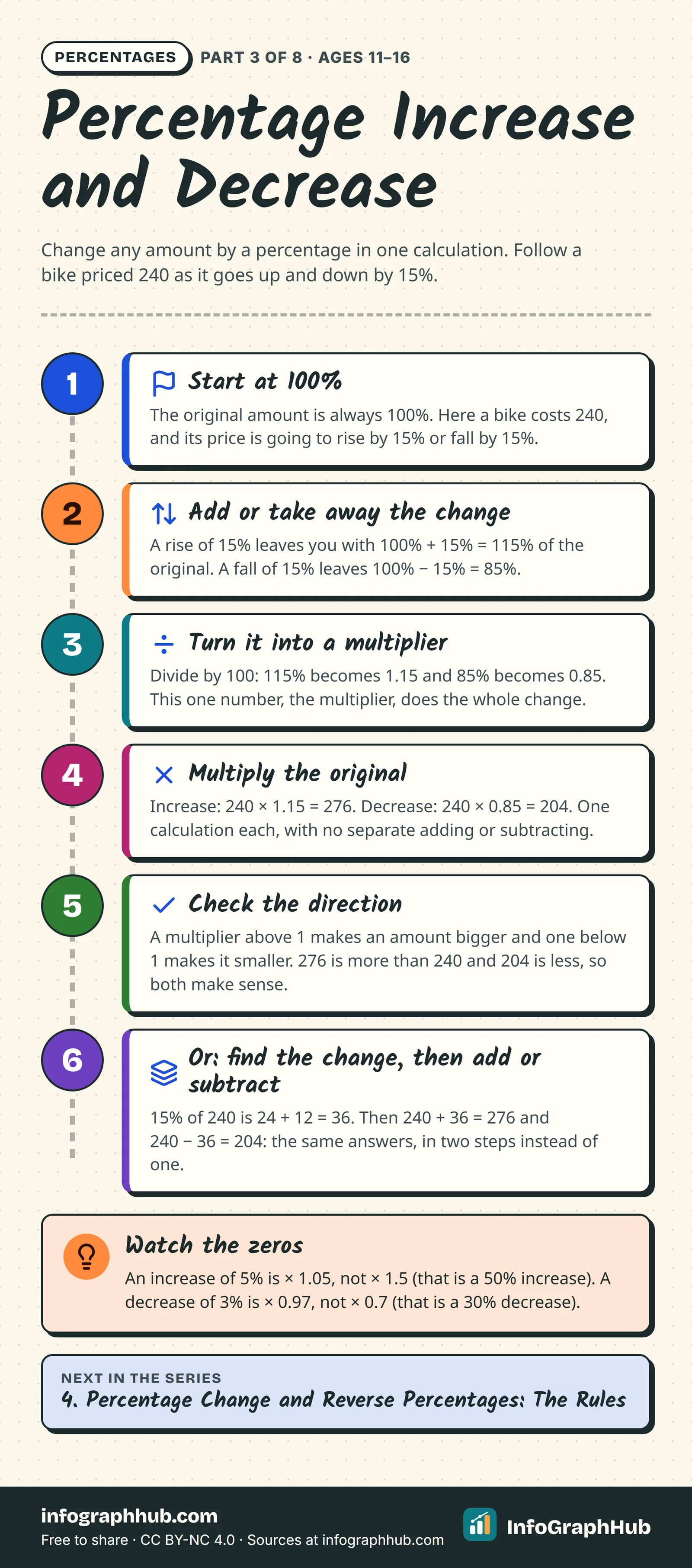
The original amount is always 100%. Here a bike costs 240, and its price is going to rise by 15% or fall by 15%.
Step 2 of 6: Add or take away the change
A rise of 15% leaves you with 100% + 15% = 115% of the original. A fall of 15% leaves 100% − 15% = 85%.
Step 3 of 6: Turn it into a multiplier
Divide by 100: 115% becomes 1.15 and 85% becomes 0.85. This one number, the multiplier, does the whole change.
Step 4 of 6: Multiply the original
Increase: 240 × 1.15 = 276. Decrease: 240 × 0.85 = 204. One calculation each, with no separate adding or subtracting.
Step 5 of 6: Check the direction
A multiplier above 1 makes an amount bigger and one below 1 makes it smaller. 276 is more than 240 and 204 is less, so both make sense.
Step 6 of 6: Or: find the change, then add or subtract
15% of 240 is 24 + 12 = 36. Then 240 + 36 = 276 and 240 − 36 = 204: the same answers, in two steps instead of one.
Use this infographic
Free under CC BY-NC 4.0, with credit to InfoGraphHub.
Two ways to change an amount by a percentage
To increase or decrease an amount by a percentage you can either:
- Find the change, then add or subtract it. 15% of 240 is 36, so a 15% rise gives 240 + 36 = 276 and a 15% fall gives 240 − 36 = 204.
- Use a multiplier. Work out what percentage of the original you end up with, write it as a decimal and multiply once: 240 × 1.15 = 276 and 240 × 0.85 = 204.
The first method is easy to follow and good for mental maths. The second is faster on a calculator, and it is the one you will need for reverse percentages and for several changes in a row.
Why the multiplier works
The original amount is 100% of itself. After a 15% rise you have the original 100% plus another 15%, so 115% of the original. 115% of 240 is 1.15 × 240, which is exactly the increased price. After a 15% fall you keep 100% − 15% = 85%, and 85% of 240 is 0.85 × 240.
So the multiplier is just (100 + increase) ÷ 100 or (100 − decrease) ÷ 100.
A table of multipliers
| Change | You end up with | Multiplier |
|---|---|---|
| Increase by 15% | 115% | 1.15 |
| Decrease by 15% | 85% | 0.85 |
| Increase by 5% | 105% | 1.05 |
| Decrease by 3% | 97% | 0.97 |
| Decrease by 40% | 60% | 0.6 |
| Increase by 100% | 200% | 2 |
| Increase by 150% | 250% | 2.5 |
Increases bigger than 100% are allowed. A plant 40 cm tall that grows by 150% ends up 40 × 2.5 = 100 cm tall. Decreases can go down to 100%, which leaves nothing (× 0).
Checking your answer
Two quick checks catch most slips. First, the direction: a multiplier bigger than 1 must give a bigger answer, and a multiplier between 0 and 1 a smaller one. Second, the size: 15% is between 10% and 20%, so a 15% change on 240 should move it by between 24 and 48. If your answer has moved by 3.6 or 360, a decimal point has slipped.
With money, round to two decimal places at the end: a 7% rise on 18.50 is 18.50 × 1.07 = 19.795, which rounds to 19.80.
When to use which method
Use the find-the-change method when you need to know the size of the change itself, for example how much you save in a sale, or when the numbers are friendly enough for mental maths. Use the multiplier when you only need the final amount, when you have a calculator, or when there is more than one change to apply. For several changes in a row you multiply by each multiplier in turn; the common mistakes part of this series shows why you must not simply add the percentages.
Frequently asked questions
What is the multiplier for a 15% increase?
1.15. You keep the original 100% and add 15%, which makes 115%, and 115 ÷ 100 = 1.15. So 240 increased by 15% is 240 × 1.15 = 276.
What is the multiplier for a 15% decrease?
0.85. You keep 100% − 15% = 85% of the original, and 85 ÷ 100 = 0.85. So 240 decreased by 15% is 240 × 0.85 = 204.
How do you increase an amount by a percentage without a calculator?
Find the percentage of the amount using 10%, 5% and 1%, then add it on. 15% of 240 is 24 + 12 = 36, so the new amount is 240 + 36 = 276.
Can you increase something by more than 100%?
Yes. A 100% increase doubles an amount (× 2) and a 150% increase multiplies it by 2.5. A decrease can only go as far as 100%, which leaves zero.

Sources & methodology
Every fact is checked against the sources below. We write original explanations and draw original graphics; no figures are copied from textbooks. Spotted an error? See our corrections policy.
- How to increase an amount by a percentage (BBC Bitesize, accessed 1 Oct 2026)
- How to decrease an amount by a percentage (BBC Bitesize, accessed 1 Oct 2026)
- Prealgebra 2e, 6.2 Solve General Applications of Percent (OpenStax (Rice University), accessed 1 Oct 2026)
- Percentage Change (Maths is Fun, accessed 1 Oct 2026)
Editorial review pending · Updated
Made by the InfoGraphHub editorial team (how we research and check: editorial and AI policy). First published 1 October 2026, last reviewed 1 October 2026. Found a mistake? Tell the editors.
For teachers: ages and curriculum fit
Ages 11–16 · Grades 6–10 (US) · Years 7–11 (UK) · Classes 6–10 (India)
Common Core State Standards © Copyright 2010 National Governors Association Center for Best Practices and Council of Chief State School Officers. All rights reserved. Names and codes are used only to describe curriculum fit; InfoGraphHub is not endorsed by these organisations.
Embed this on your site
Paste this HTML into your page. Keep the credit line: it is required by the CC BY-NC 4.0 license.
Related infographics


For teachers and parents: new InfoGraphHub resources by email
One short email when new free resources go live. For adults (18+) only. No spam, no tracking in emails, unsubscribe anytime.