9-part series · Ages 11–16
The Solar System
Nine infographics that tour the Sun, the planets and the small worlds between them, from how it all formed to how we explore it.
Complete pack: all 9 parts in one PDF
Printable, with the quiz answers. Free under CC BY-NC 4.0.
The 9 parts
 Overview
The Solar System Explained
 Key numbers
The Planets by the Numbers
 Compare
Rocky Planets vs Giant Planets
 Types
Moons, Dwarf Planets, Asteroids and Comets
 How it works
How the Solar System Formed
 Timeline
Exploring the Solar System: A Timeline
 Myths vs facts
Solar System Myths and the Real Science
 Key terms
Solar System Key Terms
 Quiz
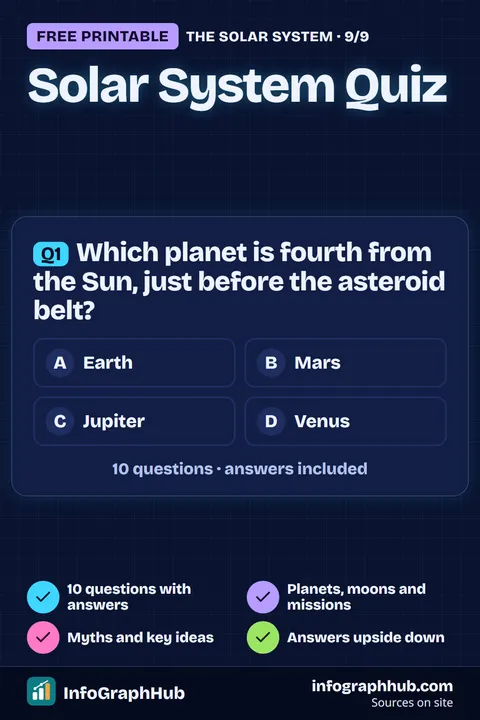
Solar System Quiz: Test Yourself


Watch the whole series

The complete guide
The Solar System explained
Our Solar System is the Sun and everything its gravity holds on to: eight planets, hundreds of moons, five named dwarf planets and millions of asteroids and comets. This series takes it one question at a time: what is out there and in what order, how big and how far, why the inner and outer planets are so different, how it all formed 4.6 billion years ago, how we have explored it, and which popular ideas about it are wrong.
Each part is a printable infographic with sources, written for ages 11–16 and their teachers, using NASA's figures with dates where numbers change. Work through them in order, or jump to the part you need, then test yourself with the quiz at the end.
What the Solar System is
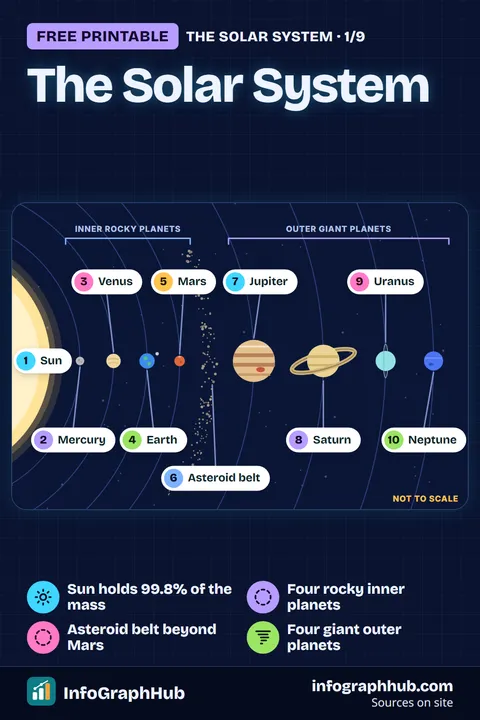
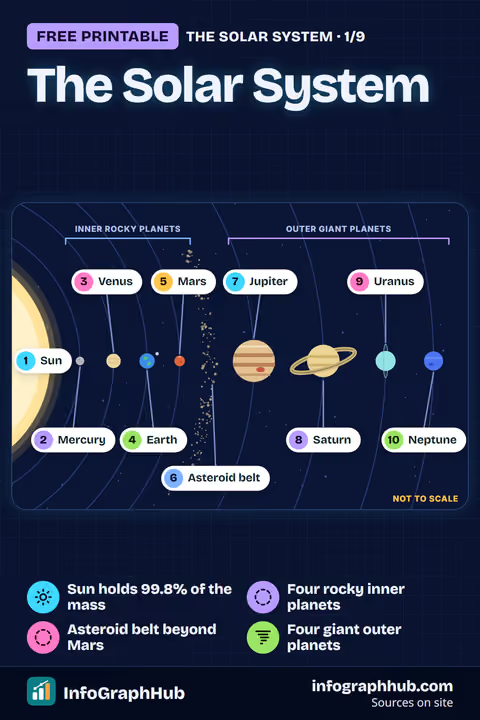
The Solar System is the Sun and every object that its gravity holds in orbit. NASA lists one star, eight planets, five officially named dwarf planets, hundreds of moons, and countless asteroids, comets and icy bodies. The name comes from sol, Latin for 'Sun'.
The Sun dominates. It holds about 99.8 per cent of all the mass in the Solar System and is about 1.4 million km across, roughly 109 times wider than Earth. Its gravity steers everything else, and its light and heat make life on Earth possible.
In order from the Sun, the eight planets are:
- Mercury
- Venus
- Earth
- Mars
- Jupiter
- Saturn
- Uranus
- Neptune
The asteroid belt, a wide ring of rocky leftovers, lies between Mars and Jupiter. Beyond Neptune is the Kuiper Belt of icy bodies, home to Pluto, and far beyond that the Oort Cloud, a vast shell of icy objects thought to reach about 100,000 times Earth's distance from the Sun.
All eight planets orbit in the same direction and in nearly the same flat plane. Their orbits are ellipses, slightly stretched circles. The closer a planet is to the Sun, the faster it travels and the shorter its year.
How big and how far: the scale of the Solar System
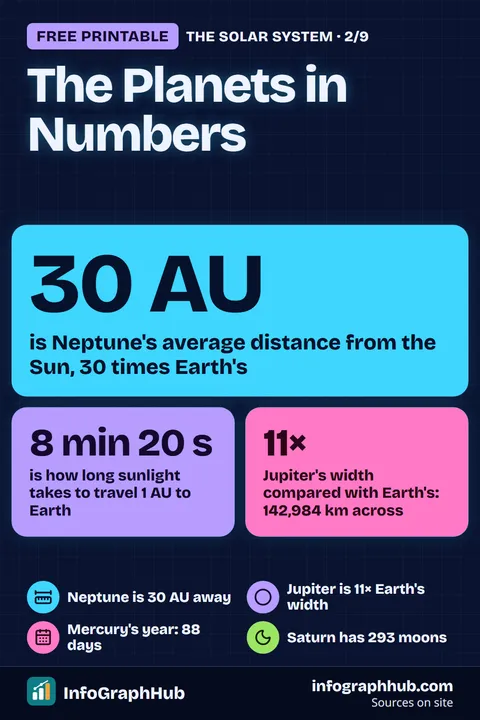
Kilometres soon become clumsy in space, so astronomers use the astronomical unit (AU), Earth's average distance from the Sun: about 149.6 million km. Average distances from the Sun, from NASA's planetary fact sheets, are:
| Planet | Distance (AU) | Diameter (km) | One orbit |
|---|---|---|---|
| Mercury | 0.39 | 4,879 | 88 days |
| Venus | 0.72 | 12,104 | 225 days |
| Earth | 1.00 | 12,756 | 365.26 days |
| Mars | 1.52 | 6,792 | 687 days |
| Jupiter | 5.20 | 142,984 | 11.9 years |
| Saturn | 9.57 | 120,536 | 29.5 years |
| Uranus | 19.17 | 51,118 | 84.0 years |
| Neptune | 30.18 | 49,528 | 164.8 years |
To convert, multiply by 149.6 million: Jupiter is 5.20 × 149.6 million ≈ 778 million km from the Sun. Light, at about 300,000 km per second, takes about 8 minutes 20 seconds to reach Earth and just over 4 hours to reach Neptune.
No diagram can show this to scale. Shrink the Sun to a 22 cm football and Earth becomes a 2 mm peppercorn about 24 metres away, while Neptune is a pea about 700 metres away. The working: the Sun is about 1.39 million km wide and Earth is 149.6 million km away, about 108 Sun-widths, and 108 × 22 cm ≈ 24 m.
Moon counts change as new small moons are confirmed. As of August 2026, NASA lists 293 confirmed moons for Saturn, 115 for Jupiter, 29 for Uranus, 16 for Neptune, 2 for Mars and 1 for Earth. Mercury and Venus have none. Always give the date when you quote a moon count.
Two families of planets
The asteroid belt divides the planets into two families.
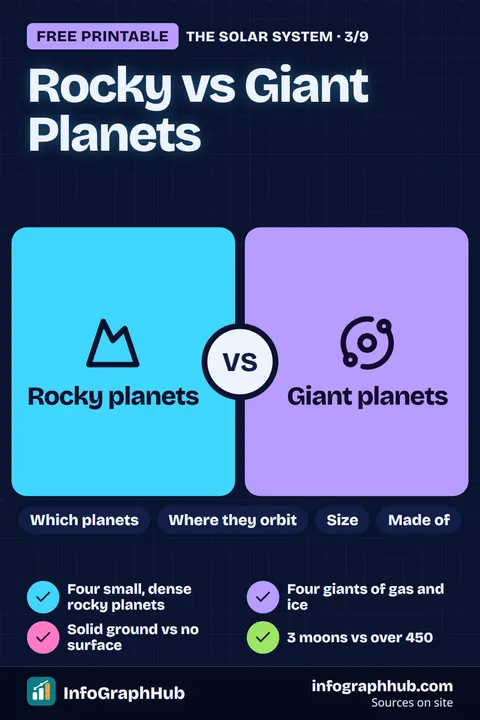
The rocky or terrestrial planets, Mercury, Venus, Earth and Mars, are small and dense, with a metal core, a rocky mantle and a solid crust. Their densities range from 3,934 kg/m³ (Mars) to 5,514 kg/m³ (Earth, the densest planet). Between them they have only three moons and no rings.
The giant planets are much bigger and have no solid surface. Jupiter and Saturn are gas giants, made mostly of hydrogen and helium. Uranus and Neptune are ice giants: NASA explains that 80 per cent or more of Uranus's mass is a hot, dense fluid of water, methane and ammonia above a small rocky core. All four giants have rings, and between them they have over 450 known moons.
A worked comparison shows the difference. Jupiter is about 11.2 times wider than Earth, so its volume is about 11.2³ ≈ 1,400 times Earth's. Yet its mass is only about 318 times Earth's. More space but much less matter per cubic metre means a low density: 1,326 kg/m³ against Earth's 5,514. Saturn's density, 687 kg/m³, is even lower than water's.
See the infographic: Part 3, Rocky Planets vs Giant Planets →
Moons, dwarf planets and other small worlds
Most objects in the Solar System are not planets.
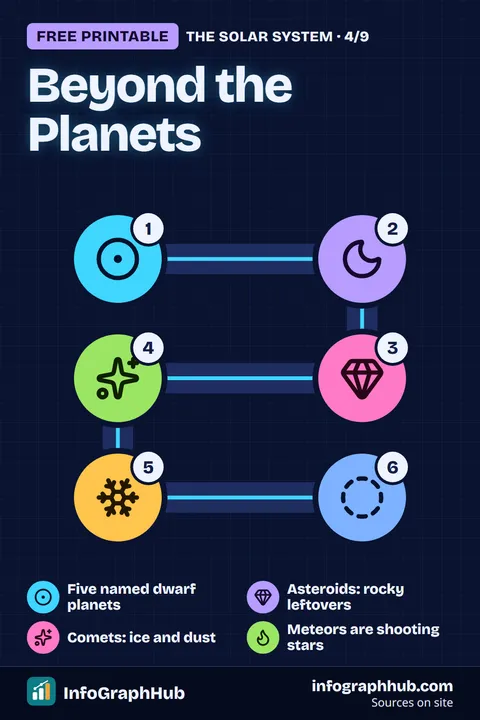
- Dwarf planets orbit the Sun and are massive enough to be nearly round, but share their orbits with other objects. NASA lists five: Ceres (in the asteroid belt), Pluto, Haumea, Makemake and Eris.
- Moons are natural satellites of planets, dwarf planets and even asteroids. Jupiter's Ganymede, the largest, is bigger than the planet Mercury; Saturn's Titan is the only moon with a thick atmosphere.
- Asteroids are rocky and metal leftovers. NASA estimates that the main belt holds 1.1 to 1.9 million asteroids larger than 1 km, yet all of them together have less mass than our Moon.
- Comets are lumps of ice and dust a few kilometres across. Near the Sun they grow a glowing coma and two tails, one of dust and one of gas, that point away from the Sun. Short-period comets mostly come from the Kuiper Belt; long-period comets fall in from the Oort Cloud.
- A meteoroid is a small space rock. The streak of light it makes burning up in Earth's air is a meteor, and any piece that lands is a meteorite.
Because many of these small bodies have barely changed since the planets formed, they are a record of what the early Solar System was like.
See the infographic: Part 4, Moons, Dwarf Planets, Asteroids and Comets →
How the Solar System formed
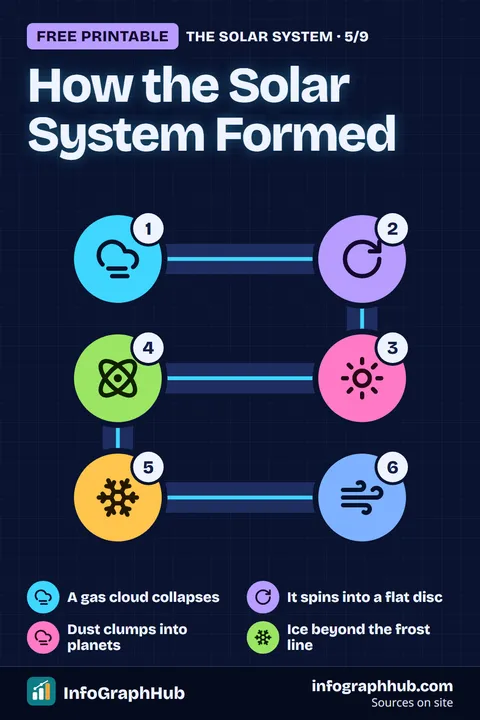
About 4.6 billion years ago, part of a cold cloud of gas and dust began to collapse, possibly squeezed by shock waves from a nearby supernova. As it shrank, it spun faster and flattened into a disc, the solar nebula. Most of the material fell to the centre, where pressure and temperature rose until hydrogen began to fuse into helium: the Sun was born.
In the surrounding disc, dust grains stuck together in a process called accretion, growing into pebbles, boulders and kilometre-sized planetesimals. NASA describes how, within about a million years, collisions had built planetary embryos roughly as massive as Mars.
Temperature decided what kind of planet formed where. Near the Sun only rock and metal could stay solid, so the inner planets stayed small and rocky. Beyond the frost line, which NASA places between the orbits of Mars and Jupiter, water and other ices also froze. With much more solid material, the outer cores grew large enough to pull in vast amounts of hydrogen and helium and became the giants.
After a few million years, radiation from the young Sun and nearby stars blew away the leftover gas. Solid bodies kept colliding and merging for millions of years more. Material that never joined a planet survives as asteroids, comets and Kuiper Belt objects.
The evidence includes the flat, same-direction orbits of the planets, primitive meteorites that date the Solar System's first solids to about 4,568 million years ago, and discs of gas and dust seen today around very young stars.
Exploring the Solar System
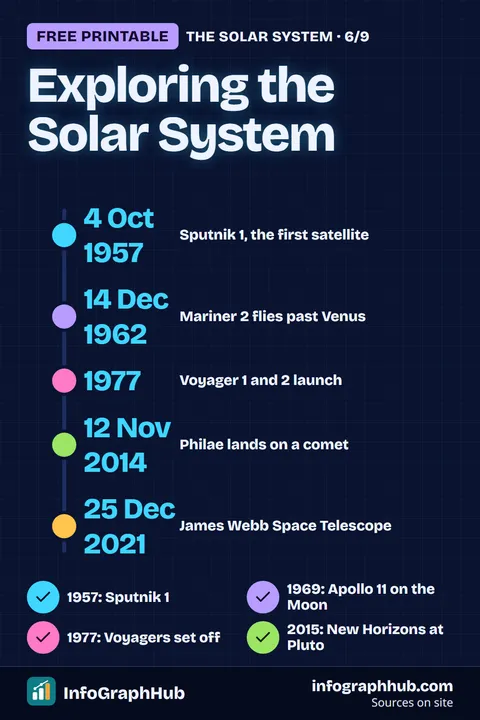
Space exploration began on 4 October 1957, when the Soviet Union launched Sputnik 1, the first artificial satellite. Milestones followed quickly:
- 1959: the Soviet probe Luna 2 reached the Moon on 13 September, the first spacecraft to reach another world; Luna 3 photographed the far side weeks later.
- 1962: NASA's Mariner 2 flew past Venus on 14 December, the first successful visit to another planet.
- 1969: Apollo 11 landed on the Moon on 20 July, and six Apollo crews landed by 1972.
- 1977: Voyager 2 (20 August) and Voyager 1 (5 September) launched. Voyager 2 is still the only spacecraft to visit Uranus (1986) and Neptune (1989); both probes have since crossed into interstellar space.
- 1990: the Hubble Space Telescope was launched on 24 April, above the blurring atmosphere.
- 2014: ESA's Rosetta mission landed Philae on Comet 67P on 12 November, the first landing on a comet.
- 2015: NASA's New Horizons flew past Pluto on 14 July.
- 2021: the James Webb Space Telescope, a NASA, ESA and Canadian Space Agency partnership, launched on 25 December from French Guiana.
See the infographic: Part 6, Exploring the Solar System: A Timeline →
Common misconceptions
Several wrong ideas about the Solar System are widespread:
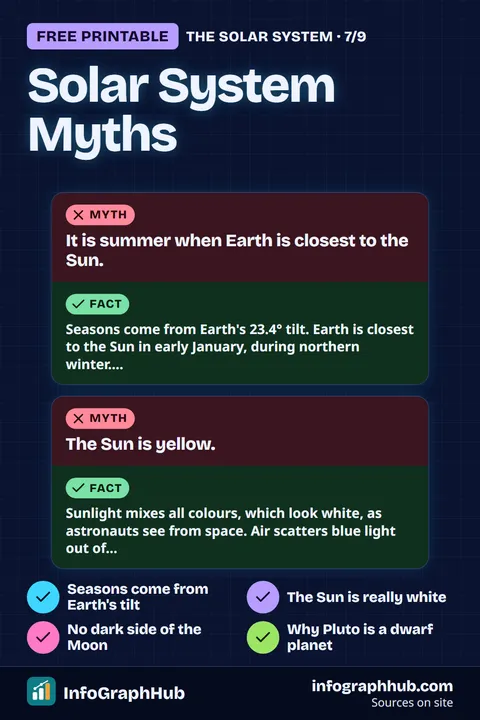
- 'Seasons happen because Earth gets closer to the Sun.' Earth is closest in early January, during northern winter. The real cause is Earth's 23.4° tilt.
- 'The Sun is yellow.' Sunlight mixes all colours and looks white from space; the air scatters blue light, so it looks yellow from the ground.
- 'The Moon has a permanent dark side.' The far side gets as much sunlight as the near side; we just never see it, because the Moon spins once per orbit.
- 'Space is completely empty.' The solar wind of charged particles streams past the planets at about 400 km/s.
- 'Pluto was demoted for being small.' On 24 August 2006 the International Astronomical Union defined a planet as a body that orbits the Sun, is nearly round, and has cleared the neighbourhood around its orbit. Pluto fails the third test because it shares its zone with many Kuiper Belt objects, so it is a dwarf planet.
- 'There is no gravity in space.' Earth's gravity at the International Space Station's height is about 90 per cent of its surface value; astronauts float because they are in free fall.
See the infographic: Part 7, Solar System Myths and the Real Science →
Words to use precisely
A few terms come up again and again:
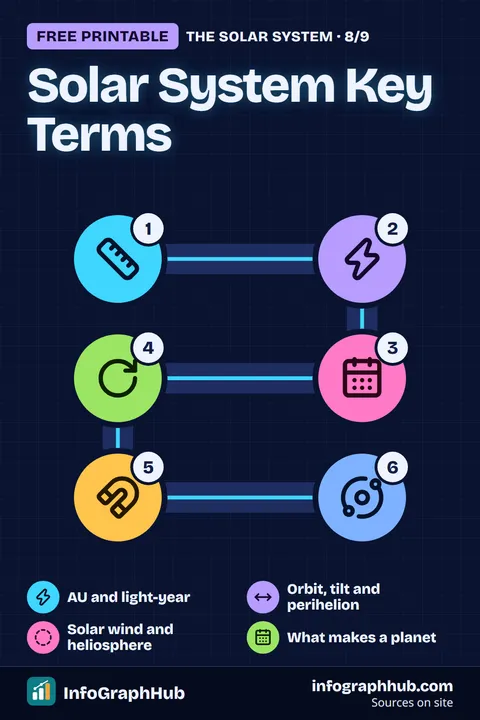
- Astronomical unit (AU): Earth's average distance from the Sun, about 149.6 million km.
- Light-year: a distance, not a time: how far light travels in a year, about 9.46 trillion km. One light-year is about 63,000 AU.
- Orbital period: a planet's year. Rotation period: the time to spin once; Earth's is about 23.9 hours.
- Perihelion and aphelion: the closest and farthest points of an orbit from the Sun.
- Axial tilt: how far a spin axis leans; Earth's is 23.4°, Uranus's about 98°.
- Tidal locking: spinning once per orbit, so one face always points inwards, as our Moon does.
- Solar wind and heliosphere: the stream of particles from the Sun and the huge bubble it blows around the Solar System.
Why the Solar System matters
Studying the Solar System explains our own planet. Earth's seasons, tides, day and year all come from its place in the system. Comparing Earth with Venus, a runaway greenhouse world with an average temperature of 464 °C, and Mars, which became a cold desert, helps scientists understand what keeps a planet habitable. Watching for near-Earth asteroids helps protect us from impacts.
It also connects to bigger questions. Moons such as Europa, where NASA reports strong evidence of a saltwater ocean beneath the ice, are among the best places to search for life beyond Earth. And NASA now counts more than 6,000 confirmed planets around other stars, so our Solar System is the one example we can study up close of how planetary systems form and change.
Ready to check what you have learned? The quiz covers every part of this guide.
See the infographic: Part 9, Solar System Quiz: Test Yourself →
Frequently asked questions
What are the 8 planets in order from the Sun?
Mercury, Venus, Earth, Mars, Jupiter, Saturn, Uranus and Neptune. The asteroid belt lies between Mars and Jupiter. The first four are rocky planets; the last four are giant planets.
How old is the Solar System?
About 4.6 billion years. Scientists date it mainly from the oldest meteorites, whose first solid grains formed about 4,568 million years ago in the disc of gas and dust around the young Sun.
Why is Pluto not a planet?
In 2006 the International Astronomical Union decided a planet must orbit the Sun, be nearly round and have cleared the neighbourhood around its orbit. Pluto shares its orbital zone with many Kuiper Belt objects, so it is classed as a dwarf planet.
Which planet has the most moons?
Saturn, with 293 confirmed moons as of August 2026, according to NASA. Jupiter has 115. Counts change as astronomers confirm new small moons, so always quote the date.
How big is the Solar System?
Neptune, the farthest planet, is about 30 AU (4.5 billion km) from the Sun. The Kuiper Belt extends to about 50 AU, and the Oort Cloud of icy objects is thought to reach about 100,000 AU, over a light-year away.
How did the Solar System form?
A cloud of gas and dust collapsed and spun into a flat disc. The Sun formed at the centre, and dust in the disc stuck together into ever-larger bodies that built the planets: rocky ones near the Sun and giants beyond the frost line.
Sources & methodology
Every fact is checked against the sources below. We write original explanations and draw original graphics; no figures are copied from textbooks. Spotted an error? See our corrections policy.
- Our Solar System: Facts (NASA Science, accessed 1 Oct 2026)
- Planetary Fact Sheet (Metric) (NASA Goddard Space Flight Center (NSSDCA), accessed 1 Oct 2026)
- Sun: Facts (NASA Science, accessed 1 Oct 2026)
- Planetary Systems (NASA Science, accessed 1 Oct 2026)
- Resolution B5: Definition of a Planet in the Solar System, and B6: Pluto (International Astronomical Union (IAU), accessed 1 Oct 2026)
- Webb liftoff on Ariane 5 to unlock secrets of the Universe (European Space Agency (ESA), accessed 1 Oct 2026)
- Solar System quick facts (Royal Museums Greenwich, accessed 1 Oct 2026)
- How our solar system was born (Natural History Museum, London, accessed 1 Oct 2026)
- Exoplanets (NASA Science, accessed 1 Oct 2026)
Editorial review pending · Updated
For teachers and parents: new InfoGraphHub resources by email
One short email when new free resources go live. For adults (18+) only. No spam, no tracking in emails, unsubscribe anytime.