Science, spaceQuizPart 9 of 9, The Solar SystemUpdated 1 October 2026
Solar System Quiz: Test Yourself
Ten questions on the whole Solar System series: the order of the planets, distances in AU, rocky and giant planets, dwarf planets, comets, how the Solar System formed, famous missions and common myths. Answers are printed upside down.
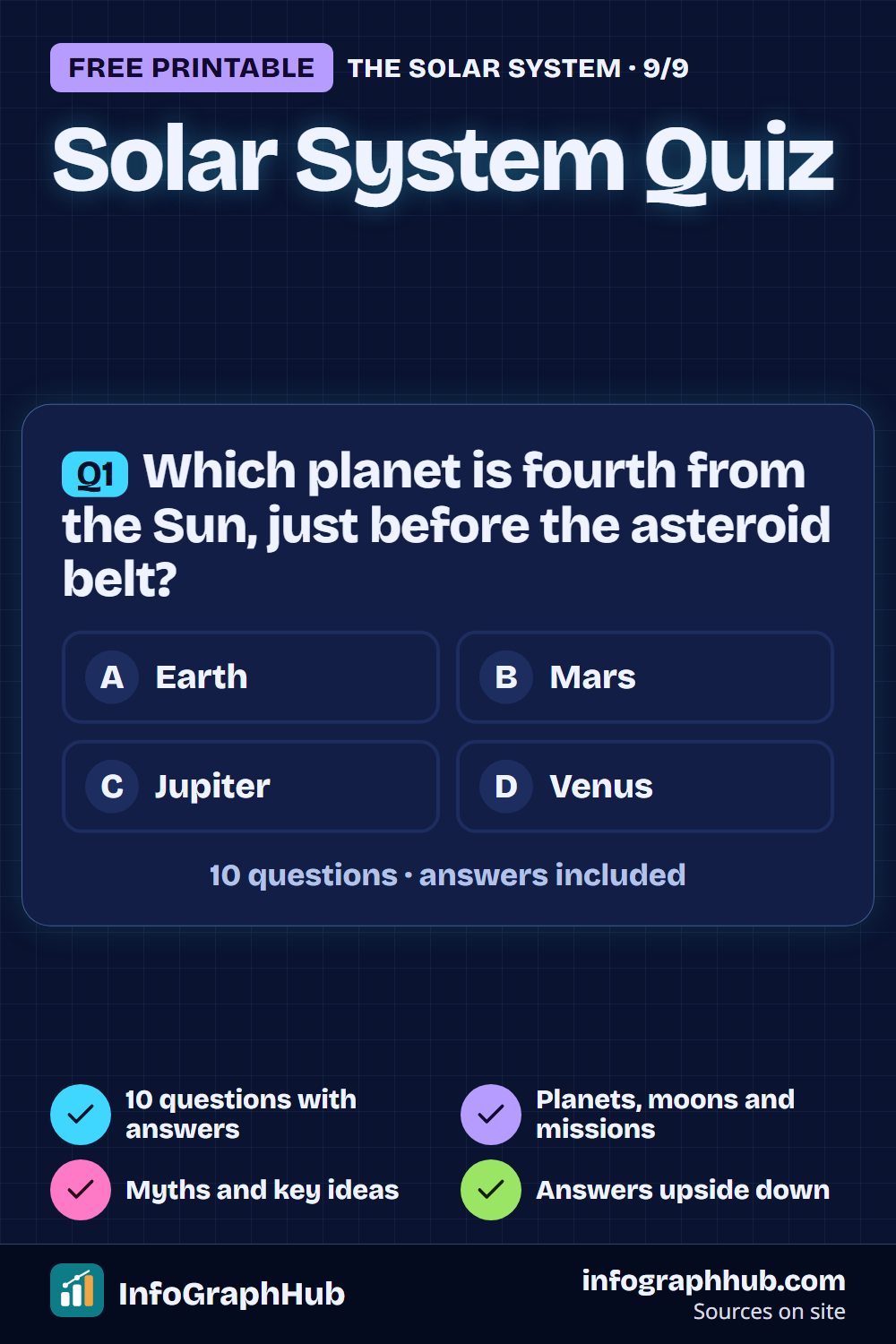
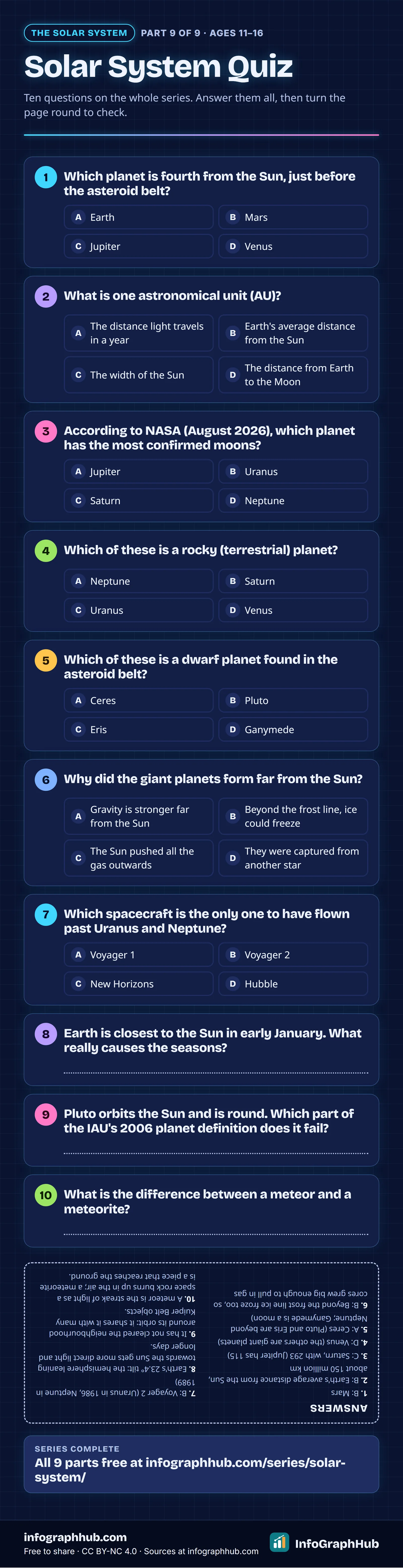
Use this infographic
Free under CC BY-NC 4.0, with credit to InfoGraphHub.
How to use this quiz
These ten questions cover the whole Solar System series, one or two from each part. Seven are multiple choice; the last three ask you to explain, which is good practice for written answers.
- Answer every question before you look at the answers.
- Turn the page round to read the answers, which are printed upside down at the foot of the infographic.
- For each one you got wrong, go back to the part of the series that covers it. The list below shows where to look.
Teachers can use it as a starter, a plenary or a homework check. It works well in pairs: one person reads the question, the other answers and explains why, and then you swap.
Where each question comes from
| Question | Topic | Part of the series |
|---|---|---|
| 1 | Order of the planets | The Solar System Explained |
| 2 | The astronomical unit | The Planets by the Numbers |
| 3 | Moon counts | The Planets by the Numbers |
| 4 | Rocky and giant planets | Rocky Planets vs Giant Planets |
| 5 | Dwarf planets | Moons, Dwarf Planets, Asteroids and Comets |
| 6 | The frost line | How the Solar System Formed |
| 7 | Voyager 2 | Exploring the Solar System |
| 8 | Seasons | Solar System Myths |
| 9 | Pluto and the IAU definition | Solar System Myths |
| 10 | Meteor and meteorite | Moons, Dwarf Planets, Asteroids and Comets |
Tips for the explain questions
Questions 8 to 10 need more than one word. A good answer names the key idea and then gives the evidence.
- Seasons: do not stop at 'the tilt'. Say which hemisphere leans towards the Sun, what that does to the sunlight it gets, and add the evidence that rules out distance: Earth is closest to the Sun in early January, in the middle of northern winter.
- Pluto: name the test it fails. Saying it is 'too small' is the most common wrong answer; the IAU's third test is about clearing the neighbourhood around its orbit.
- Meteor vs meteorite: the difference is where the rock is. A meteor is the streak of light in the air; a meteorite is the piece that lands.
Going further
If you scored 8 or more, try writing three questions of your own from the Key Terms sheet and swap them with a friend. Good questions have one clearly correct answer and wrong options that sound reasonable. If you scored fewer than 5, start again with the overview diagram in Part 1, then work through the series in order.
One more challenge: question 3 has an answer that will change. Astronomers keep confirming new small moons around the giant planets, so look up the latest counts on NASA's moon pages and see whether Saturn is still ahead. Science numbers like this are always the best measurement so far, which is why good answers say where a number comes from and when it was measured.
Frequently asked questions
What is a good Solar System quiz question?
One that checks understanding, not just recall: for example, asking why Pluto is a dwarf planet or what really causes the seasons, rather than only asking for the order of the planets.
Where are the answers to this quiz?
They are printed upside down at the foot of the infographic, and they appear again in the complete pack for the series.
What topics does the quiz cover?
The order of the planets, the astronomical unit, moon counts, rocky and giant planets, dwarf planets, how the Solar System formed, space missions, seasons, Pluto's classification, and meteors and meteorites.
Sources & methodology
Every fact is checked against the sources below. We write original explanations and draw original graphics; no figures are copied from textbooks. Spotted an error? See our corrections policy.
- Our Solar System: Facts (NASA Science, accessed 1 Oct 2026)
- Saturn's Moons (NASA Science, accessed 1 Oct 2026)
- Dwarf Planets (NASA Science, accessed 1 Oct 2026)
- Voyager 2 (NASA Science, accessed 1 Oct 2026)
- Resolution B5: Definition of a Planet in the Solar System (International Astronomical Union (IAU), accessed 1 Oct 2026)
- What Causes the Seasons? (NASA Space Place, accessed 1 Oct 2026)
Editorial review pending · Updated
Made by the InfoGraphHub editorial team (how we research and check: editorial and AI policy). First published 2 October 2026, last reviewed 1 October 2026. Found a mistake? Tell the editors.
For teachers: ages and curriculum fit
Ages 11–16 · Grades 6–10 (US) · Years 7–11 (UK) · Classes 6–10 (India)
NGSS is a registered trademark of WestEd. Names and codes are used only to describe curriculum fit; InfoGraphHub is not endorsed by these organisations.
Embed this on your site
Paste this HTML into your page. Keep the credit line: it is required by the CC BY-NC 4.0 license.
Related infographics


For teachers and parents: new InfoGraphHub resources by email
One short email when new free resources go live. For adults (18+) only. No spam, no tracking in emails, unsubscribe anytime.