Science, spaceMyths and factsPart 7 of 9, The Solar SystemUpdated 1 October 2026
Solar System Myths and the Real Science
Eight common Solar System myths, corrected with evidence: seasons are not caused by distance from the Sun, the Sun is white, the Moon has no permanent dark side, space is not empty, and Pluto was not reclassified for being small.
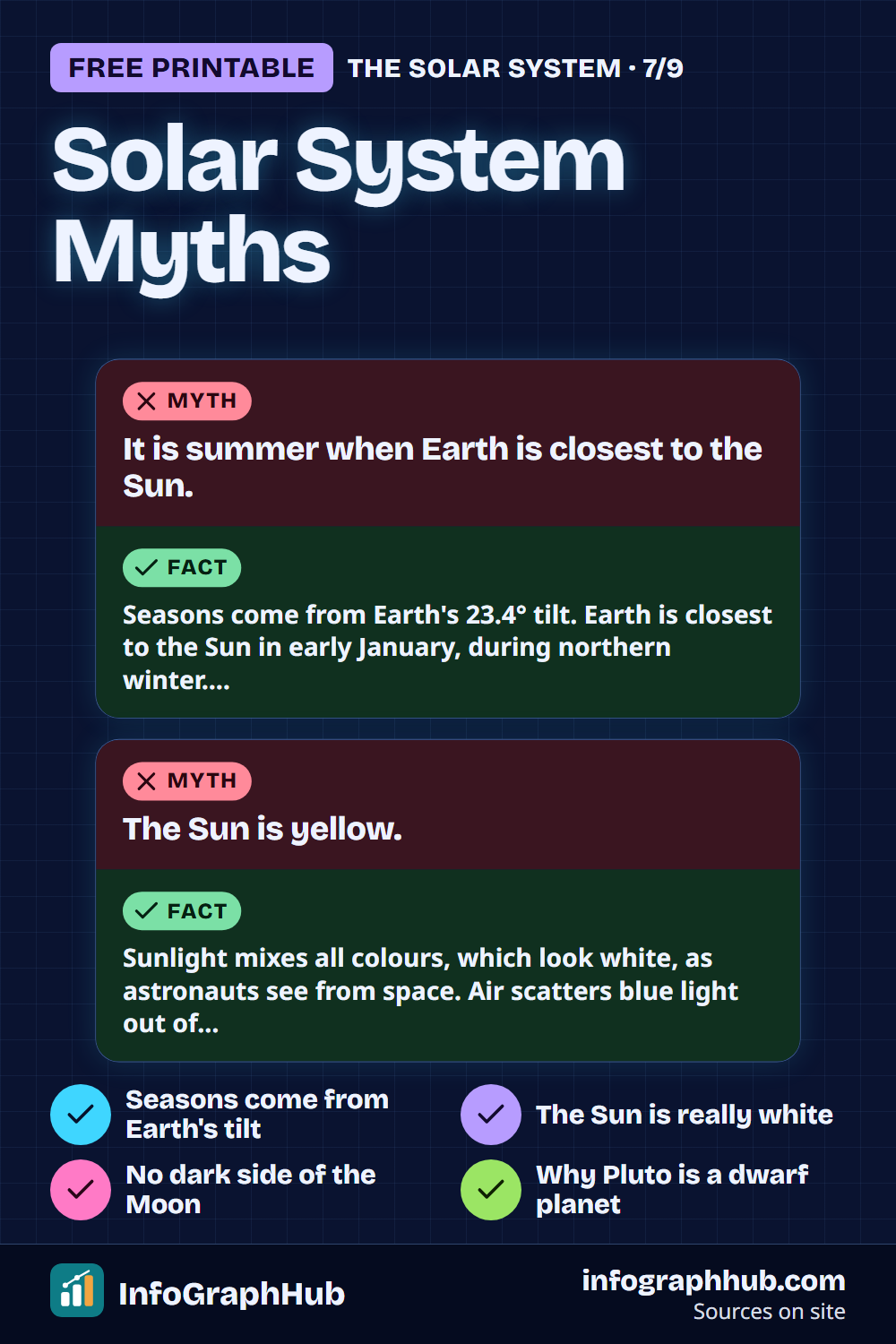
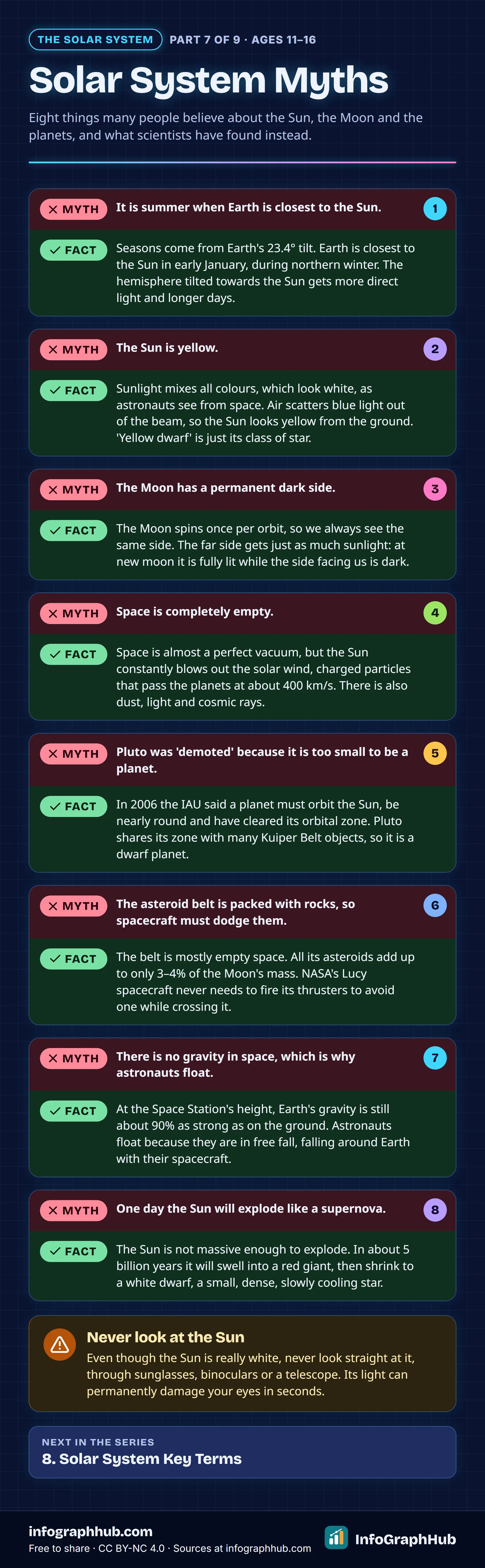
Use this infographic
Free under CC BY-NC 4.0, with credit to InfoGraphHub.
Why space myths stick
Most of what we know about space comes from pictures, films and simple diagrams, and many of them squash or exaggerate things to make them easy to show. Everyday language does not help: we talk about the 'dark side of the Moon' and 'zero gravity' as if they were real. The myths on this infographic are some of the most common, among adults as well as students.
Seasons: tilt, not distance
If seasons came from Earth's distance to the Sun, both hemispheres would have summer at the same time. They do not: when it is summer in Europe, it is winter in Australia. In fact Earth is closest to the Sun in early January, about 147.1 million km away, and farthest in early July, about 152.1 million km away. That difference of about 3 per cent is too small to matter much.
The real cause is Earth's tilt. Its axis leans about 23.4° and keeps pointing the same way in space as Earth orbits. Around June, the Northern Hemisphere leans towards the Sun: sunlight hits it more directly and days are longer, so it is summer there. Around December, the Southern Hemisphere has its turn.
The colour of the Sun
Sunlight is a mixture of all the colours of the rainbow, and together they look white. Stanford University's Solar Center explains that the Sun's visible light is actually strongest in the green part of the spectrum, though our eyes do not see it as green. Seen from space, above the air, the Sun looks white.
It looks yellow, orange or red from the ground because the atmosphere scatters short wavelengths (violet, blue and some green) out of the direct beam, which is also why the sky is blue. The effect is strongest at sunrise and sunset, when sunlight passes through the most air. Astronomers do call the Sun a 'yellow dwarf', but that is the name of its class of star, not a description of its colour. Never look directly at the Sun, even briefly: it can permanently damage your eyes.
The Moon's far side
The Moon spins on its axis in exactly the time it takes to orbit Earth, about 27 days. This is called synchronous rotation, and it means the same side always faces us. The side we never see is the far side. It is not permanently dark: NASA points out that at new moon, when the side facing us is in darkness, the far side is in full sunlight. Every part of the Moon has roughly two weeks of daylight followed by two weeks of night. People first saw the far side in 1959, in photos from the Soviet probe Luna 3.
Is space empty?
Space between the planets is an extremely good vacuum, far emptier than the air around us, but it is not completely empty. The Sun constantly blows out the solar wind, a stream of electrically charged particles, mainly protons and electrons, carrying the Sun's magnetic field. Near the planets it usually travels at about 400 km/s. Space also contains dust, light and other radiation, and fast particles called cosmic rays. The solar wind blows out a huge bubble around the Solar System, the heliosphere, and the Voyager probes have crossed its edge.
Pluto and the 2006 definition
Pluto was not reclassified simply because it is small. On 24 August 2006, in Prague, the International Astronomical Union (IAU) voted on the first formal definition of a planet. A planet must:
- orbit the Sun;
- have enough mass for its gravity to pull it into a nearly round shape;
- have cleared the neighbourhood around its orbit, meaning it dominates its orbital zone.
Pluto passes the first two tests but fails the third. It shares its region with many icy Kuiper Belt objects, and some of them, such as Eris, discovered in 2005, are similar in size. The IAU made Pluto a dwarf planet: a round body orbiting the Sun that has not cleared its neighbourhood and is not a moon.
Asteroid belts, gravity and the Sun's future
Films show crowded asteroid fields, but the real asteroid belt is mostly empty space. Its total mass is only about 3 to 4 per cent of the Moon's, spread over an enormous volume. NASA's Lucy spacecraft, crossing the belt, never needs to fire its thrusters to avoid an asteroid.
Astronauts float, but not because gravity has disappeared. At the height of the International Space Station, Earth's gravity is about 90 per cent as strong as on the ground. Astronauts float because they and their spacecraft are in constant free fall, falling around Earth together.
Finally, the Sun will not end in a giant explosion. NASA explains that only stars at least 8 times as massive as the Sun explode as supernovae. In about 5 billion years it will swell into a red giant, then shrink into a small, dense white dwarf.
Frequently asked questions
What causes the seasons on Earth?
The tilt of Earth's axis, about 23.4°. The hemisphere tilted towards the Sun gets more direct sunlight and longer days, so it has summer. Distance is not the cause: Earth is closest to the Sun in early January.
Is there a dark side of the Moon?
No. There is a far side that always faces away from Earth, because the Moon spins once for every orbit. But the far side gets as much sunlight as the near side: it is fully lit at new moon.
Why is Pluto not a planet any more?
In 2006 the IAU decided that a planet must orbit the Sun, be nearly round and have cleared the neighbourhood around its orbit. Pluto shares its orbital zone with many Kuiper Belt objects, so it fails the third test and is classed as a dwarf planet.
What colour is the Sun really?
White. Sunlight contains all the colours of the rainbow, which together look white, as astronauts see from space. It looks yellow or orange from the ground because the air scatters blue light out of the direct beam.
Is there no gravity in space?
There is. At the height of the International Space Station, Earth's gravity is about 90% as strong as on the surface. Astronauts float because they are in free fall, constantly falling around Earth along with their spacecraft.
Sources & methodology
Every fact is checked against the sources below. We write original explanations and draw original graphics; no figures are copied from textbooks. Spotted an error? See our corrections policy.
- What Causes the Seasons? (NASA Space Place, accessed 1 Oct 2026)
- Earth: Facts (NASA Science, accessed 1 Oct 2026)
- The 'Green' Sun (Stanford University Solar Center, accessed 1 Oct 2026)
- Moon: Facts (NASA Science, accessed 1 Oct 2026)
- Solar Wind (NOAA Space Weather Prediction Center, accessed 1 Oct 2026)
- Resolution B5: Definition of a Planet in the Solar System, and B6: Pluto (International Astronomical Union (IAU), accessed 1 Oct 2026)
- The Density of the Asteroid Belt (NASA Lucy mission, Southwest Research Institute, accessed 1 Oct 2026)
- What Is Microgravity? (Grades 5–8) (NASA, accessed 1 Oct 2026)
- Supernovae (NASA Goddard Space Flight Center (Imagine the Universe!), accessed 1 Oct 2026)
Editorial review pending · Updated
Made by the InfoGraphHub editorial team (how we research and check: editorial and AI policy). First published 2 October 2026, last reviewed 1 October 2026. Found a mistake? Tell the editors.
For teachers: ages and curriculum fit
Ages 11–16 · Grades 6–10 (US) · Years 7–11 (UK) · Classes 6–10 (India)
NGSS is a registered trademark of WestEd. Names and codes are used only to describe curriculum fit; InfoGraphHub is not endorsed by these organisations.
Embed this on your site
Paste this HTML into your page. Keep the credit line: it is required by the CC BY-NC 4.0 license.
Related infographics


For teachers and parents: new InfoGraphHub resources by email
One short email when new free resources go live. For adults (18+) only. No spam, no tracking in emails, unsubscribe anytime.