Science, spaceProcessPart 5 of 9, The Solar SystemUpdated 1 October 2026
How the Solar System Formed
About 4.6 billion years ago a cloud of gas and dust collapsed. Its centre became the Sun, and a spinning disc around it built the planets: rocky worlds near the Sun, giants beyond the frost line, and leftovers we still see today.
Interactive
Explore it step by step
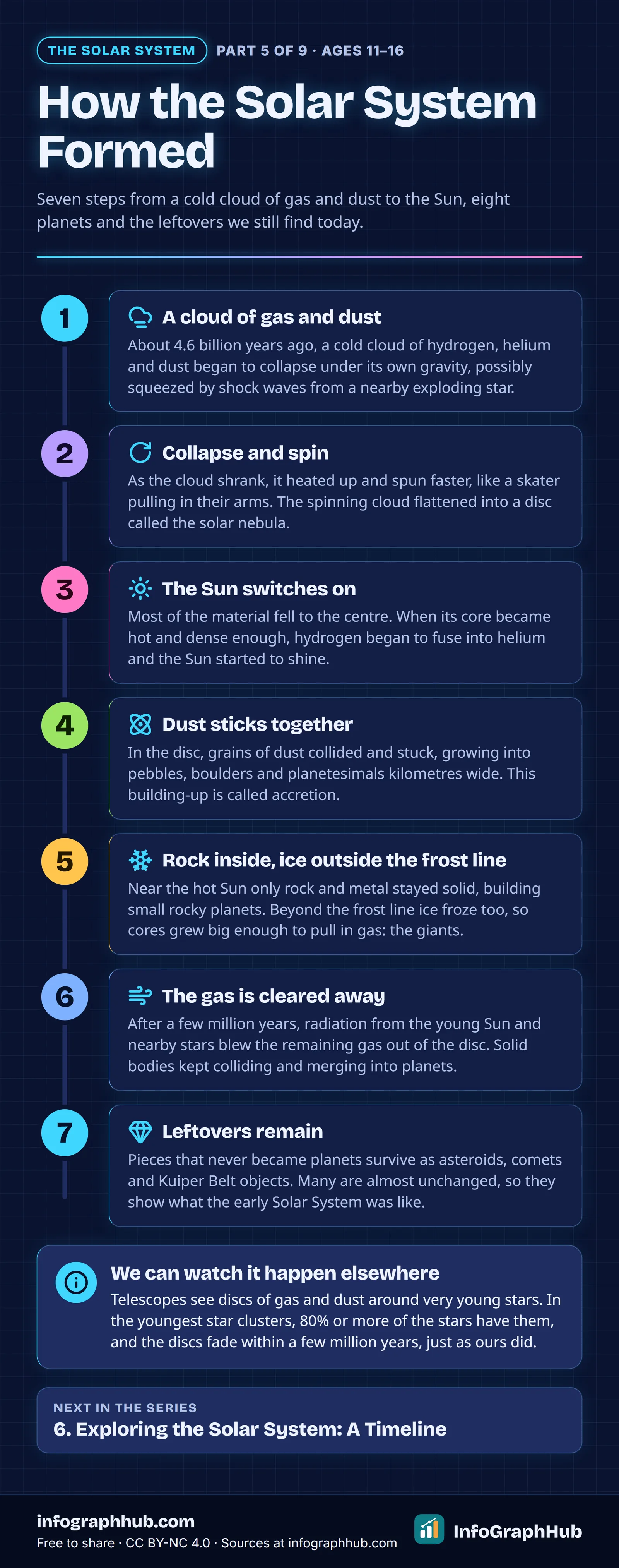
7 steps: A cloud of gas and dust → Collapse and spin → The Sun switches on → Dust sticks together → Rock inside, ice outside the frost line → The gas is cleared away → Leftovers remain. Press play, or choose a number to explore.
Step 1 of 7: A cloud of gas and dust
About 4.6 billion years ago, a cold cloud of hydrogen, helium and dust began to collapse under its own gravity, possibly squeezed by shock waves from a nearby exploding star.
Step 2 of 7: Collapse and spin
As the cloud shrank, it heated up and spun faster, like a skater pulling in their arms. The spinning cloud flattened into a disc called the solar nebula.
Step 3 of 7: The Sun switches on
Most of the material fell to the centre. When its core became hot and dense enough, hydrogen began to fuse into helium and the Sun started to shine.
Step 4 of 7: Dust sticks together
In the disc, grains of dust collided and stuck, growing into pebbles, boulders and planetesimals kilometres wide. This building-up is called accretion.
Step 5 of 7: Rock inside, ice outside the frost line
Near the hot Sun only rock and metal stayed solid, building small rocky planets. Beyond the frost line ice froze too, so cores grew big enough to pull in gas: the giants.
Step 6 of 7: The gas is cleared away
After a few million years, radiation from the young Sun and nearby stars blew the remaining gas out of the disc. Solid bodies kept colliding and merging into planets.
Step 7 of 7: Leftovers remain
Pieces that never became planets survive as asteroids, comets and Kuiper Belt objects. Many are almost unchanged, so they show what the early Solar System was like.
Use this infographic
Free under CC BY-NC 4.0, with credit to InfoGraphHub.
A cloud that collapsed
About 4.6 billion years ago, the material that would become the Solar System was part of a cold, dense cloud of gas and dust floating between the stars. The gas was mostly hydrogen and helium; the dust was tiny grains of rock, metal and ice.
Something made part of the cloud start to collapse under its own gravity. NASA and London's Natural History Museum both suggest a likely trigger: shock waves from a nearby supernova, an exploding star, squeezing the cloud. Once the collapse began, gravity kept it going. The more material gathered in the middle, the harder it pulled in the rest.
From cloud to spinning disc
The cloud was turning slightly. As it shrank, it spun faster, in the same way that an ice skater spins faster when they pull their arms in. Falling gas also heated up. The spinning cloud flattened into a disc, called the solar nebula or protoplanetary disc, with a hot, dense bulge at its centre.
The centre became the Sun. When the pressure and temperature in its core grew high enough, hydrogen atoms began to fuse into helium, releasing enormous amounts of energy, and the Sun began to shine. It had collected almost all the material: today it holds about 99.8 per cent of the Solar System's mass. The planets, moons and everything else were built from the thin disc of leftovers.
Dust to planets: accretion
In the disc, dust grains collided and stuck together. Specks grew into pebbles, pebbles into boulders, and boulders into bodies kilometres across, called planetesimals. This gradual building-up is called accretion.
Once a planetesimal was big enough, its gravity helped it sweep up more material, so the largest grew fastest. NASA explains that within about a million years, collisions among planetesimals had built planetary embryos roughly as massive as Mars. Some bodies grew large enough for gravity to pull them into balls, becoming planets, dwarf planets and large moons.
The frost line: why rocky and giant planets differ
The disc was hot near the young Sun and cold far away. Close in, only materials with high melting points, such as rock and metal, could stay solid. Water, methane and ammonia stayed as gas.
Farther out, the disc was cold enough for those substances to freeze into ice. The boundary is called the frost line, or snow line. NASA says that in our Solar System it lay between the orbits of Mars and Jupiter.
That explains the two planet families. Inside the frost line, there was only a small amount of rock and metal, so the planets stayed small and rocky: Mercury, Venus, Earth and Mars. Outside it, ice added a lot more solid material, so cores grew much bigger. The biggest became heavy enough to pull in huge amounts of hydrogen and helium gas from the disc, becoming the giant planets.
Clearing the disc
The gas did not last long. NASA describes how, after another few million years, radiation from the young Sun and nearby stars blew away the disc's remaining gas. Any planet that was going to gather a thick atmosphere of hydrogen and helium had to do it before then.
What was left were solid bodies, which kept crashing, shattering and merging for many millions of years until the planets reached their final sizes. Pieces that never became part of a planet survive as asteroids, comets and the icy bodies of the Kuiper Belt. The asteroid belt is made of material that never came together into a planet.
How do we know?
Nobody watched the Solar System form, but several lines of evidence point to the same story.
- The planets' orbits. All eight orbit the Sun in the same direction and in nearly the same flat plane, just as you would expect if they formed from one spinning disc.
- Meteorites. The Natural History Museum describes primitive meteorites called chondrites as unchanged samples of the first solids that formed in the cooling disc. Dating them gives the age of the Solar System.
- Young stars today. Telescopes see discs of gas and dust around many very young stars. NASA notes that in the youngest star clusters, 80 per cent or more of the stars show the warm glow of such discs, and that the discs disappear within a few million years.
Frequently asked questions
How old is the Solar System?
About 4.6 billion years. Scientists work this out mainly by dating the oldest meteorites, which formed from the first solids in the disc around the young Sun.
What is the solar nebula?
The spinning, flattened disc of gas and dust that formed when a cloud collapsed about 4.6 billion years ago. The Sun formed at its centre and the planets grew from the rest of the disc.
What is the frost line?
The distance from the young Sun beyond which it was cold enough for water and other substances to freeze into ice. In our Solar System it lay between Mars and Jupiter. Rocky planets formed inside it and giant planets outside it.
What is accretion in planet formation?
The process in which dust grains collide and stick together, growing into pebbles, boulders and then planetesimals kilometres across, which merge to build planets.

Sources & methodology
Every fact is checked against the sources below. We write original explanations and draw original graphics; no figures are copied from textbooks. Spotted an error? See our corrections policy.
- Our Solar System: Facts (NASA Science, accessed 1 Oct 2026)
- Planetary Systems (NASA Science, accessed 1 Oct 2026)
- Space Snow Visible in Bright Baby Solar System (NASA Science, accessed 1 Oct 2026)
- How our solar system was born (Natural History Museum, London, accessed 1 Oct 2026)
- Sun: Facts (NASA Science, accessed 1 Oct 2026)
- The age of the Solar System redefined by the oldest Pb–Pb age of a meteoritic inclusion (Nature Geoscience (Bouvier and Wadhwa, 2010), accessed 1 Oct 2026)
Editorial review pending · Updated
Made by the InfoGraphHub editorial team (how we research and check: editorial and AI policy). First published 2 October 2026, last reviewed 1 October 2026. Found a mistake? Tell the editors.
For teachers: ages and curriculum fit
Ages 11–16 · Grades 6–10 (US) · Years 7–11 (UK) · Classes 6–10 (India)
NGSS is a registered trademark of WestEd. Names and codes are used only to describe curriculum fit; InfoGraphHub is not endorsed by these organisations.
Embed this on your site
Paste this HTML into your page. Keep the credit line: it is required by the CC BY-NC 4.0 license.
Related infographics


For teachers and parents: new InfoGraphHub resources by email
One short email when new free resources go live. For adults (18+) only. No spam, no tracking in emails, unsubscribe anytime.