Science, spaceTimelinePart 6 of 9, The Solar SystemUpdated 1 October 2026
Exploring the Solar System: A Timeline
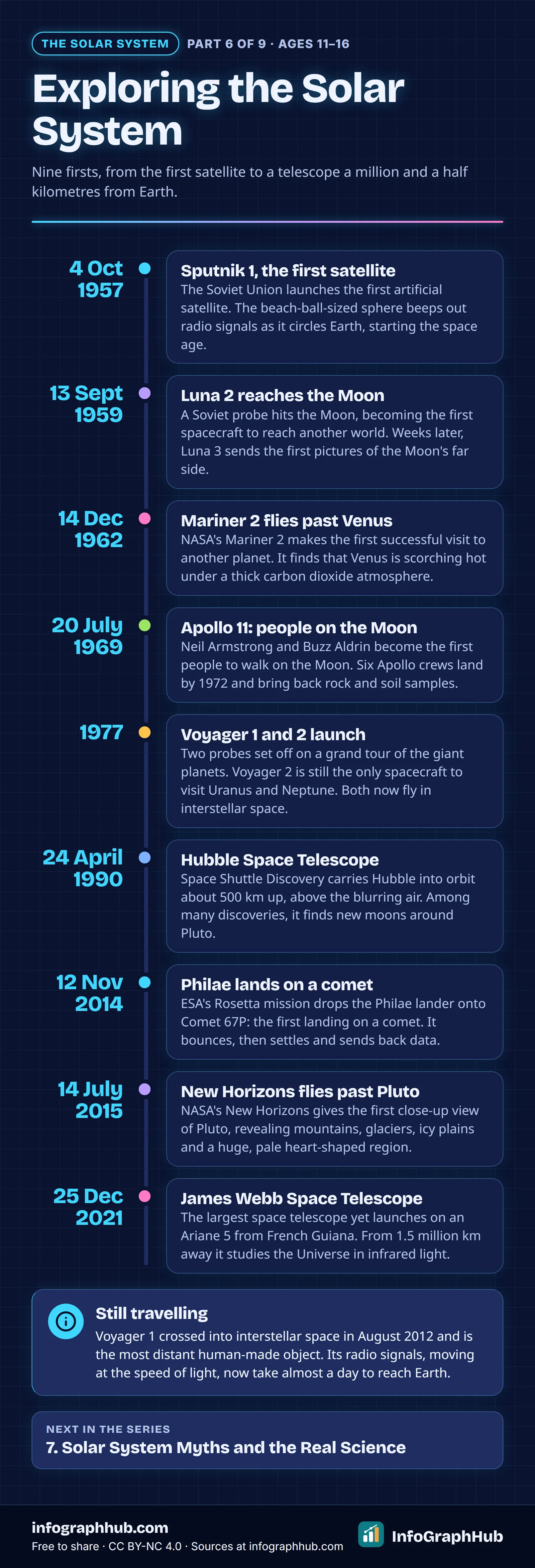
From Sputnik's first orbit in 1957 to the James Webb Space Telescope in 2021: nine milestones in exploring the Solar System, including the first Moon landing, the Voyager probes, Hubble, a landing on a comet and a flyby of Pluto.
Interactive
Explore it step by step
9 events: Sputnik 1, the first satellite → Luna 2 reaches the Moon → Mariner 2 flies past Venus → Apollo 11: people on the Moon → Voyager 1 and 2 launch → Hubble Space Telescope → Philae lands on a comet → New Horizons flies past Pluto → James Webb Space Telescope. Press play, or choose a number to explore.
4 Oct 1957Event 1 of 9: Sputnik 1, the first satellite
The Soviet Union launches the first artificial satellite. The beach-ball-sized sphere beeps out radio signals as it circles Earth, starting the space age.
13 Sept 1959Event 2 of 9: Luna 2 reaches the Moon
A Soviet probe hits the Moon, becoming the first spacecraft to reach another world. Weeks later, Luna 3 sends the first pictures of the Moon's far side.
14 Dec 1962Event 3 of 9: Mariner 2 flies past Venus
NASA's Mariner 2 makes the first successful visit to another planet. It finds that Venus is scorching hot under a thick carbon dioxide atmosphere.
20 July 1969Event 4 of 9: Apollo 11: people on the Moon
Neil Armstrong and Buzz Aldrin become the first people to walk on the Moon. Six Apollo crews land by 1972 and bring back rock and soil samples.
1977Event 5 of 9: Voyager 1 and 2 launch
Two probes set off on a grand tour of the giant planets. Voyager 2 is still the only spacecraft to visit Uranus and Neptune. Both now fly in interstellar space.
24 April 1990Event 6 of 9: Hubble Space Telescope
Space Shuttle Discovery carries Hubble into orbit about 500 km up, above the blurring air. Among many discoveries, it finds new moons around Pluto.
12 Nov 2014Event 7 of 9: Philae lands on a comet
ESA's Rosetta mission drops the Philae lander onto Comet 67P: the first landing on a comet. It bounces, then settles and sends back data.
14 July 2015Event 8 of 9: New Horizons flies past Pluto
NASA's New Horizons gives the first close-up view of Pluto, revealing mountains, glaciers, icy plains and a huge, pale heart-shaped region.
25 Dec 2021Event 9 of 9: James Webb Space Telescope
The largest space telescope yet launches on an Ariane 5 from French Guiana. From 1.5 million km away it studies the Universe in infrared light.
Use this infographic
Free under CC BY-NC 4.0, with credit to InfoGraphHub.
From points of light to real worlds
For most of history, the planets were wandering points of light. Telescopes, from the 1600s onwards, turned them into discs with moons, rings and markings. But the biggest change came after 1957, when people began sending machines into space. In less than 70 years, spacecraft have flown past every planet, landed on the Moon, Venus, Mars, Saturn's moon Titan and a comet, and carried instruments beyond the edge of the Sun's influence.
This timeline picks nine milestones. Each one was a 'first' that changed what we know about the Solar System or how we explore it.
The space age begins
On 4 October 1957, the Soviet Union launched Sputnik 1, the first artificial satellite. It was a metal ball about the size of a beach ball, weighing about 85 kg, and it carried little more than a radio transmitter that beeped as it circled Earth. It fell back to Earth in January 1958, but it had started the space age, and the race between the USSR and the USA that followed.
Less than two years later, on 13 September 1959, the Soviet probe Luna 2 hit the Moon. It was the first spacecraft to reach the surface of another world. A few weeks later, Luna 3 sent back the first pictures of the Moon's far side.
The first visit to another planet came on 14 December 1962, when NASA's Mariner 2 flew past Venus. It found a planet with a very hot surface, high pressure and an atmosphere of mostly carbon dioxide, nothing like the warm, swampy world some people had imagined.
People on the Moon
On 20 July 1969, NASA's Apollo 11 landed on the Moon, and Neil Armstrong and Buzz Aldrin became the first people to walk on another world. Six Apollo missions landed between 1969 and 1972, and their astronauts brought back rock and soil samples that scientists still study. The last of them, Apollo 17, left the Moon in December 1972.
The grand tour of the giant planets
In 1977 NASA launched two identical probes: Voyager 2 on 20 August and Voyager 1 on 5 September. A rare line-up of the outer planets let them use each planet's gravity to swing on to the next. Voyager 1 flew past Jupiter and Saturn. Voyager 2 visited all four giants and is still the only spacecraft to have flown past Uranus (1986) and Neptune (1989).
Both are still sending back data. Voyager 1 crossed into interstellar space in August 2012 and Voyager 2 followed in November 2018, making them the first human-made objects to leave the bubble of the solar wind.
Telescopes in space
Earth's atmosphere blurs and blocks some of the light from space, so astronomers put telescopes above it. The Hubble Space Telescope was launched from the Space Shuttle Discovery on 24 April 1990 and orbits about 500 km above Earth. Among many discoveries, it found new moons around Pluto.
The James Webb Space Telescope (JWST), a partnership between NASA, ESA and the Canadian Space Agency, launched on an Ariane 5 rocket from Europe's Spaceport in French Guiana on 25 December 2021. It sits about 1.5 million km from Earth and sees mainly infrared light, which lets it study cold, faint objects, from distant galaxies to the outer planets of our own Solar System.
Comets and dwarf planets up close
On 12 November 2014, the European Space Agency's Rosetta mission dropped its lander Philae onto Comet 67P/Churyumov–Gerasimenko: the first ever landing on a comet. Philae bounced before coming to rest, but it still collected data.
On 14 July 2015, NASA's New Horizons flew past Pluto, giving the first close-up view of a dwarf planet in the Kuiper Belt. It found mountains up to 3 km high, glaciers and plains coated in nitrogen and methane frost, and a huge, pale heart-shaped region. In 2019 it went on to fly past Arrokoth, the most distant object ever explored by a spacecraft.
Frequently asked questions
What was the first spacecraft to reach the Moon?
Luna 2, a Soviet probe that hit the Moon on 13 September 1959. It was the first human-made object to reach another world. The first people landed on the Moon ten years later, with Apollo 11 on 20 July 1969.
Which spacecraft have visited Uranus and Neptune?
Only one: NASA's Voyager 2, which flew past Uranus in January 1986 and Neptune in August 1989. It is the only spacecraft to have studied all four giant planets close up.
When did New Horizons reach Pluto?
It flew past Pluto on 14 July 2015, giving the first close-up pictures of the dwarf planet. In 2019 it flew past Arrokoth, a small icy object in the Kuiper Belt.
When was the James Webb Space Telescope launched?
On 25 December 2021, on a European Ariane 5 rocket from French Guiana. It is a joint project of NASA, ESA and the Canadian Space Agency and observes mainly in infrared light.

Sources & methodology
Every fact is checked against the sources below. We write original explanations and draw original graphics; no figures are copied from textbooks. Spotted an error? See our corrections policy.
- Moon Missions (NASA Science, accessed 1 Oct 2026)
- USSR Launches Sputnik (National Geographic Education, accessed 1 Oct 2026)
- Mariner 2 (NASA Space Science Data Coordinated Archive, accessed 1 Oct 2026)
- Voyager 2 (NASA Science, accessed 1 Oct 2026)
- Voyager 1 (NASA Science, accessed 1 Oct 2026)
- This Week in NASA History: Hubble Space Telescope Launches, April 24, 1990 (NASA, accessed 1 Oct 2026)
- Touchdown! Rosetta's Philae probe lands on comet (European Space Agency (ESA), accessed 1 Oct 2026)
- Pluto: Facts (NASA Science, accessed 1 Oct 2026)
- Webb liftoff on Ariane 5 to unlock secrets of the Universe (European Space Agency (ESA), accessed 1 Oct 2026)
Editorial review pending · Updated
Made by the InfoGraphHub editorial team (how we research and check: editorial and AI policy). First published 2 October 2026, last reviewed 1 October 2026. Found a mistake? Tell the editors.
For teachers: ages and curriculum fit
Ages 11–16 · Grades 6–10 (US) · Years 7–11 (UK) · Classes 6–10 (India)
NGSS is a registered trademark of WestEd. Names and codes are used only to describe curriculum fit; InfoGraphHub is not endorsed by these organisations.
Embed this on your site
Paste this HTML into your page. Keep the credit line: it is required by the CC BY-NC 4.0 license.
Related infographics


For teachers and parents: new InfoGraphHub resources by email
One short email when new free resources go live. For adults (18+) only. No spam, no tracking in emails, unsubscribe anytime.