Science, spaceNumbersPart 2 of 9, The Solar SystemUpdated 1 October 2026
The Planets by the Numbers
How far, how big, how long a year and how many moons? NASA's figures for all eight planets: distances in astronomical units, diameters, orbit times and moon counts, from Mercury's 88-day year to Saturn's 293 known moons.
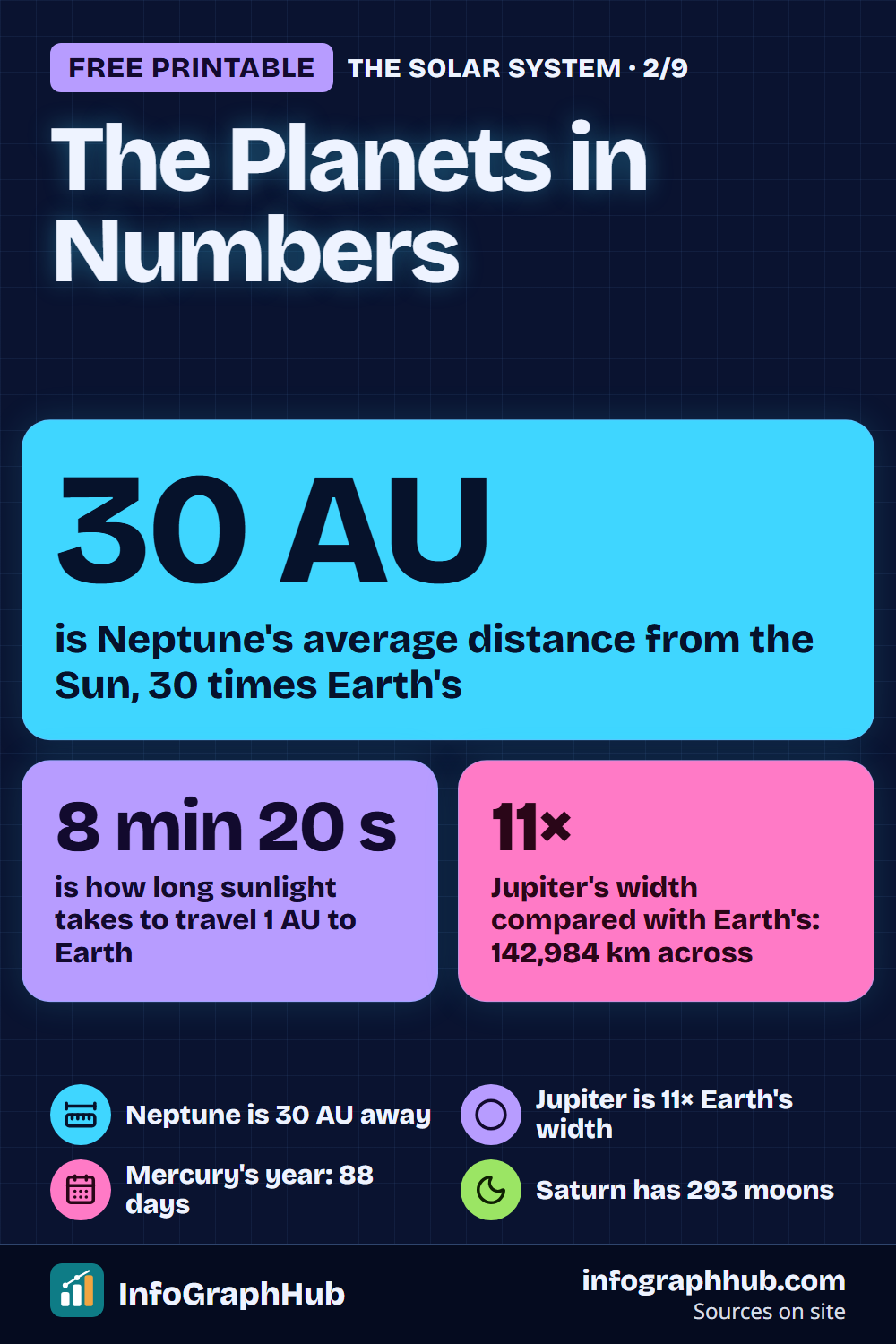
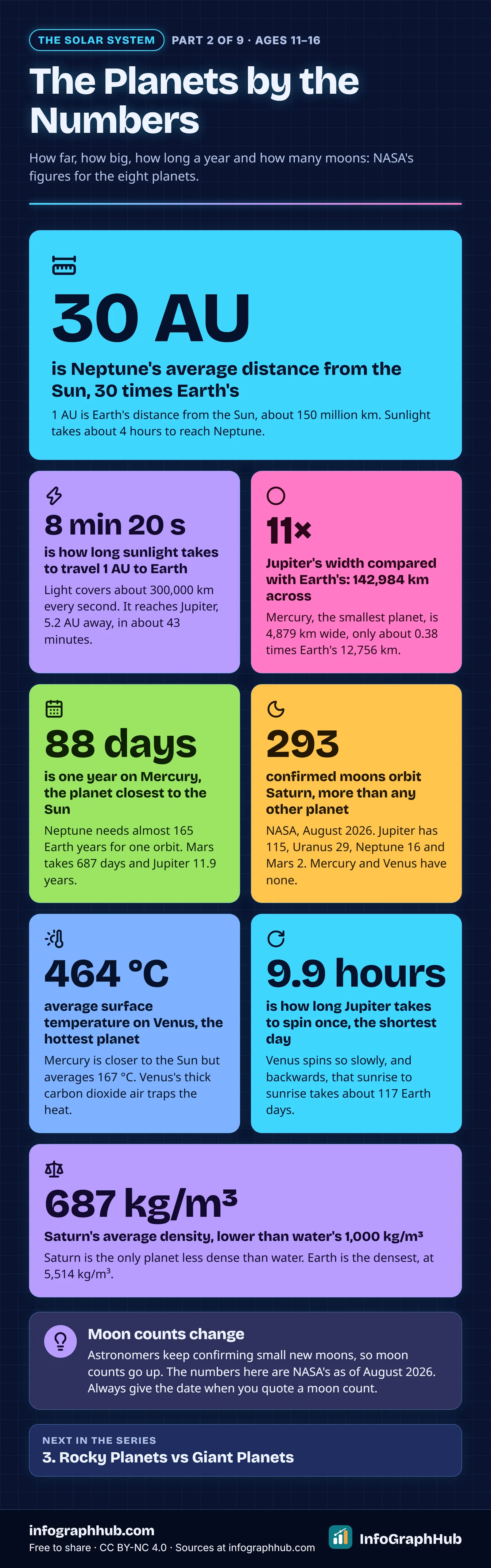
Use this infographic
Free under CC BY-NC 4.0, with credit to InfoGraphHub.
Measuring the Solar System
Distances in space are so large that kilometres soon become clumsy. Inside the Solar System, astronomers use the astronomical unit (AU): Earth's average distance from the Sun, about 150 million km (149.6 million km). Mercury is 0.39 AU from the Sun and Neptune is about 30 AU away, numbers that are much easier to compare than 57.9 million km and 4,515 million km.
To turn AU into kilometres, multiply by 149.6 million. Jupiter, for example, is 5.20 AU from the Sun: 5.20 × 149.6 million ≈ 778 million km.
Light is a useful ruler too. It travels about 300,000 km every second, so sunlight takes about 8 minutes 20 seconds to reach Earth (149.6 million ÷ 299,792 ≈ 499 seconds). It needs about 43 minutes to reach Jupiter and just over 4 hours to reach Neptune. When a spacecraft near Neptune sends a message, controllers on Earth wait more than four hours to receive it.
The eight planets in one table
These figures come from NASA's planetary fact sheets (one orbit = the sidereal period, measured against the stars); moon counts are from NASA's planet pages as of August 2026.
| Planet | Distance from Sun (AU) | Diameter (km) | One orbit | Known moons |
|---|---|---|---|---|
| Mercury | 0.39 | 4,879 | 88 days | 0 |
| Venus | 0.72 | 12,104 | 225 days | 0 |
| Earth | 1.00 | 12,756 | 365.26 days | 1 |
| Mars | 1.52 | 6,792 | 687 days | 2 |
| Jupiter | 5.20 | 142,984 | 11.9 years | 115 |
| Saturn | 9.57 | 120,536 | 29.5 years | 293 |
| Uranus | 19.17 | 51,118 | 84.0 years | 29 |
| Neptune | 30.18 | 49,528 | 164.8 years | 16 |
Distances are averages, because every orbit is a slightly stretched circle (an ellipse). Diameters are measured across the equator. The giant planets spin so fast that they bulge at the middle, so they are a little narrower from pole to pole.
Size: from Mercury to Jupiter
Jupiter is about 11 times wider than Earth, and about 1,000 Earths could fit inside it. It is also more than twice as massive as all the other planets put together. Mercury, the smallest planet, is only about 0.38 times Earth's width: smaller than Jupiter's moon Ganymede.
The four inner planets are all small. Earth is the largest of them, with Venus close behind at 95 per cent of Earth's width. Even the smallest giant planet, Neptune, is almost four times wider than Earth.
Years and days
A planet's year is the time it takes to go once around the Sun. Planets close to the Sun have short orbits and move fast, so Mercury's year lasts only 88 Earth days. Neptune's orbit is huge and it moves slowly, so its year lasts almost 165 Earth years. Neptune was discovered in 1846 and only completed its first full orbit since then in 2011.
A day is a different measurement: the time from one sunrise to the next. Jupiter spins fastest, giving a day of about 10 hours. Venus turns so slowly, and backwards, that one day there lasts about 117 Earth days.
Moons: a number that keeps changing
Moon counts are the figures most likely to be out of date. Telescopes keep finding small moons, often only a few kilometres wide, and each one must be confirmed before it is officially counted. As of August 2026, NASA lists 293 confirmed moons for Saturn, 115 for Jupiter, 29 for Uranus and 16 for Neptune. Mars has two, Earth has one, and Mercury and Venus have none.
If you use these numbers in homework, give the date with them, for example 'as of August 2026', and check NASA's moon pages for the latest count.
Frequently asked questions
How far is each planet from the Sun in AU?
On average: Mercury 0.39 AU, Venus 0.72, Earth 1.00, Mars 1.52, Jupiter 5.20, Saturn 9.57, Uranus 19.17 and Neptune 30.18 AU. One AU is about 149.6 million km.
Which planet has the most moons?
Saturn, with 293 confirmed moons as of August 2026, according to NASA. Jupiter is second with 115. Counts change as new small moons are confirmed, so always give the date.
How long is a year on each planet?
Mercury 88 days, Venus 225 days, Earth 365.26 days, Mars 687 days, Jupiter 11.9 years, Saturn 29.5 years, Uranus 84.0 years and Neptune 164.8 Earth years.
How long does sunlight take to reach Earth?
About 8 minutes 20 seconds. Light travels about 299,792 km every second, and the Sun is about 149.6 million km away, so the trip takes about 499 seconds.
Sources & methodology
Every fact is checked against the sources below. We write original explanations and draw original graphics; no figures are copied from textbooks. Spotted an error? See our corrections policy.
- Planetary Fact Sheet (Metric) (NASA Goddard Space Flight Center (NSSDCA), accessed 1 Oct 2026)
- Planetary Fact Sheet: Ratio to Earth Values (NASA Goddard Space Flight Center (NSSDCA), accessed 1 Oct 2026)
- Saturn's Moons (NASA Science, accessed 1 Oct 2026)
- Jupiter Moons (NASA Science, accessed 1 Oct 2026)
- Uranus Moons (NASA Science, accessed 1 Oct 2026)
- Neptune Moons (NASA Science, accessed 1 Oct 2026)
Editorial review pending · Updated
Made by the InfoGraphHub editorial team (how we research and check: editorial and AI policy). First published 2 October 2026, last reviewed 1 October 2026. Found a mistake? Tell the editors.
For teachers: ages and curriculum fit
Ages 11–16 · Grades 6–10 (US) · Years 7–11 (UK) · Classes 6–10 (India)
NGSS is a registered trademark of WestEd. Names and codes are used only to describe curriculum fit; InfoGraphHub is not endorsed by these organisations.
Embed this on your site
Paste this HTML into your page. Keep the credit line: it is required by the CC BY-NC 4.0 license.
Related infographics


For teachers and parents: new InfoGraphHub resources by email
One short email when new free resources go live. For adults (18+) only. No spam, no tracking in emails, unsubscribe anytime.