Science, spaceCheat sheetPart 8 of 9, The Solar SystemUpdated 1 October 2026
Solar System Key Terms
The 16 words you need to describe the Solar System precisely, from astronomical unit and light-year to orbit, axial tilt, perihelion, solar wind, heliosphere and tidal locking, each with a short, exact definition.
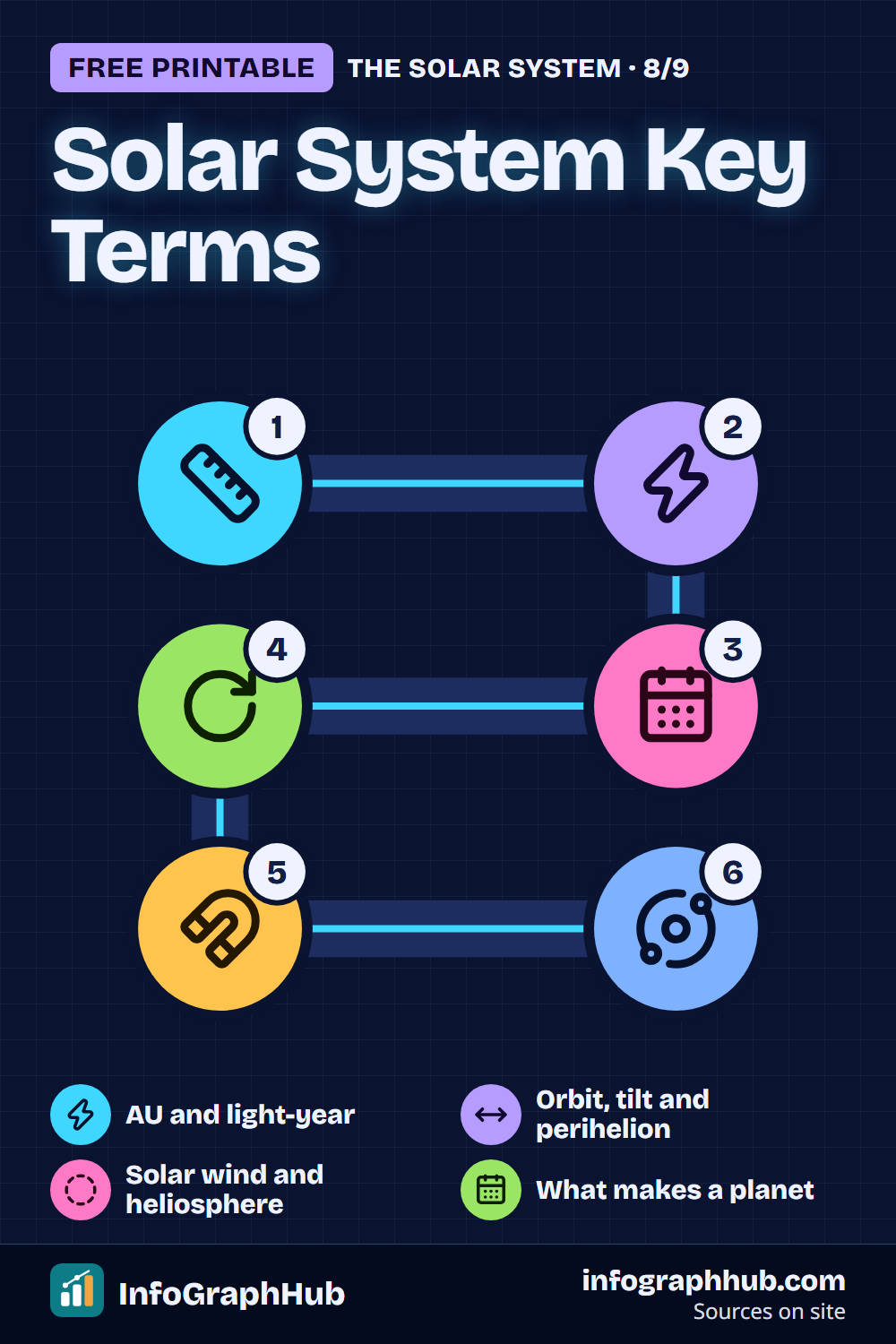
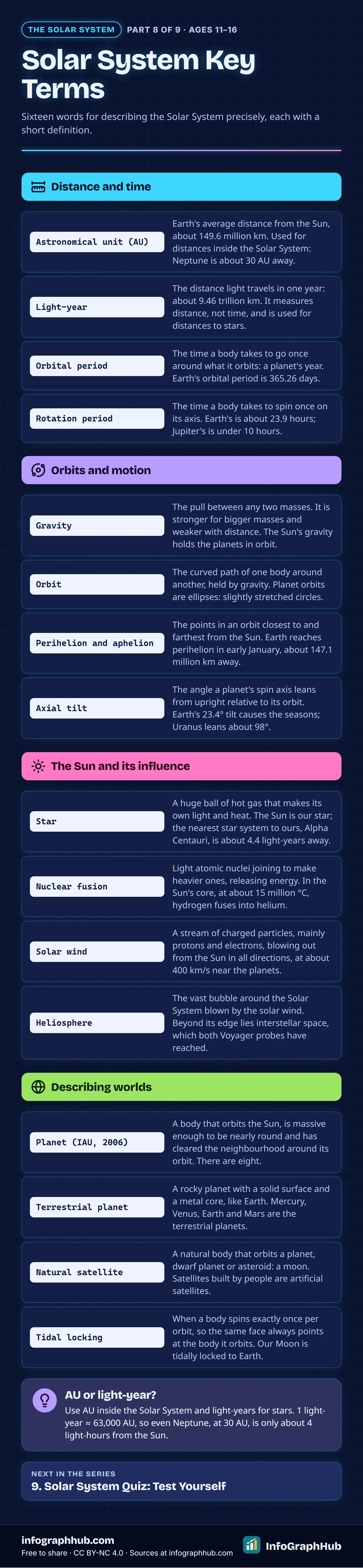
Use this infographic
Free under CC BY-NC 4.0, with credit to InfoGraphHub.
Why precise words matter
Astronomy uses everyday words in exact ways. A 'year' and a 'day' have precise meanings, a 'light-year' is a distance rather than a time, and since 2006 even 'planet' has had an official definition. Using the right term, with the right number, is often what separates a vague answer from a full-mark one. This sheet collects the terms that come up again and again across the series, grouped by topic.
Measuring distance and time
Space distances are huge, so astronomers use bigger units than the kilometre.
- The astronomical unit (AU) is Earth's average distance from the Sun, about 149.6 million km. It suits distances inside the Solar System: Jupiter is about 5.2 AU from the Sun.
- The light-year is the distance light travels in one year. Light covers about 299,792 km every second, and a year has about 31.6 million seconds, so a light-year is about 9.46 trillion km. It suits distances to stars. The nearest star system to the Sun, Alpha Centauri, is about 4.4 light-years away.
Two kinds of time matter for every planet. Its orbital period (its year) is how long it takes to go once around the Sun. Its rotation period is how long it takes to spin once on its axis. For Earth these are 365.26 days and about 23.9 hours. The 24-hour day from one noon to the next is slightly longer than one spin, because Earth moves along its orbit while it turns.
Orbits and gravity
Gravity is the force of attraction between any two masses. The more massive an object, the stronger its pull; the farther away you are, the weaker it gets. The Sun's gravity holds the planets in their orbits: each planet is pulled towards the Sun while its speed carries it sideways, so it keeps curving round.
Orbits are ellipses, slightly stretched circles, so a planet's distance from the Sun changes during its year. Its closest point is perihelion and its farthest is aphelion. Earth's perihelion is in early January, about 147.1 million km from the Sun, and its aphelion is in early July, about 152.1 million km away.
Tilt and spin
A planet's axial tilt is the angle between its spin axis and a line at right angles to its orbit. Earth's is about 23.4°, and it causes the seasons. Uranus is tilted about 98°, so it spins almost on its side.
Tidal locking, or synchronous rotation, happens when a body spins exactly once for every orbit, so it always shows the same face to the body it orbits. Our Moon is tidally locked to Earth, which is why we always see the same side.
The Sun's influence
A star is a huge ball of hot gas that makes its own light and heat by nuclear fusion: in the Sun's core, at about 15 million °C, hydrogen nuclei join to make helium, releasing energy. The Sun also blows out the solar wind, a stream of charged particles that carves out a vast bubble around the Solar System called the heliosphere. Its edge, where the solar wind meets the gas between the stars, is where interstellar space begins.
Frequently asked questions
What is an astronomical unit?
An astronomical unit (AU) is Earth's average distance from the Sun, about 149.6 million km. Astronomers use it for distances inside the Solar System: Neptune, for example, is about 30 AU from the Sun.
Is a light-year a measure of time?
No, it is a distance: how far light travels in one year, about 9.46 trillion km. It is used for distances to stars and galaxies.
What is the difference between a planet's day and its year?
Its year (orbital period) is the time it takes to go once around the Sun. Its day depends on how fast it spins on its axis. Earth spins once in about 23.9 hours and orbits the Sun in 365.26 days.
What are perihelion and aphelion?
Perihelion is the point in an orbit closest to the Sun and aphelion the farthest. Earth is at perihelion in early January (about 147.1 million km) and at aphelion in early July (about 152.1 million km).
Sources & methodology
Every fact is checked against the sources below. We write original explanations and draw original graphics; no figures are copied from textbooks. Spotted an error? See our corrections policy.
- Our Solar System: Facts (NASA Science, accessed 1 Oct 2026)
- Earth Fact Sheet (NASA Goddard Space Flight Center (NSSDCA), accessed 1 Oct 2026)
- Moon: Facts (NASA Science, accessed 1 Oct 2026)
- Sun: Facts (NASA Science, accessed 1 Oct 2026)
- Resolution B5: Definition of a Planet in the Solar System (International Astronomical Union (IAU), accessed 1 Oct 2026)
- Solar Wind (NOAA Space Weather Prediction Center, accessed 1 Oct 2026)
- Alpha Centauri: A Triple Star System about 4 Light Years from Earth (NASA, accessed 1 Oct 2026)
Editorial review pending · Updated
Made by the InfoGraphHub editorial team (how we research and check: editorial and AI policy). First published 2 October 2026, last reviewed 1 October 2026. Found a mistake? Tell the editors.
For teachers: ages and curriculum fit
Ages 11–16 · Grades 6–10 (US) · Years 7–11 (UK) · Classes 6–10 (India)
NGSS is a registered trademark of WestEd. Names and codes are used only to describe curriculum fit; InfoGraphHub is not endorsed by these organisations.
Embed this on your site
Paste this HTML into your page. Keep the credit line: it is required by the CC BY-NC 4.0 license.
Related infographics


For teachers and parents: new InfoGraphHub resources by email
One short email when new free resources go live. For adults (18+) only. No spam, no tracking in emails, unsubscribe anytime.