TechComparisonPart 4 of 9, How the Internet WorksUpdated 2 October 2026
The Internet vs the Web: What's the Difference?
The internet and the World Wide Web are not the same thing. The internet is the global network of networks that moves data between devices. The web is one service that runs on it: pages and files linked together, found by URLs and fetched with HTTP.
Interactive
Explore it step by step
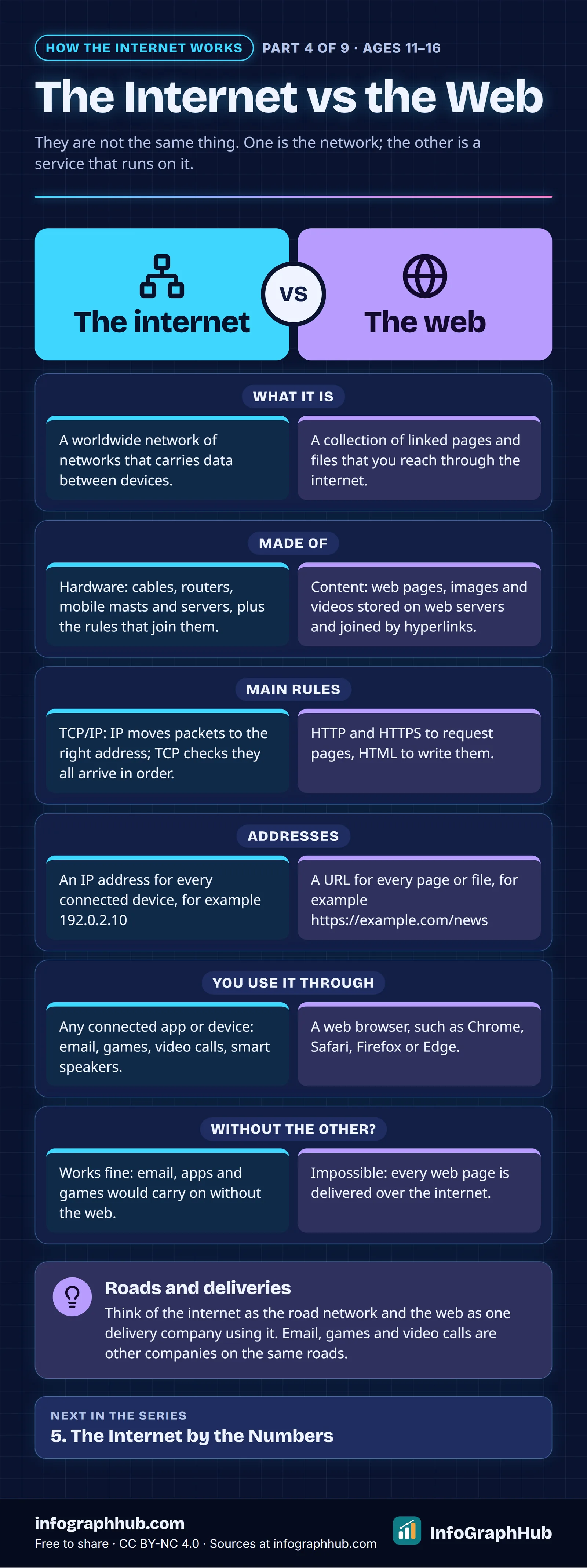
- What it is
The internet: A worldwide network of networks that carries data between devices.
The web: A collection of linked pages and files that you reach through the internet.
- Made of
The internet: Hardware: cables, routers, mobile masts and servers, plus the rules that join them.
The web: Content: web pages, images and videos stored on web servers and joined by hyperlinks.
- Main rules
The internet: TCP/IP: IP moves packets to the right address; TCP checks they all arrive in order.
The web: HTTP and HTTPS to request pages, HTML to write them.
- Addresses
The internet: An IP address for every connected device, for example 192.0.2.10
The web: A URL for every page or file, for example https://example.com/news
- You use it through
The internet: Any connected app or device: email, games, video calls, smart speakers.
The web: A web browser, such as Chrome, Safari, Firefox or Edge.
- Without the other?
The internet: Works fine: email, apps and games would carry on without the web.
The web: Impossible: every web page is delivered over the internet.
Use this infographic
Free under CC BY-NC 4.0, with credit to InfoGraphHub.
Two words people mix up
People often say 'the internet' and 'the web' as if they meant the same thing. In everyday talk that rarely matters, but in computing they are different things, and examiners expect you to know the difference.
A good comparison is a road network and a delivery service. The internet is like the roads: the physical connections and the rules for moving things along them. The web is like one delivery company that uses those roads. Many other services use the same roads too.
The internet: the infrastructure
The internet is a worldwide network of networks. It is made of hardware, such as cables, routers, mobile masts and servers, plus the rules that let them work together, above all the Internet Protocol (IP) and TCP. Every device on it has an IP address.
The internet does not care what the data means. It simply carries packets from one IP address to another, whether they hold part of a web page, an email, a voice call or a move in an online game.
The web: one service on top
The World Wide Web is a huge collection of linked pages, images, videos and other files that you can reach through the internet. It rests on three ideas from its inventor, Tim Berners-Lee:
- HTML, the language used to write web pages;
- URLs, the addresses that point to each page or file;
- HTTP (and its secure form, HTTPS), the protocol a browser uses to ask a web server for a page.
The feature that makes it a web is the hyperlink: almost any page can link to any other, on any server in the world. You use the web through a web browser such as Chrome, Safari, Firefox or Edge.
Lots of the internet is not the web
Plenty of what you do online uses the internet without using the web:
- email sent between mail servers;
- messaging and video-call apps, which often have their own protocols;
- online multiplayer games;
- file transfers and many smart-home devices;
- streaming apps on a TV or console.
Some of these also use HTTP behind the scenes, and many can be opened in a browser as well, so the line is not always sharp. The simple rule still holds: the web needs the internet, but the internet does not need the web. Without the web, email and games would still work; without the internet, there would be no web at all.
Why the difference matters
Knowing which layer you are talking about helps you explain problems. If your Wi-Fi drops, every app stops: that is an internet problem. If one website shows '404 Not Found' but everything else works, the internet is fine and the problem is on that website's web server.
It also explains why the internet is older than the web. The networks and their rules came first; the web was later built on top of them, and it is still only one of many services the internet carries.
Frequently asked questions
What is the difference between the internet and the World Wide Web?
The internet is the global network of networks: the cables, routers and protocols that move data between devices. The web is a service that runs on the internet: pages and files linked together, found with URLs and fetched with HTTP in a web browser.
Is email part of the web?
Not in the strict sense. Email travels over the internet between mail servers using its own protocols. You can read email on a website, which does use the web, but email itself would still work without it.
Which came first, the internet or the web?
The internet. Networks joined by TCP/IP were working years before Tim Berners-Lee invented the web, which was then built on top of the internet. See the timeline part of this series for the dates.
Can you use the internet without the web?
Yes. Messaging apps, online games, email and many smart devices use the internet without opening any web pages. But you cannot use the web without the internet, because web pages are delivered over it.
Sources & methodology
Every fact is checked against the sources below. We write original explanations and draw original graphics; no figures are copied from textbooks. Spotted an error? See our corrections policy.
- World Wide Web (glossary) (MDN Web Docs (Mozilla), accessed 1 Oct 2026)
- Internet (glossary) (MDN Web Docs (Mozilla), accessed 1 Oct 2026)
- How does the Internet work? (MDN Web Docs (Mozilla), accessed 1 Oct 2026)
- Web History (Web at 30) (CERN, accessed 1 Oct 2026)
- How does the Internet work? (Cloudflare Learning Center, accessed 1 Oct 2026)
Editorial review pending · Updated
Made by the InfoGraphHub editorial team (how we research and check: editorial and AI policy). First published 1 October 2026, last reviewed 2 October 2026. Found a mistake? Tell the editors.
For teachers: ages and curriculum fit
Ages 11–16 · Grades 6–10 (US) · Years 7–11 (UK) · Classes 6–10 (India)
Embed this on your site
Paste this HTML into your page. Keep the credit line: it is required by the CC BY-NC 4.0 license.
Related infographics


For teachers and parents: new InfoGraphHub resources by email
One short email when new free resources go live. For adults (18+) only. No spam, no tracking in emails, unsubscribe anytime.